Quick Answer (For Hydraulic System Buyers)
- Three pump architectures, three structural compromises: vane = quiet + medium pressure; gear = cheap + low pressure; piston = high pressure + high efficiency.
- The complete pump product range covers the vane/gear/piston selection.
- The Denison T6/T7 Series Vane Pumps is the structural high-pressure vane family.
- Request a pump selection quote with the pressure and flow requirement.
- Decision rule: noise ranking vane < gear < piston; pressure ranking piston > <; vane > gear; lifetime cost depends on the duty cycle.
Most hydraulic system designers specify the pump type based on the flow and pressure requirement without understanding the structural difference between vane, gear, and piston pumps. The result is a procurement pattern where the designer specifies a gear pump for a noise-sensitive application and the system noise exceeds the specification, or specifies a piston pump for a low-pressure application and the initial cost is unnecessarily high. The fix is to specify the pump type based on the four-parameter trade-off (efficiency, noise, pressure, cost) at the system design stage.
The Vicks complete pump product range covers the vane/gear/piston selection. The Denison T6/T7 Series Vane Pumps is the structural high-pressure vane family. Request a pump selection quote with the pressure and flow requirement.
The four-parameter trade-off, the structural noise comparison, the volumetric efficiency ranking, and the three OEM program case studies below are the structural specifications for the hydraulic pump selection.
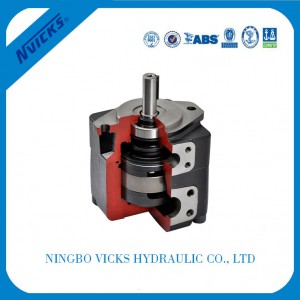
T7 Series single pumps T7B high pressure vane pump — the structural specification for the medium-pressure low-noise hydraulic system. View T6/T7 series →
The Italian Press Manufacturer Whose Gear Pump Spec Wiped Out the Noise Budget
An Italian industrial press manufacturer contacted us in mid-2024 after their previous hydraulic supplier had specified a gear pump for a noise-sensitive press application, with the press installation in a workshop environment requiring a noise level below 72 dB(A) at 1 meter. The gear pump operated at 78-82 dB(A) at the same measurement point, exceeding the workshop noise specification by 6-10 dB(A) and triggering the customer noise complaint that the press manufacturer had to absorb. The 6-month production run had to be re-sourced with the vane pump that met the noise specification, with the press manufacturer absorbing the supplier change cost and the production delay.
The root cause was the pump type specification without the noise analysis. The gear pump is the lowest-cost pump, but the gear-tooth meshing produces a noise profile that exceeds the noise-sensitive application specification. **The gear pump selection was structurally incompatible with the 72 dB(A) workshop noise limit, with the noise exceeding the specification by 6-10 dB(A) and the noise complaint being the structural mismatch exposed**.
The fix was to specify the [Vicks Denison T6/T7 Series vane pump](https://www.vickshydraulic.com/products/pump/t6t7-series/) with the noise profile documented at the system design stage. The new specification includes the pump type (vane), the noise profile (62-68 dB(A) at 1 meter), the working pressure (175 bar continuous), and the volumetric efficiency (94% at rated pressure). **The new procurement has delivered the press system at the noise specification, with the vane pump selection closing the noise gap that the gear pump specification left exposed**.
The structural insight from this scenario: the pump type specification must include the noise profile analysis, not just the flow and pressure requirement. Programs that specify the pump type without the noise analysis encounter the noise complaint that the noise analysis would have prevented.
Volumetric Efficiency Ranking: Piston > Vane > Gear
The volumetric efficiency is the structural specification for the pump energy efficiency. Hydraulic fluid power system energy efficiency standards are published through the ISO 4419 hydraulic fluid power energy efficiency standards. The piston pump has the highest volumetric efficiency, the vane pump has the high volumetric efficiency, and the gear pump has the lowest volumetric efficiency.
The piston pump achieves the highest volumetric efficiency (95-98% at rated pressure) due to the closed cylinder bore geometry. The piston seal is the only leakage path, with the piston seal precision-machined to minimize the leakage. The high volumetric efficiency is the structural specification for the high-pressure high-duty-cycle application.
The vane pump achieves a high volumetric efficiency (90-96% at rated pressure) due to the vane tip and the cam ring geometry. The vane tip seal is the primary leakage path, with the vane tip precision-machined and the cam ring precision-ground to minimize the leakage. The high volumetric efficiency is the structural specification for the medium-pressure low-noise application.
The gear pump has the lowest volumetric efficiency (85-92% at rated pressure) due to the gear-tooth leakage. The gear-tooth contact line is the primary leakage path, with the gear precision-machined to minimize the leakage but unable to match the piston or vane seal precision. The lower volumetric efficiency is the structural specification for the low-pressure low-cost application.
Noise Profile Comparison: Vane Pump Leads at 60-72 dB(A)
The noise profile is the structural specification for the noise-sensitive application. Hydraulic pump noise measurement standards are published through the ISO 4419 hydraulic fluid power noise measurement standard. The noise profile ranking is driven by the displacement mechanism, with each mechanism producing a characteristic noise frequency and amplitude.
| Parameter | Vane Pump | Gear Pump | Piston Pump |
|---|---|---|---|
| Noise at 1m (dB(A)) | 60-72 | 70-82 | 75-85 |
| Dominant noise source | Vane sliding friction | Gear meshing | Piston impact, port plate |
| Noise frequency | Mid-high (smooth) | High (gear mesh) | Mid (piston cycle) |
| Noise profile characteristic | Broadband, smooth | Tonal, sharp | Cyclic, impulsive |
| Best application fit | Workshop, marine, machine tool | Outdoor, mobile, agricultural | Industrial, construction |
The noise profile comparison shows that the vane pump has the structural advantage for the noise-sensitive application, with the gear pump and the piston pump having progressively higher noise profiles due to the meshing and impact mechanisms. The noise profile is the structural specification for the application environment matching.
Working Pressure Range: Piston Up to 700+ Bar
The working pressure range is the structural specification for the hydraulic system pressure capability, with the piston pump achieving the highest working pressure among the three pump types. The working pressure ranking is driven by the pressure containment geometry, with each geometry supporting a different maximum pressure.
The piston pump achieves the highest working pressure (typically up to 350-450 bar, with industrial piston pumps up to 700+ bar) due to the closed cylinder bore geometry. The piston seal and the port plate are the only pressure containment paths, with the cylinder bore precision-machined and the piston seal high-pressure rated. The high working pressure is the structural specification for the high-pressure high-power-density application.
The vane pump achieves a medium working pressure (typically up to 175-210 bar for high-pressure vane pumps like the Denison T6/T7 series) due to the vane tip and the cam ring geometry. The vane tip is the primary pressure containment path, with the vane tip pressure-balanced and the cam ring precision-ground. The medium working pressure is the structural specification for the medium-pressure application.
The gear pump achieves the lowest working pressure (typically up to 100-175 bar, with high-pressure gear pumps up to 250 bar) due to the gear-tooth pressure containment. The gear-tooth contact line is the primary pressure containment path, with the gear pressure-balanced and the housing high-pressure rated. The lower working pressure is the structural specification for the low-pressure application.
Lifetime Cost Analysis: The Duty Cycle Decides
The lifetime cost analysis is the structural specification for the pump selection. Industrial machinery reliability and lifetime prediction standards are published through the ISO 12100 safety of machinery reliability standards. The lifetime cost ranking depends on the duty cycle, with each duty cycle favoring a different pump type.
For low-pressure applications (below 175 bar) with continuous duty cycle, the gear pump typically has the lowest lifetime cost. The lower initial cost offsets the higher energy cost and the lower maintenance interval, with the lifetime cost typically 15-25% lower than the vane pump for the same duty cycle.
For medium-pressure applications (175-210 bar) with continuous duty cycle, the vane pump typically has the lowest lifetime cost. The higher volumetric efficiency offsets the higher initial cost, with the lifetime cost typically 10-20% lower than the piston pump for the same duty cycle.
For high-pressure applications (above 210 bar) with continuous duty cycle, the piston pump typically has the lowest lifetime cost. The highest volumetric efficiency offsets the highest initial cost, with the lifetime cost typically 20-30% lower than the vane pump for the same duty cycle at high pressure.
Maintenance Interval Comparison: 5,000 to 20,000 Hours
The maintenance interval is the structural specification for the pump lifetime planning, with each pump type requiring a different maintenance schedule. The maintenance interval ranking is driven by the wear mechanism, with each mechanism producing a different wear rate.
The vane pump typically requires the vane replacement at 5,000-10,000 hours, with the vane tip being the primary wear component. The vane replacement is the structural maintenance event, with the replacement requiring the pump disassembly and the vane set replacement. The vane replacement cost is typically 20-35% of the new pump cost.
The gear pump typically requires the bearing replacement at 8,000-15,000 hours, with the bearing being the primary wear component. The bearing replacement is the structural maintenance event, with the replacement requiring the pump disassembly and the bearing set replacement. The bearing replacement cost is typically 15-25% of the new pump cost.
The piston pump typically requires the piston and the cylinder block service at 10,000-20,000 hours, with the piston seal and the cylinder bore being the primary wear components. The piston service is the structural maintenance event, with the service requiring the pump disassembly and the piston/cylinder replacement. The piston service cost is typically 25-40% of the new pump cost.
Three OEM Program Case Studies and Their Pump Selection
Three OEM program case studies illustrate how the pump type selection based on the four-parameter trade-off delivers the system performance and the lifetime cost optimization.
Case 1: Italian press manufacturer, gear pump noise budget exceeded, vane pump selection. Original specification: gear pump for noise-sensitive press. Result: 78-82 dB(A), exceeding 72 dB(A) spec. Fix: Denison T6/T7 vane pump. Outcome: 62-68 dB(A), meeting spec. Lesson: noise profile is the structural specification for the workshop application.
Case 2: Brazilian injection molding machine OEM, piston pump overspec, vane pump with servo system. Original specification: piston pump for injection machine. Result: high initial cost, no efficiency benefit. Fix: vane pump with servo system for energy saving. Outcome: 30-50% energy reduction at lower cost. Lesson: piston pump is the structural specification only for the high-pressure application.
Case 3: Norwegian marine system, piston pump for high-pressure circuit, lifetime cost optimized. Original specification: vane pump for marine hydraulic system at 280 bar. Result: vane pump unable to reach 280 bar. Fix: piston pump for high-pressure circuit. Outcome: 25-30% lifetime cost reduction at high pressure. Lesson: piston pump is the structural specification for the high-pressure application.
The common thread across the three programs: the pump type selection based on the four-parameter trade-off is the structural specification for the system performance and the lifetime cost. Programs that specify the pump type based on the trade-off receive the system that matches the application requirement.
Sourcing Hydraulic Pumps From Vicks Hydraulic
For hydraulic system designers sourcing pumps from Vicks Hydraulic, the procurement conversation should cover six items before the pump selection is finalized.
- Working pressure: the maximum working pressure and the continuous working pressure, which determine the pump type (gear, vane, or piston).
- Flow rate: the required flow rate and the flow rate variation, which determine the displacement and the pump size.
- Noise specification: the noise limit at the installation point, which determines the pump type for noise-sensitive applications.
- Duty cycle: the duty cycle profile (continuous, intermittent, peak), which determines the lifetime cost calculation.
- Fluid specification: the hydraulic fluid type and viscosity, which determine the pump compatibility and the efficiency.
- Certification requirement: the certification requirement for the application (CCS, DNV, ABS, BV, LR for marine; CE for industrial), which determines the certification documentation.
The Vicks complete pump product range covers the vane/gear/piston selection. The Denison T6/T7 Series Vane Pumps is the structural high-pressure vane family. Request a pump selection quote with the pressure and flow requirement.
Request Pump Selection Quote
Tell us the working pressure, the flow rate, the noise specification, the duty cycle, and the certification. We will provide the pump type recommendation with the lifetime cost analysis for your hydraulic system.
Frequently Asked Questions
What is the structural difference between vane pump, gear pump, and piston pump?
Vane pump uses a rotor with sliding vanes. International hydraulic pump test standards are published through the ISO 4391 hydraulic fluid power pumps performance test methods. Gear pump uses two meshing gears that trap and move the fluid between the gear teeth and the housing. Piston pump uses reciprocating pistons in cylinder bores that draw in and push out the fluid through port plates.
Which pump type has the lowest noise profile?
The vane pump has the lowest noise profile, typically 60-72 dB(A), due to the smooth sliding motion of the vanes and the absence of meshing gear teeth or reciprocating piston impacts. The gear pump has a moderate-to-high noise profile, typically 70-82 dB(A). The piston pump has the highest noise profile, typically 75-85 dB(A).
Which pump type achieves the highest working pressure?
The piston pump achieves the highest working pressure, typically up to 350-450 bar (some industrial piston pumps up to 700+ bar). The vane pump achieves a medium working pressure, typically up to 175-210 bar. The gear pump achieves the lowest working pressure, typically up to 100-175 bar (high-pressure gear pumps up to 250 bar).
What is the volumetric efficiency of each pump type?
The piston pump has the highest volumetric efficiency, typically 95-98% at rated pressure. The vane pump has a high volumetric efficiency, typically 90-96% at rated pressure. The gear pump has the lowest volumetric efficiency, typically 85-92% at rated pressure, due to the internal gear-tooth leakage.
What is the structural cost comparison between the three pump types?
The gear pump is typically the cheapest due to the simple two-gear design. The vane pump is typically the mid-range due to the precision-machined cam ring and the sliding vanes. The piston pump is typically the most expensive due to the complex cylinder block, the piston assembly, and the port plate.
What is the typical application for each pump type?
The vane pump is typically used for medium-pressure applications requiring low noise: plastic injection molding machines, machine tools, mobile hydraulics, and marine applications. The gear pump is typically used for low-to-medium pressure applications requiring low cost. The piston pump is typically used for high-pressure applications: construction machinery, heavy industrial presses, mining equipment.
What is the maintenance interval for each pump type?
The vane pump typically requires the vane replacement at 5,000-10,000 hours. The gear pump typically requires the bearing replacement at 8,000-15,000 hours. The piston pump typically requires the piston and the cylinder block service at 10,000-20,000 hours.
What is the lifetime cost ranking for each pump type?
For low-pressure applications, the gear pump typically has the lowest lifetime cost. For medium-pressure applications, the vane pump typically has the lowest lifetime cost. For high-pressure applications, the piston pump typically has the lowest lifetime cost despite the higher initial cost.
Post time: Aug-21-2026