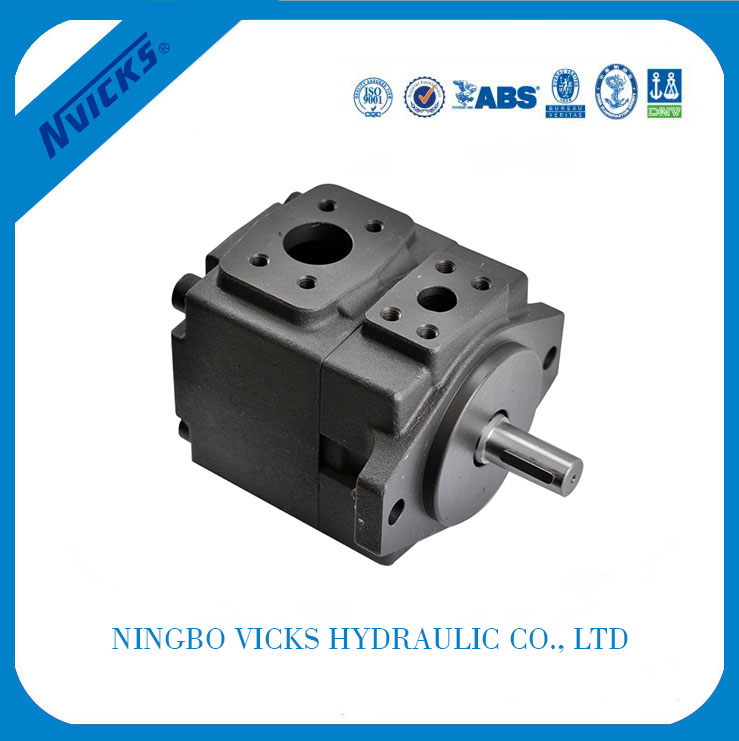
Vane Pump Architecture for Injection Molding
Injection molding machines draw on two distinct hydraulic circuits that run on different pressure and flow profiles. The main injection circuit drives the plastic melt through the screw and into the mold cavity, and it operates at the machine’s maximum system pressure (typically up to 175 bar on standard hydraulic presses) with peak flow concentrated in the injection and plasticizing phases. The pilot circuit drives the clamping, ejector, mold-open, and core-pull functions, and it operates at lower pressure with smoother continuous flow across the full machine cycle.
Because the two circuits operate on different flow and pressure profiles, injection molding machines typically use either two separate single pumps or one double pump that combines a large and a small cartridge on a common shaft. The double-pump architecture is the more common choice on mid-tonnage and high-tonnage presses because it simplifies the plumbing, reduces alignment cost on the machine frame, and lets the operator match the displacement of each circuit independently on our buyer side. Single-pump configurations are still the right answer for very small presses or for retrofit programs where the existing machine plumbing is built around a single-pump architecture.
Vicks Hydraulic’s injection molding vane pump catalog covers both architectures, with the PV2R series carrying the cartridge, rotor, vane kit, cam ring, and bearing components that are shared across the single and double pump frames. Our PV2R1, PV2R2, and PV2R3 product page carries the frame-specific catalog and the displacement code reference for each frame size on our end. Buyers writing a procurement specification should read this material before locking the SKU list, and our sales team walks through the catalog on each inquiry response.
Tonnage-to-Pump Matching: 90T to 3000T
The clamping tonnage is the first spec that drives the vane pump selection, because the clamping force requirement scales the main circuit flow demand on the pump. A 90-ton press draws less than half the flow of a 200-ton press, and a 1000-ton press draws several times the flow of a 200-ton press on the main injection circuit. The clamping tonnage does not drive the pressure rating (which is fixed by the system relief valve setting), but it does drive the displacement of the main pump and the frame size selection on our end.
The table below covers the tonnage-to-pump matching pattern that our sales team uses in routine RFQ responses. The displacement codes in the table refer to the Vicks PV2R catalog displacement reference, which uses the same code system as the Yuken PV2R catalog on our buyer side. The actual displacement value depends on the catalog frame size and the displacement code combined.
| Machine Tonnage | Main Circuit Architecture | Pilot Circuit Architecture | Vicks Catalog Reference | Typical Application |
|---|---|---|---|---|
| 90T to 160T | Single PV2R1 pump | Cartridge inside PV2R1 frame | PV2R1 frame, small displacement | Small precision parts, thin-wall packaging |
| 160T to 400T | Single PV2R2 pump | Small PV2R1 cartridge | PV2R2 frame, mid displacement | General-purpose injection molding |
| 400T to 800T | Single PV2R3 pump or double PV2R2+PV2R1 | PV2R1 cartridge in double frame | PV2R3 frame, large displacement | Automotive interior, appliance housings |
| 800T to 1600T | Double PV2R3+PV2R2 | PV2R1 or PV2R2 cartridge | Double frame, large+mid displacement | Large automotive, structural foam molding |
| 1600T to 3000T | Double PV2R3+PV2R3 (or two single PV2R3) | PV2R2 cartridge | Double frame, large+large displacement | Two-platen presses, large structural parts |
The table above is a starting point, and the exact match depends on the cycle time target, the shot weight, the plasticizing throughput, and the servo-hydraulic or fixed-displacement architecture on the buyer side. Servo-hydraulic machines draw less continuous flow than fixed-displacement machines at the same shot weight, because the servo pump only delivers flow when the cylinder is moving and idles at near-zero flow during the hold and cooling phases on our end.
Displacement Codes: PV2R Series Catalog Reference
The displacement code is the second spec that drives the vane pump selection, and the code is independent of the frame size. A frame size refers to the physical envelope of the pump housing, and the displacement code refers to the cam ring geometry that determines the swept volume per revolution. The Vicks PV2R catalog uses the same displacement code reference as the Yuken PV2R catalog, which makes the two series direct-swap compatible on the machine frame on our buyer side.
The catalog reference below covers the displacement codes that our buyers most often request in injection molding RFQs. The full displacement code range runs wider than the table below, and our sales team provides the full code reference on each inquiry response for buyers that need to match an unusual machine profile. The frame size (20V, 25V, 35V) sets the maximum displacement ceiling for that frame, and the displacement code (single or double digit) sets the actual cam ring geometry on our end.
| Frame Size | Displacement Code Range | Cartridge Kit Code | Typical Pump Configuration |
|---|---|---|---|
| 20V | 2, 3, 4, 5, 6, 7, 8, 9, 10, 11 | PC- (single pump), F3- (double pump) | Single PV2R1 frame, small injection presses |
| 25V | 10, 12, 14, 15, 17, 19, 21, 25 | PC- (single pump), F3- (double pump) | Single PV2R2 frame, mid-tonnage presses |
| 35V | 21, 25, 30, 32, 35, 38, 45 | PC- (single pump), F3- (double pump) | Single PV2R3 frame, high-tonnage presses |
The displacement code selection should match the cycle time target and the shot weight. A higher displacement code delivers more flow per revolution and shortens the cycle time, but it also increases the absorbed power and the heat load on the hydraulic oil reservoir on the buyer side. Our buyers tend to size the displacement to the cycle time target first and the absorbed power ceiling second, and the catalog reference above lets them start the matching conversation with our sales team on the same displacement code system as the existing machine frame.
PV2R Single Pump Spec Card (Cartridge Kit)
- Cartridge Kit Mark
- PC- (no marking = petroleum oil or emulsification fluid)
- Series Code
- 20V / 25V / 35V
- Flow Code
- Single or double digit within the frame range
- Rotation
- Viewed from shaft end of pump (R / L)
- Design Number
- 10 (current revision in our catalog)
Single vs Double Pump Configuration
The single vs double pump decision is one of the most consequential calls in an injection molding vane pump specification, because it determines the plumbing architecture, the alignment cost, and the spare parts inventory pattern. Our buyers tend to start the conversation with the existing machine plumbing, because retrofitting a single-pump machine to a double-pump architecture is significantly more expensive than sizing a double-pump machine from scratch on our end.
The single-pump architecture is the right choice for small presses (under 160T) where the main injection circuit flow and the pilot circuit flow can be drawn from the same pump without starving either circuit. The single-pump architecture also wins on retrofit programs where the existing machine plumbing is built around a single pump, because swapping to a double-pump architecture requires changes to the manifold, the reservoir, and the motor mounting on the machine frame. Our single vane pump catalog covers the PV2R1 and small PV2R2 frame sizes that are most often used in single-pump configurations on our buyer side.
The double-pump architecture is the right choice for mid-tonnage and high-tonnage presses where the main injection circuit flow demand would starve the pilot circuit on a single pump. The double-pump architecture uses one shaft with two cartridges (one large, one small), and each cartridge serves its own circuit independently. The double-pump architecture reduces plumbing complexity, simplifies the alignment on the machine frame, and lets the operator replace the small cartridge for pilot-circuit wear without disturbing the large cartridge for main-circuit wear on the buyer side. Our PV2R2 + PV2R1 and PV2R3 + PV2R2 double-pump references are the most common configurations in our catalog for mid-tonnage and high-tonnage presses.
| Architecture | Best-Fit Tonnage Range | Plumbing Complexity | Spare Parts Pattern | Typical Buyer Profile |
|---|---|---|---|---|
| Single PV2R1 | Under 160T | Low | Single cartridge kit | Small precision parts, packaging |
| Single PV2R2 | 160T to 400T | Low | Single cartridge kit | General-purpose molding |
| Double PV2R2 + PV2R1 | 160T to 800T | Mid | Two cartridge kits, shared shaft | Mid-tonnage automotive, appliance |
| Double PV2R3 + PV2R2 | 400T to 1600T | Mid | Two cartridge kits, shared shaft | High-tonnage automotive |
| Two single PV2R3 | 1600T+ | High | Two complete pumps | Two-platen presses, large structural |
Pressure Rating and Servo-Hydraulic Retrofit
Standard injection molding hydraulic systems operate at a maximum system pressure of 175 bar on the main circuit, with the pilot circuit typically set at 80 to 120 bar depending on the clamping and ejector cylinder geometry on the buyer side. The PV2R series vane pump is rated for continuous operation up to 175 bar on the main circuit and intermittent peak operation beyond that during the injection phase. Pressure ratings above 175 bar are not common in injection molding, but the Vicks catalog covers higher-pressure vane pump configurations for industrial automation programs that share the same hydraulic circuit architecture on our end.
The servo-hydraulic retrofit is the most common pressure-and-flow modification that our buyers request on existing machines. Servo-hydraulic machines replace the fixed-displacement pump with a servo-driven variable-displacement pump, and the servo pump only delivers flow when the cylinder is moving on our buyer side. The energy savings on a servo retrofit range from 30% to 60% on typical duty profiles, and the payback period on a servo retrofit is 12 to 24 months on most mid-tonnage presses that run two or more shifts per day.
The pressure rating selection on a new machine specification should reference the system relief valve setting, not the pump maximum pressure rating. A pump rated for 175 bar continuous operation is the right choice for a system relief valve setting of 160 bar, because the pump should never operate at its continuous maximum in normal service on our buyer side. Our sales team reviews the relief valve setting and the duty profile before locking the pressure rating on the RFQ response.
Direct-Swap Replacement on Existing Machines
The PV2R series is dimensionally interchangeable with the Yuken PV2R catalog, which means our pumps drop into the same envelope, the same flange, and the same shaft geometry as the existing Yuken pump on the machine frame. Direct-swap replacement is the most common procurement pattern in our catalog, because buyers who operate existing injection molding machines prefer to replace a worn pump with a same-form-factor unit rather than redesign the machine frame for a new pump envelope on our buyer side. The vane pump Wikipedia reference covers the basic vane pump architecture and the cartridge construction that makes direct-swap replacement straightforward across our catalog.
The direct-swap replacement process follows the same pattern across our catalog: identify the existing pump model code (typically a Yuken PV2R model number), confirm the displacement code against our catalog reference, and confirm the rotation direction by viewing the shaft end of the existing pump on our buyer side. Our sales team provides a cross-reference spreadsheet on request for buyers that need to map an existing fleet to the replacement pump on each machine. The cross-reference covers frame size, displacement code, rotation direction, and the design number for each frame size on our end.
The most common direct-swap mistake that our buyers see is ignoring the design number revision. The Yuken PV2R catalog has been revised multiple times since the original release, and the design number (the trailing digit in the model code) identifies the revision. Our catalog ships the current design number for each frame size, and our sales team flags the design number revision on the RFQ response so buyers can confirm the direct-swap compatibility on our buyer side.
Writing the RFQ: What to Send Vicks Hydraulic
The RFQ for an injection molding vane pump specification should include the machine tonnage, the cycle time target, the existing pump model code, the servo vs fixed-displacement architecture, the displacement code if known, and the destination country with the relevant classification society certification requirement. Our sales team sizes the PV2R frame size and displacement code to the machine profile on the buyer side, and we respond with the pump model code, the cartridge kit code, the lead time, and the per-unit tier breakdown on each inquiry response.
The destination country matters because the classification society certification (CCS, DNV, ABS, BV, LR) is required for marine and offshore injection molding equipment, and the same production line supports industrial automation, plastics machinery, and servo-hydraulic retrofit programs on our buyer side. Send the destination country and the classification requirement with the RFQ, and our sales team confirms the certification envelope on the response. The classification society certification is most relevant for marine and offshore applications, but the same certification envelope supports military and other high-reliability applications on our catalog.
Send Machine Tonnage for Pump Matching
Submit the machine tonnage, the cycle time target, the existing pump model code, and the destination country through our contact page, and our sales team responds with the PV2R frame size, the displacement code, and the per-unit tier breakdown within two business days. Browse our full injection molding vane pump catalog or jump to the PV2R1, PV2R2, and PV2R3 product page for the displacement code reference.
Frequently Asked Questions
What is the difference between PV2R1, PV2R2, and PV2R3 vane pumps?
PV2R1, PV2R2, and PV2R3 are the three displacement sizes in the Vicks Yuken PV2R single-pump series. PV2R1 is the smallest displacement range, typically used on smaller injection molding machines and lower-flow circuits, while PV2R2 sits in the middle for medium-tonnage presses, and PV2R3 covers the largest displacement for high-tonnage presses and main hydraulic circuits. The same cartridge, rotor, vane kit, cam ring, and bearing architecture is shared across the three frame sizes, so buyers can mix and match spare parts across our catalog without carrying three separate spare parts inventories for the same machine on the buyer side. The frame size selection is the first spec, and the displacement code selection within the frame size is the second spec, and our sales team walks through both on each RFQ response.
Which Vicks PV2R pump should I match to a 200-ton injection molding machine?
A 200-ton injection molding machine typically calls for a PV2R2-series single pump for the main injection circuit, with a smaller PV2R1 cartridge in a double-pump configuration for the clamping and ejector circuits. The exact displacement code depends on the cycle time target, the shot weight, and the servo or fixed-displacement architecture on the buyer side. Send us the machine tonnage, the cycle time target, the existing pump model code, and the destination country with the RFQ, and our sales team sizes the PV2R series SKU to the machine profile on each RFQ response. Buyers should also send the design number revision on the existing pump so the direct-swap compatibility is confirmed on the buyer side.
What is the difference between a single vane pump and a double vane pump for injection molding?
A single vane pump has one pumping chamber driven by one shaft, and ships as a self-contained cartridge kit for the smaller PV2R frame sizes. A double vane pump uses two cartridges on a common shaft, typically one large and one small, to supply high flow to the main injection circuit and lower flow to the clamping or ejector circuit from a single pump housing. The double-pump configuration reduces plumbing complexity and alignment cost on the machine frame, which is why most mid-tonnage injection molding machines run a double-pump architecture on our buyer side, and why the spare parts inventory for a double-pump machine can be smaller per pump than for two separate single-pump machines.
What classification society certifications do Vicks vane pumps carry?
Vicks vane pumps carry Chinese CCS, Norwegian DNV, American ABS, French BV, and British LR classification society certification, and the same pumps are batch-applied to military industry on our end. The classification society certification is most relevant for marine and offshore injection molding equipment, but the same production line supports industrial automation, plastics machinery, and servo-hydraulic retrofit programs in our catalog. Buyers writing a procurement specification should reference the classification envelope per shipping destination alongside the CCS, DNV, ABS, BV, and LR certification on the catalog side, and our sales team confirms the certification coverage on the RFQ response for marine and offshore programs.
Can Vicks PV2R pumps replace existing Yuken or Vickers pumps on existing machines?
Yes, our PV2R series is dimensionally interchangeable with the Yuken PV2R catalog and is widely used as a direct-swap replacement on existing injection molding machines. The cartridge, flange, and shaft geometry follow the Yuken PV2R envelope, and our catalog covers the displacement codes 20V, 25V, and 35V frame sizes across the PV2R1, PV2R2, and PV2R3 references on our end. Send us the existing pump model code, the machine tonnage, and the design number revision, and our sales team confirms the direct-swap Vicks SKU on the RFQ response within two business days on the buyer side. The direct-swap pattern also applies to Vickers V10, V20, and V2010 references across our catalog.
Demi Ge
Hydraulic Solutions Expert at Ningbo Vicks Hydraulic Co., Ltd.
Demi Ge is a hydraulic solutions expert at Vicks Hydraulic, a national high-tech enterprise founded in 2007, specializing in vane pumps, servo systems, and one-stop energy-saving hydraulic solutions. With 6 world-leading production lines and an annual capacity of 80,000+ vane pumps, Vicks serves industries including marine, military, and industrial automation. Expert in high-pressure hydraulic technology — helping global buyers source CCS, DNV, ABS, BV, and LR-certified components from a presiding industry standard revision unit.
Post time: Aug-27-2026