A marine procurement checklist for sourcing DNV-certified vane pumps from Chinese manufacturers — the three-certificate model covering the type approval, the shop approval, and the individual certificate; the four-step verification flow against the official dnv.com portal; the five IACS classification society certifications (CCS / DNV / ABS / BV / LR) that matter for shipboard and offshore hydraulic vane pumps; the five claim pitfalls in supplier marketing materials; and the three buyer scenarios where the certification stack decides the vendor.
TL;DR
- A Chinese vane pump can pass DNV certification — but only when three documents align: the type approval for the specific pump model series, the shop approval for the manufacturing facility, and the individual certificate (or Declaration of Conformity) for the production lot. A one-time test report is not a type approval; a CCS-only approval is not a DNV approval; a shop approval does not cover the product.
- The four-step certificate verification flow before issuing the RFQ is: request the certificate scan with the certificate number visible, look up the certificate on the official dnv.com portal, confirm the certificate is active (not expired or revoked), and cross-check the certificate validity period against the production date of the pump being shipped.
- The five IACS classification society certifications that matter for marine and offshore hydraulic vane pumps are CCS (China), DNV (Norway), ABS (USA), BV (France), and LR (UK). A pump certified to all five is sellable across the major shipbuilding registries; a pump certified to only one or two is restricted to vessels of those flags only.
- The five claim pitfalls in supplier marketing materials are: quoting the test report as the type approval, quoting the CCS certificate as the DNV certificate, quoting the shop approval as the product approval, quoting a sister-class certificate (ABS or BV) as the DNV certificate, and quoting an expired certificate without flagging the renewal status.
- The three buyer scenarios where certification decides the vendor are: shipyard orders for DNV-class newbuild vessels, offshore platform retrofit on a DNV-class unit, and military or paramilitary-eligible marine procurement.
Table of Contents
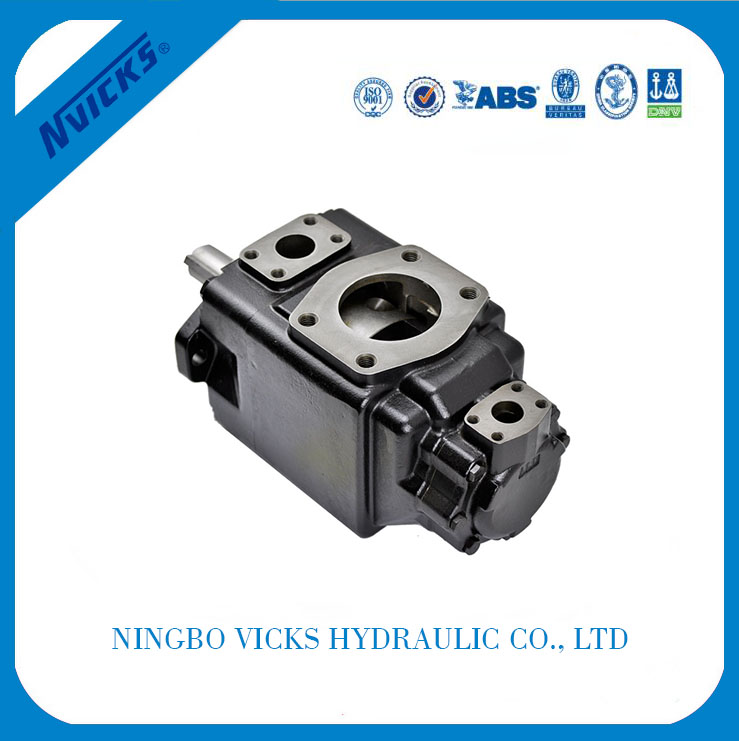 Denison T6ED marine hydraulic vane pump — high-pressure double vane pump for marine and offshore hydraulic systems, covered by Vicks Hydraulic’s five IACS classification society certifications. Source: T6ED marine vane pump product page.
The three-certificate model most Chinese suppliers quote
DNV (now operating as DNV after the merger with GL, and competing with Bureau Veritas, Lloyd’s Register, ABS, RINA, and the Korean Register) does not issue a single document called a “DNV certificate.” The certification landscape for a marine hydraulic vane pump consists of three distinct layers, and each layer covers a different scope:
**Type approval.** A type approval certificate is issued to the manufacturer for a specific pump model series after the manufacturer submits the pump design, the manufacturing process, the quality system documentation, and the type-test results to the classification society for review. The type approval certifies that the pump design meets the classification society’s technical requirements and is valid for a defined period (typically five years), subject to annual factory audit and quality-system surveillance. A type approval is the only layer that is product-specific and model-series-specific.
**Shop approval.** A shop approval certificate is issued to the manufacturing facility for the production process and the quality system. The shop approval certifies that the factory can build products to the classification society’s requirements, but it does not certify any specific product. A factory with a DNV shop approval can produce DNV-class components if those components are also covered by a separate type approval; the shop approval alone is not a product certificate.
**Individual certificate or Declaration of Conformity.** An individual certificate (or a DoC Declaration of Conformity under the Marine Equipment Directive MED or the UK MER equivalent) is issued per production lot and certifies that the specific production lot conforms to the type approval under which it was built. The individual certificate references the type approval certificate number and carries the production lot serial number.
A Chinese supplier quoting “DNV certification” can be quoting any of the three layers, and the three layers are not interchangeable. A supplier with only a one-time test report is not DNV-certified. A supplier with only a shop approval is not DNV-certified for the product. A supplier with only a CCS approval is not DNV-certified. The Ningbo Vicks Hydraulic T6 series marine vane pump catalog documents the IACS-classified product range that covers the three-layer certification model in full.
The four-step verification flow
The procurement officer who is about to issue the RFQ runs a four-step verification flow before signing the purchase order. The four steps take less than an hour for a single certificate and less than a day for a full supplier shortlist, and they catch the five common claim pitfalls before they become warranty clauses.
**Step 1: Request the certificate scan with the certificate number visible.** The supplier sends a PDF scan of the certificate; the procurement officer confirms that the certificate number, the manufacturer name, the product model designation, and the validity dates are legible. A scan with a missing or partially redacted certificate number is not a usable certificate.
**Step 2: Look up the certificate on the official dnv.com portal.** DNV publishes a certificate database on dnv.com that allows searching by certificate number, manufacturer name, or product category. The procurement officer enters the certificate number from the scan and confirms that the certificate is listed. A certificate that does not appear on the official portal is not a valid certificate. The DNV certificate verification portal is the public-facing entry point for the second and third verification steps.
**Step 3: Confirm the certificate is active (not expired or revoked).** The certificate lookup on dnv.com shows the current status of the certificate. A certificate that has expired is no longer a valid certificate, and a certificate that has been revoked (rare, but it happens when a manufacturer fails to maintain the underlying type-test program or the quality system) is no longer a valid certificate. The procurement officer confirms the certificate status is “active” on the lookup date.
**Step 4: Cross-check the certificate validity period against the production date of the pump being shipped.** A type approval certificate issued in year X is valid for production lots manufactured during the validity period, typically with a built-in audit cycle that the manufacturer must maintain. The procurement officer confirms the production lot serial number on the shipping documents falls within the certificate validity period.
The four steps are not optional. They are the operational difference between a pump that passes the surveyor’s inspection at delivery and a pump that gets rejected on the shipyard floor. The DNV certificate verification portal is the public-facing entry point for the second and third verification steps.
The five IACS classification society certifications
A marine vane pump intended for shipboard or offshore installation is normally certified to one or more of the five major IACS member classification societies. A pump certified to all five is sellable across the major shipbuilding registries; a pump certified to only one or two is restricted to vessels of those flags only. The five IACS certifications that apply to the marine vane pump are:
**CCS (China Classification Society).** CCS is the classification society for Chinese-flagged vessels and is the gateway certification for Chinese-built marine equipment. A CCS approval is the entry-level certification for a Chinese-manufactured vane pump, and the CCS certificate is the most commonly issued certificate in the Chinese marine supplier market. A CCS approval alone restricts the pump to Chinese-flagged vessels.
**DNV (Norway, formerly Det Norske Veritas).** DNV is the classification society for Norwegian-flagged vessels and for a substantial share of the international offshore fleet. A DNV approval is the certification that matters for buyers serving the Norwegian, Northern European, and Gulf of Mexico offshore markets. DNV is widely treated as the most rigorous of the IACS members for marine hydraulic equipment.
**ABS (American Bureau of Shipping).** ABS is the classification society for US-flagged vessels and for a substantial share of the international tanker and offshore fleet. An ABS approval is the certification that matters for buyers serving the US Gulf, the US-flag commercial fleet, and the international offshore market where ABS-class vessels are common. The ABS classification society homepage is the public-facing entry point for ABS-class vessel and product registration.
**BV (Bureau Veritas, France).** BV is the classification society for French-flagged vessels and for a substantial share of the Mediterranean and West African offshore fleet. A BV approval is the certification that matters for buyers serving the French, Mediterranean, and West African offshore markets. The Bureau Veritas Marine & Offshore homepage is the public-facing entry point for BV-class registration.
**LR (Lloyd’s Register, UK).** LR is the classification society for UK-flagged vessels and for a substantial share of the international commercial fleet. An LR approval is the certification that matters for buyers serving the UK, Northern European, and international commercial shipping markets. The Lloyd’s Register homepage is the public-facing entry point for LR-class registration.
The DNV, ABS, BV, and LR qualifying approval databases are the public-facing entry points for verifying each of the four non-CCS certificates. The Ningbo Vicks Hydraulic marine vane pump line holds all five certifications across the T6, T7, V, VQ, V10, V20, SQP, and PV2R model series; the certification dossier with the per-model certificate numbers is available on request from the Vicks Hydraulic sales team.
The five claim pitfalls
The procurement officer who is comparing two Chinese vane pump quotes on DNV certification encounters five recurring pitfall statements in the supplier marketing materials. The five pitfalls are the most common ways a Chinese supplier quotes “DNV certified” without actually being DNV-certified for the product being shipped.
**Pitfall 1: Quoting the test report as the type approval.** A test report is a one-time document recording the result of a specific test on a specific pump sample. A test report is not a type approval, and a supplier with a test report is not DNV-certified. The procurement officer confirms the supplier holds a type approval certificate, not just a test report.
**Pitfall 2: Quoting the CCS certificate as the DNV certificate.** A CCS approval is not the same as a DNV approval. The two classification societies have different technical requirements, different audit cycles, and different certificate databases. A supplier with only a CCS approval is not DNV-certified, and a vessel delivered with a CCS-only pump will be rejected by the DNV surveyor.
**Pitfall 3: Quoting the shop approval as the product approval.** A DNV shop approval certifies the factory, not the product. A supplier with only a shop approval is not DNV-certified for the product. The procurement officer confirms the supplier holds a product-specific type approval.
**Pitfall 4: Quoting a sister-class certificate as the DNV certificate.** An ABS or BV certificate is not a DNV certificate. The three classification societies cooperate through the IACS framework but do not recognise each other’s individual approvals. A pump with an ABS approval cannot be installed on a DNV-class vessel on the basis of the ABS approval alone.
**Pitfall 5: Quoting an expired certificate without flagging the renewal status.** A type approval is valid for a defined period (typically five years) and must be renewed before expiry. A pump built under an expired type approval is not DNV-certified. The procurement officer confirms the certificate is active on the dnv.com portal as of the production date. The International Association of Classification Societies framework page documents the common technical framework the IACS member societies apply to type-approval audits.
The Can a Chinese vane pump really pass DNV? article walks the same five pitfalls from the production-side perspective; this article walks them from the procurement-side perspective.
The three buyer scenarios where certification decides the vendor
The certification question is not the only question a marine procurement officer asks when evaluating a vane pump supplier, but in three buyer scenarios it is the question that decides the vendor. The three scenarios are:
**Shipyard orders for DNV-class newbuild vessels.** The shipyard is building a vessel to DNV class, and the vessel’s hydraulic system requires DNV-class vane pumps. The supplier shortlist is filtered to suppliers holding an active DNV type approval for the specific pump model series. Suppliers without the DNV type approval do not get past the shortlist, regardless of price. The procurement officer requests the DNV type approval certificate scan, runs the four-step verification flow, and confirms the certificate is active before issuing the RFQ.
**Offshore platform retrofit on a DNV-class unit.** An offshore platform (fixed, floating, or subsea) is operating under DNV class, and a vane pump on the platform’s hydraulic system requires replacement. The replacement pump must be DNV-class or the platform’s DNV class status is at risk. The supplier shortlist is filtered to suppliers holding an active DNV type approval for the specific pump model series and the individual certificate (or DoC) for the production lot. The procurement officer requests the individual certificate alongside the type approval.
**Military or paramilitary-eligible marine procurement.** Naval procurement (or coast guard procurement where the coast guard operates under naval standards) typically requires certification to military specifications in addition to the civilian classification society certification. A supplier with the civilian DNV certification is the entry-level qualification; the supplier must also hold the military specification approval for the specific application. The procurement officer requests the DNV certification dossier and the military specification approval dossier.
The marine procurement checklist
The procurement officer issuing the RFQ for a marine vane pump follows a six-checkpoint checklist:
- **Confirm the classification society requirement.** The vessel or platform class status determines which classification society certificate is required. DNV, ABS, BV, LR, and CCS are the five IACS member societies most commonly applied to marine vane pumps.
- **Confirm the type approval certificate.** The vendor holds an active type approval certificate for the specific pump model series being quoted. The type approval certificate number is verified on the official classification society portal.
- **Confirm the shop approval certificate.** The vendor holds an active shop approval certificate for the manufacturing facility. The shop approval certificate number is verified on the official classification society portal.
- **Confirm the individual certificate or DoC for the production lot.** The vendor commits to issuing an individual certificate (or DoC Declaration of Conformity) for the specific production lot being shipped. The individual certificate references the type approval certificate number and carries the production lot serial number.
- **Confirm the certificate validity period covers the production date.** The type approval certificate is active on the production date of the pump being shipped. The certificate validity period is checked against the production lot serial number on the shipping documents.
- **Confirm the test report accompanies the pump.** The vendor provides the per-pump test report recording the hydraulic performance, the noise level, the pressure rating, and the temperature rating measured on the actual pump being shipped. The test report carries the pump serial number and the test bench identifier.
The six-checkpoint checklist is the operational translation of the four-step verification flow into a procurement-side decision framework. The checklist runs end-to-end before the purchase order is signed.
The Ningbo Vicks Hydraulic marine production base sits on 6 world-leading production lines with an annual capacity above 80,000 vane pumps, and the engineering team is the presiding unit of the Chinese national vane pump industry standard revision. The marine vane pump line covers the T6, T7, V, VQ, V10, V20, SQP, and PV2R model series across all five IACS classification societies. The Denison T6ED marine hydraulic vane pump product page walks the high-pressure marine operating envelope the T6ED model is built for. The certification dossier with the per-model certificate numbers is available on request from the Vicks Hydraulic sales team.
Frequently Asked Questions
Can a Chinese vane pump really pass DNV certification?
Yes — when the manufacturer holds the type approval for the specific pump model series, the shop approval for the manufacturing facility, and the individual certificate (or Declaration of Conformity) for the production lot. The certificate stack is the basis for the certification, and the four-step verification flow against the dnv.com portal confirms the certificate is currently active. A Chinese supplier with all three layers is treated by DNV on the same basis as a Norwegian, German, or American supplier with the same certificate stack.
What is the difference between a type approval, a shop approval, and an individual certificate?
The type approval certifies the pump design for a specific model series and is product-level. The shop approval certifies the manufacturing facility’s quality system and is factory-level. The individual certificate (or DoC Declaration of Conformity) certifies the specific production lot and is lot-level. The three layers are not interchangeable; a supplier must hold all three for the production lot to be DNV-class.
How does the four-step certificate verification flow work?
The four steps are: (1) request the certificate scan with the certificate number visible, (2) look up the certificate on the official dnv.com portal, (3) confirm the certificate is active (not expired or revoked), and (4) cross-check the certificate validity period against the production date of the pump being shipped. The four steps take less than an hour for a single certificate and catch the five common claim pitfalls before they become warranty clauses.
What is the difference between CCS, DNV, ABS, BV, and LR certification?
CCS is the Chinese classification society. DNV is the Norwegian classification society and is widely treated as the most rigorous for hydraulic equipment. ABS is the American classification society. BV is the French classification society. LR is the UK classification society. The five are members of the International Association of Classification Societies (IACS) and share a common technical framework, but each society issues its own certificates and does not recognise the others’ individual approvals. A pump certified to all five is sellable across the major shipbuilding registries; a pump certified to only one or two is restricted to vessels of those flags.
What are the most common DNV certification claim pitfalls in Chinese supplier marketing?
The five most common pitfalls are: (1) quoting the test report as the type approval, (2) quoting the CCS certificate as the DNV certificate, (3) quoting the shop approval as the product approval, (4) quoting a sister-class certificate (ABS or BV) as the DNV certificate, and (5) quoting an expired certificate without flagging the renewal status. The four-step verification flow against the dnv.com portal catches all five pitfalls before the purchase order is signed.
What is the IACS framework, and why does it matter?
IACS is the International Association of Classification Societies, which coordinates the technical requirements and the audit practices across the major classification societies (CCS, DNV, ABS, BV, LR, plus RINA, the Korean Register, and others). IACS membership signals a baseline level of technical rigour and audit consistency. A pump certified to an IACS-member society meets a recognised international framework, but the individual society certificates still need to be verified independently because the societies do not recognise each other’s individual approvals.
What is the procurement-side verification of a marine vane pump certification dossier?
The procurement-side verification runs the six-checkpoint checklist: (1) confirm the classification society requirement, (2) confirm the type approval certificate, (3) confirm the shop approval certificate, (4) confirm the individual certificate or DoC for the production lot, (5) confirm the certificate validity period covers the production date, and (6) confirm the test report accompanies the pump. The checklist is the operational translation of the four-step verification flow into a procurement-side decision framework.
Demi Ge is a hydraulic solutions expert at Vicks Hydraulic, a national high-tech enterprise founded in 2007, specializing in vane pumps, servo systems, and one-stop energy-saving hydraulic solutions. With 6 world-leading production lines and an annual capacity of 80,000+ vane pumps, Vicks serves industries including marine, military, and industrial automation. Expert in high-pressure hydraulic technology — helping global buyers source CCS, DNV, ABS, BV, and LR-certified components from a presiding industry standard revision unit.
Post time: Sep-23-2026