For a hydraulic pump replacement, provide the complete pump model number, manufacturer, pump type, displacement, rated pressure, operating speed, rotation, shaft and mounting details, port configuration, control method, application, and fluid information. Clear nameplate photographs and measurements help a supplier verify compatibility before hydraulic pump ordering.
- The model number is useful, but it should be verified against physical dimensions and application requirements.
- Flow, pressure, speed, rotation, shaft, flange, ports, and controls determine whether a replacement will fit and perform correctly.
- Photographs of the nameplate, mounting face, shaft, ports, and original installation can prevent costly ordering errors.
- A technically compatible pump may still fail if contamination, incorrect rotation, or an unresolved system fault is ignored.
Hydraulic pump replacement is an identification and system-matching task, not simply a search for a similar-looking component. Pumps have finite operating lives, and wear can show through reduced performance, abnormal noise, leakage, or unstable pressure, as explained by Fluid Power World. This guide explains the information a supplier needs, how to collect it, and how to check a proposed replacement before purchase.
Start with the pump model information
The original nameplate is usually the fastest route to an accurate identification. Record every letter, number, suffix, and prefix exactly as shown because a small code difference can indicate a different displacement, shaft, mounting, port, or control arrangement.
- Manufacturer or brand
- Complete model, series, and revision code
- Serial number, if present
- Displacement or capacity marking
- Pressure rating and speed range, if listed
- Rotation arrow or direction marking
- Special suffixes for seals, controls, ports, or mounting
A clear photograph is often more useful than a typed transcription. Take one image straight on, one showing the entire pump, and close-ups of damaged or uncertain characters. Include a ruler or caliper reading where a dimension is not marked.
Technical specifications required for a correct replacement
The replacement must match both the hydraulic duty and the mechanical interface. A pump can have the correct general family name and still be unsuitable if its displacement, shaft, rotation, or pressure capability differs from the original.
1. Pump type and displacement
Pump construction determines how the component behaves and what alternatives are realistic. Identify whether the unit is a gear, vane, piston, fixed-displacement, variable-displacement, single, tandem, or multi-section pump. For a variable pump, provide the control type, such as pressure compensation, load sensing, proportional control, or servo control.
Displacement is normally stated in cubic centimeters per revolution or another manufacturer-specific unit. If the marking is missing, provide measured operating flow and speed rather than guessing. The relationship is approximately Q = displacement × speed ÷ 1,000 when displacement is in cubic centimeters per revolution, speed is in revolutions per minute, and flow is in liters per minute.
| Illustrative displacement | Illustrative speed | Calculated theoretical flow | Interpretation |
|---|---|---|---|
| 16 cc/rev | 1,500 rpm | 24 L/min | Use only as a calculation example; confirm real efficiency and operating conditions |
| 10 cc/rev | 1,200 rpm | 12 L/min | Use only as a calculation example; actual delivered flow will vary |
These examples are calculated illustrations, not recommended specifications. Actual flow is affected by volumetric efficiency, pressure, temperature, fluid condition, and speed.
2. Pressure, speed, and duty cycle
Provide normal operating pressure, relief-valve setting, peak pressure, shaft speed, and duty cycle. A supplier also needs to know whether the pump runs continuously, intermittently, at idle, or through frequent acceleration and deceleration.
| Required field | Example format | Why it matters | Source of information |
|---|---|---|---|
| Operating pressure | bar or psi | Confirms continuous-duty suitability | Gauge reading or machine documentation |
| Peak pressure | bar or psi | Checks short-duration pressure tolerance | Test record or relief setting |
| Shaft speed | rpm | Determines flow and mechanical loading | Motor, engine, or drive data |
| Operating temperature | Degrees C or degrees F | Supports seal and fluid compatibility review | Machine record or measurement |
Do not substitute a higher pressure rating as a shortcut without checking the complete circuit. The motor, coupling, hoses, valves, relief protection, and reservoir must also be suitable for the intended duty.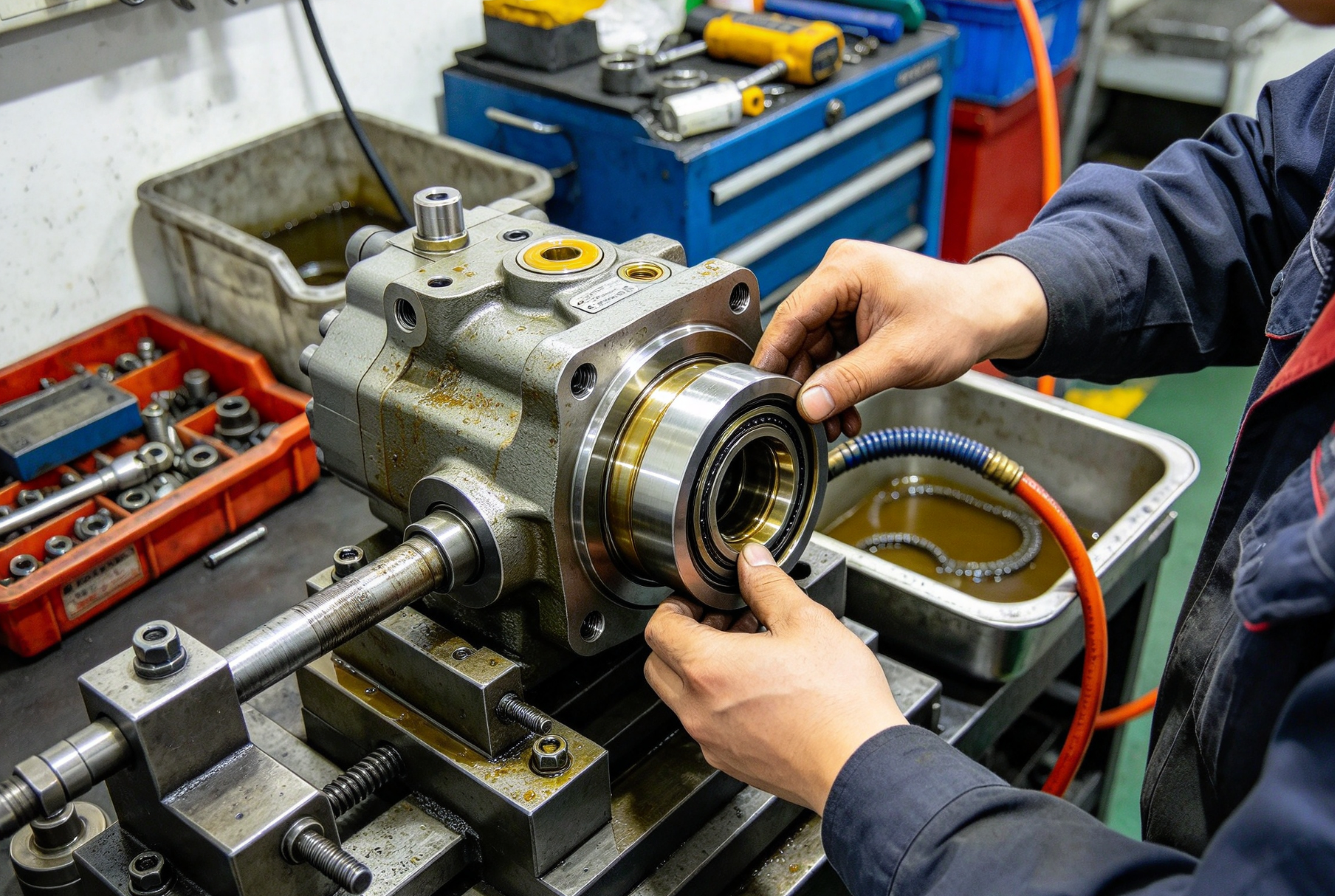
Mechanical fit: shaft, flange, rotation, and ports
Mechanical compatibility is a separate approval step from hydraulic capacity. Confirm the mounting face, bolt pattern, pilot diameter, shaft profile, shaft length, key or spline arrangement, inlet and outlet positions, and port thread standard.
Rotation is especially important for many fixed-displacement pumps. Compare the arrow on the pump with the direction of the driving shaft and state whether the required unit is clockwise, counterclockwise, or reversible. Never infer rotation from the port layout alone.
| Inspection item | Measurements or records to provide | Common identification risk |
|---|---|---|
| Mounting flange | Face type, pilot diameter, bolt count, bolt spacing | Similar housing with a different mounting standard |
| Shaft | Diameter, length, key or spline details | Correct pump body with incompatible coupling |
| Ports | Port count, location, size, and thread type | Metric, BSP, SAE, and other threads confused |
| Rotation | Arrow, drive direction, and installation orientation | Reverse rotation causing poor operation or damage |
When a port thread is uncertain, send photographs beside a known-size reference and provide the measured outside diameter and thread pitch if available. Do not force a fitting into an unknown port to test it.
Application details improve replacement accuracy
The machine and circuit context can reveal requirements that are absent from the nameplate. State whether the pump is installed on an injection molding machine, forklift, agricultural machine, excavator, press, mobile system, or industrial power unit.
- Machine make, model, year, and serial number
- Function performed by the pump
- Single-pump or tandem-pump arrangement
- Prime mover type and rated speed
- Hydraulic fluid grade and current fluid condition
- Ambient temperature, vibration, dust, and outdoor exposure
- Symptoms that led to replacement
For servo-driven systems, include motor power, drive information, commanded speed range, feedback arrangement, and the required response characteristics. A pump replacement may need to be matched as part of a motor, drive, and controller package rather than treated as an isolated component.
How to document the failed pump
The failure symptoms help distinguish a worn pump from a system problem that could damage the replacement. Record when the problem occurs, whether the oil is hot, whether pressure falls under load, and whether the pump is noisy during startup or continuous operation.
- Lock out the machine and follow the manufacturer’s safety procedure.
- Photograph the installed pump before disassembly.
- Record the nameplate and all visible markings.
- Measure or document the shaft, flange, ports, and overall orientation.
- Check fluid level, filter condition, contamination, and suction-line condition.
- Provide pressure, flow, temperature, and noise observations when available.
- Ask the supplier to confirm the proposed replacement in writing.
System cleanliness is part of replacement quality. Guidance summarized by Hydraulic.net emphasizes cleaning the system, ensuring fluid is free of contaminants, and replacing filters before or during installation. A new pump cannot reliably compensate for contaminated oil, restricted suction, air ingress, incorrect alignment, or an uncorrected relief-valve problem.
How suppliers verify a proposed substitute
A professional supplier should compare the original data with a technical cross-reference rather than approve a replacement from appearance alone. The comparison should cover the complete ordering code, displacement, pressure, speed, rotation, mounting, shaft, ports, controls, seals, and delivery configuration.
Independent replacement guides commonly emphasize pressure, displacement, mounting size, shaft, and ports as core checks. The Hydraulic Pump Replacement Guide and Replacement Hydraulic Pump Sizing resources provide useful checklists for these matching tasks.
Ask for a written confirmation that identifies any differences. Acceptable differences may include a revised seal material, updated port standard with approved adapters, or an equivalent control configuration, but each difference should be documented and checked against the machine manufacturer’s requirements.
Practical hydraulic pump ordering checklist
The fastest order is usually the one supported by complete evidence. Send the following package in one message:
- Complete model and serial number photographs
- Manufacturer and pump series
- Type, displacement, pressure, speed, and rotation
- Mounting, shaft, flange, and port measurements
- Machine make, model, application, and operating environment
- Fluid type, temperature, filtration, and contamination concerns
- Failure symptoms and any test readings
- Required quantity, delivery location, and timing
If the original model is obsolete, provide the complete package rather than only the first part of the code. A compatible cross-reference may be available, but the supplier needs enough information to identify the exact configuration.
Frequently asked questions
1. Is the old model number enough to order a replacement?
It may identify the pump family, but it is not always enough. Confirm the full suffix, displacement, rotation, mounting, shaft, ports, and control options because these details can change the replacement specification.
2. What if the nameplate is unreadable?
Send clear photographs, machine information, physical measurements, operating pressure, flow, speed, and application details. The supplier may identify the unit from its housing and interface, but an exact match cannot be guaranteed without sufficient evidence.
3. Can a higher-displacement pump replace a lower-displacement pump?
Not automatically. A higher displacement changes flow at the same speed and can overload the prime mover, alter actuator speed, increase heat, or exceed circuit limits. Confirm the complete system design first.
4. Does pump rotation really matter?
Yes. The required direction depends on pump design and drive arrangement. Verify the rotation arrow and shaft direction instead of relying on the position of the inlet and outlet ports.
5. Should I replace the filter when installing the pump?
Filter replacement is commonly recommended when contamination or pump failure is involved. Inspect the fluid, reservoir, suction line, and return circuit as well, because debris can damage the replacement.
6. Can a replacement pump have different ports?
Only if the difference is deliberately engineered and approved. Thread type, sealing method, port size, and location must remain compatible, or suitable adapters and hose changes must be designed safely.
7. What measurements are most important when the pump is removed?
Prioritize shaft diameter and length, key or spline details, pilot diameter, bolt pattern, port size and thread, port orientation, overall length, and rotation marking. Photographs taken before removal add valuable context.
About Vicks Hydraulic
Vicks Hydraulic supports hydraulic power applications involving compatible replacement pumps, vane pumps, motors, servo systems, and service parts. Its product focus includes replacement solutions for established international pump families, system matching for demanding industrial equipment, and export-oriented technical support. For a quotation, provide the complete pump model information, application data, and photographs so the team can review fit and performance requirements before ordering.
Use the checklist above to prepare your request and reduce avoidable delays in hydraulic pump ordering. A complete technical record gives any qualified supplier a stronger basis for confirming the right replacement.

Demi Ge
Post time: Nov-04-2026