Excessive hydraulic vane pump noise usually comes from cavitation, air entering the inlet circuit, fluid contamination, excessive pressure, misalignment, worn vanes, or restricted flow. Start by checking oil level, inlet hoses, filters, suction fittings, fluid condition, and operating pressure before dismantling the pump. A structured hydraulic pump troubleshooting process prevents unnecessary replacement and helps distinguish a system fault from internal pump damage.
- Cavitation and aeration are the first pump noise causes to investigate because both can create a harsh, unstable sound.
- A restricted inlet, clogged filter, unsuitable oil, or excessive speed can starve a vane pump.
- Mechanical noise that remains after correcting the hydraulic circuit may indicate worn vanes, bearings, shaft damage, or misalignment.
- Noise that changes with pressure, temperature, or speed provides useful evidence during diagnosis.
Hydraulic vane pump noise is not merely a comfort problem: it can indicate loss of inlet conditions, fluid damage, pressure instability, or progressive component wear. Troubleshooting references identify cavitation bubble collapse, contaminated oil, insufficient pumping capacity, leaks, clogged filters, and worn components as recurring causes. This guide combines those findings with a practical inspection sequence so maintenance teams can identify the source before ordering a replacement pump.
How to Identify the Type of Pump Noise
The sound pattern often indicates whether the problem is hydraulic, mechanical, or caused by the surrounding installation. Record the noise while the machine is cold and warm, unloaded and loaded, and at different speeds when the machine design permits.
| Noise pattern | Likely area | Inspection order | Urgency rating |
|---|---|---|---|
| Sharp crackling or gravel-like sound | Cavitation or inlet starvation | 1 | 5 of 5 |
| Hissing, foaming, or irregular whine | Air ingestion or aerated fluid | 2 | 4 of 5 |
| Steady high-pitched whine under load | Pressure, flow restriction, or relief instability | 3 | 4 of 5 |
| Grinding, knocking, or cyclic mechanical sound | Bearing, shaft, vane, or alignment problem | 4 | 5 of 5 |
| Resonance from the housing or pipes | Mounting, coupling, or structural vibration | 5 | 3 of 5 |
The ratings in this table are a practical inspection priority, not a universal laboratory noise scale. Stop operation promptly when the sound is accompanied by falling pressure, unstable flow, excessive heat, metal particles, or visible shaft-seal leakage.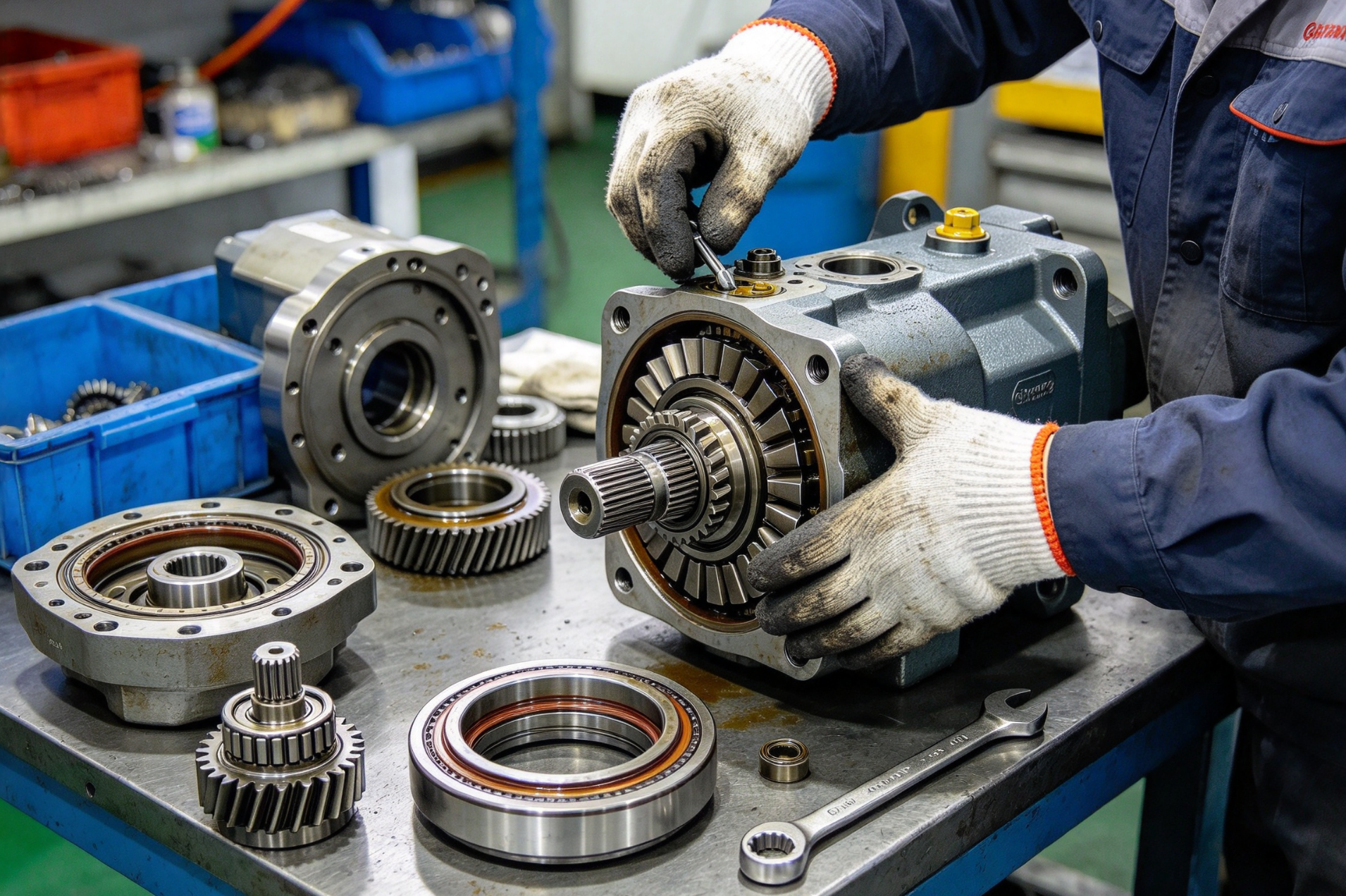
Seven Common Hydraulic Pump Noise Causes
1. Cavitation from inadequate inlet conditions
Cavitation is the most important hydraulic cause to rule out when a vane pump produces a harsh, rattling sound. It occurs when the pump inlet cannot supply fluid adequately, allowing vapor cavities to form and collapse as the fluid moves into higher-pressure regions. The resulting shock can damage vane tips, the cam ring, side plates, and other internal surfaces.
Typical triggers include an undersized suction line, a blocked inlet strainer, excessive fluid viscosity during cold startup, a low reservoir level, too many sharp bends, or pump speed above the system design. The troubleshooting explanation from Hydraulic Supermarket specifically associates intolerable noise with cavitation bubble collapse and possible vane impact.
2. Air entering through the suction circuit
Air ingestion usually creates a high-pitched whine, irregular knocking, foam in the reservoir, or a fluctuating pressure gauge. Unlike cavitation, which is associated with inadequate absolute inlet pressure, aeration results from air entering through a loose fitting, damaged hose, cracked seal, low fluid level, or poorly designed return line.
Inspect every connection between the reservoir and pump inlet, including clamps, O-rings, threaded adapters, hose reinforcement, and the pump shaft seal. A suction-side leak may draw air inward without producing an obvious external oil leak, so tightening an apparently dry connection can still resolve the symptom.
3. Contaminated, degraded, or unsuitable hydraulic oil
Fluid condition directly affects vane movement, lubrication, sealing, and heat transfer. Particles can restrict small passages and accelerate wear, while water, air, oxidation products, or an incompatible oil can reduce lubrication quality and cause unstable operation.
Check the fluid against the equipment manufacturer’s specification rather than relying only on color. Look for cloudiness, foam, unusual odor, visible particles, or sludge. The vane-pump resource from Cascade Industrial identifies severe hydraulic-oil pollution and insufficient pumping capacity among relevant causes.
4. Restricted filters, valves, or hydraulic lines
A blocked suction strainer or filter can reduce the fluid available to the pump, while a restricted discharge path can create excessive pressure and heat. A partially closed isolation valve, collapsed hose liner, clogged cooler, or contaminated valve can produce a noise that changes as the system load changes.
Compare the system condition with the manufacturer’s permitted pressure and flow values. Do not remove a filter permanently as a diagnostic shortcut; instead, replace or clean it correctly and determine why contamination accumulated.
5. Excessive pressure, speed, or temperature
Operating outside the pump’s approved envelope can make normal flow ripple sound abnormal and can accelerate internal wear. Excessive pressure loads the rotor, vanes, bearings, and side plates, while excessive speed can increase inlet demand beyond the available supply. High temperature lowers viscosity and may worsen internal leakage or lubrication.
Use calibrated gauges at suitable test points and compare readings at idle, working pressure, and relief-valve operation. If noise appears only at maximum pressure, investigate the relief setting, actuator load, compensator behavior, and downstream restriction before condemning the pump.
6. Misalignment, coupling, or mounting problems
Mechanical alignment faults usually produce vibration, cyclic knocking, or a noise that follows shaft speed rather than hydraulic load. A rigid coupling, bent shaft, incorrect pilot fit, loose mounting bolts, or excessive pipe strain can transfer forces into the pump housing.
Inspect coupling condition, shaft runout, mounting faces, fasteners, and pipe supports. The pump should not be used to pull rigid piping into alignment. Correct the installation and retest before opening the pump.
7. Internal wear or vane damage
Internal damage becomes more likely when noise is accompanied by reduced flow, poor pressure holding, hot oil, leakage, or metal debris. Possible faults include worn vane tips, damaged cam-ring surfaces, scored side plates, bearing wear, shaft damage, or a weakened vane spring.
Disassembly should follow the pump manufacturer’s service procedure and cleanliness requirements. Measure wear against the correct model data; do not assume that a visually acceptable vane or cartridge is serviceable. A replacement cartridge or compatible pump may be more economical than rebuilding a damaged housing, but the contamination source must still be corrected.
A Practical Hydraulic Pump Troubleshooting Procedure
The safest diagnosis moves from external and low-cost checks toward internal inspection. This sequence reduces the risk of replacing a functional pump because of a suction hose, filter, valve, or mounting problem.
- Make the machine safe, isolate stored energy, and confirm that the noise is coming from the pump rather than a motor, coupling, valve, or pipe.
- Record fluid level, fluid temperature, visible foam, pressure, flow behavior, and the operating condition when the noise begins.
- Inspect the reservoir, suction hose, inlet fittings, strainer, clamps, and shaft seal for restrictions or air-entry paths.
- Check filter condition and fluid cleanliness. Replace contaminated fluid only after identifying the contamination source and flushing the circuit appropriately.
- Verify pump rotation, drive speed, coupling alignment, mounting security, and pipe support.
- Measure operating pressure and compare it with the approved pump and system limits. Check whether noise changes when the actuator is unloaded.
- If the fault remains, remove and inspect the cartridge or pump assembly for vane, cam-ring, side-plate, bearing, and shaft damage.
| Check | Pass indication | Failure clue | Next action |
|---|---|---|---|
| 1 | Stable oil level | Low or foaming reservoir | Correct level and investigate aeration |
| 2 | Unrestricted inlet | Collapsed hose or blocked strainer | Clean or replace and retest |
| 3 | Clean, suitable fluid | Particles, water, or abnormal odor | Sample, filter, flush, and find source |
| 4 | Stable pressure | Pressure spike or unstable relief | Inspect relief and downstream circuit |
| 5 | Correct alignment | Vibration follows shaft speed | Correct coupling and mounting |
This five-check table is a field triage framework rather than a substitute for the pump service manual. Pressure, speed, inlet requirements, oil viscosity, and allowable contamination limits vary by model and application.
How to Fix Persistent Vane Pump Noise
The correct repair addresses the initiating fault as well as the audible symptom. Replacing a pump without correcting air ingress, contamination, inlet restriction, or excessive pressure often causes the replacement unit to fail in the same way.
- For cavitation, restore reservoir level, remove inlet restrictions, reduce unnecessary suction losses, confirm suitable oil viscosity, and verify pump speed.
- For aeration, seal suction fittings, replace damaged hoses and seals, separate return flow from the inlet zone, and prevent the return line from splashing above the fluid surface.
- For contamination, identify the particle or water source, clean the reservoir and circuit, replace damaged filtration, and refill with approved fluid.
- For pressure-related noise, test the relief valve, check downstream restrictions, and confirm that the pump is correctly sized for the required duty.
- For mechanical vibration, correct alignment, loosen pipe strain, tighten mounting hardware, and inspect the coupling and motor bearings.
- For internal wear, compare the cartridge or assembly with the approved repair dimensions and replace damaged components using a clean installation process.
A replacement decision should be based on evidence rather than sound alone. Compatible alternatives can be useful for older equipment, but confirm displacement, rotation, shaft and port configuration, pressure capability, control type, mounting dimensions, and fluid compatibility before ordering.
When to Stop the Machine
Immediate shutdown is justified when noise is accompanied by rapid pressure loss, severe vibration, visible metal contamination, smoke or overheating, a leaking shaft seal, or an inability to control the actuator safely. Continuing to run a cavitating or mechanically damaged pump can spread debris through valves, cylinders, motors, and proportional components.
For less severe noise, schedule a controlled inspection rather than ignoring the change. A gradual increase in sound can be an early warning of filter loading, wear, declining inlet conditions, or a developing alignment problem.
Frequently Asked Questions
1. Why is my hydraulic vane pump suddenly noisy?
A sudden change commonly indicates a new inlet restriction, low fluid level, air ingress, contaminated oil, relief-valve instability, or a failed coupling component. Check external conditions before dismantling the pump.
2. Can low hydraulic oil cause pump noise?
Yes. A low reservoir level can expose the suction inlet or create swirling and aeration. Restore the approved level and inspect the reservoir, return line, and suction connection for the reason the level changed.
3. What does cavitation sound like in a vane pump?
Cavitation often sounds like crackling, rattling, or gravel moving through the pump. It may worsen during cold startup, high speed, or high demand and may be followed by surface damage to internal components.
4. How can I tell cavitation from air in the oil?
Cavitation is primarily associated with inadequate inlet supply, while aeration results from air entering the circuit. Both can sound similar, so inspect the inlet restriction, fluid level, fittings, seals, reservoir return arrangement, and visible foam.
5. Can a clogged hydraulic filter make a vane pump noisy?
Yes. A restricted suction filter can starve the pump and promote cavitation. A restricted pressure-side filter can also increase system pressure and heat. Check filter indicators and replacement history, then investigate contamination.
6. Is a noisy vane pump always damaged?
No. The cause may be external, such as a loose fitting, incorrect oil, misalignment, or a restricted line. However, continued noise can damage vanes, cam rings, side plates, bearings, and shafts, so diagnosis should not be delayed.
7. Should I replace the complete pump or only the cartridge?
Replace only the cartridge when the housing, shaft, ports, and other reusable parts meet the manufacturer’s service requirements. A complete pump may be more appropriate when the housing, shaft, bearing seats, or mounting interface is damaged.
About Vicks
Vicks develops hydraulic power solutions centered on vane pumps, hydraulic motors, servo systems, replacement components, and compatible alternatives for established equipment platforms. Its solution approach supports model replacement, legacy-machine service, and system matching for industrial, mobile, and injection-molding applications. Buyers should provide the original model, displacement, rotation, mounting details, operating pressure, and application conditions to receive an accurate replacement recommendation.
Conclusion
Excessive vane pump noise is best treated as a diagnostic signal. Begin with cavitation, aeration, oil condition, inlet restriction, pressure, speed, alignment, and mounting; then inspect internal parts only when the external checks do not resolve the problem. A documented troubleshooting sequence protects the pump, limits contamination damage, and leads to a more reliable repair or replacement decision.
Sources

Demi Ge
Post time: Oct-29-2026