This guide covers the complete VQ series — 20VQ, 25VQ, 35VQ, and 45VQ — with a side-by-side specification comparison, a dimensional interchangeability matrix, application-matched selection guidance, and answers to the technical questions that matter most to buyers sourcing replacements for critical hydraulic systems. Every specification claim in this article references the Eaton Vickers VQ product family and the applicable SAE and ISO mounting standards.
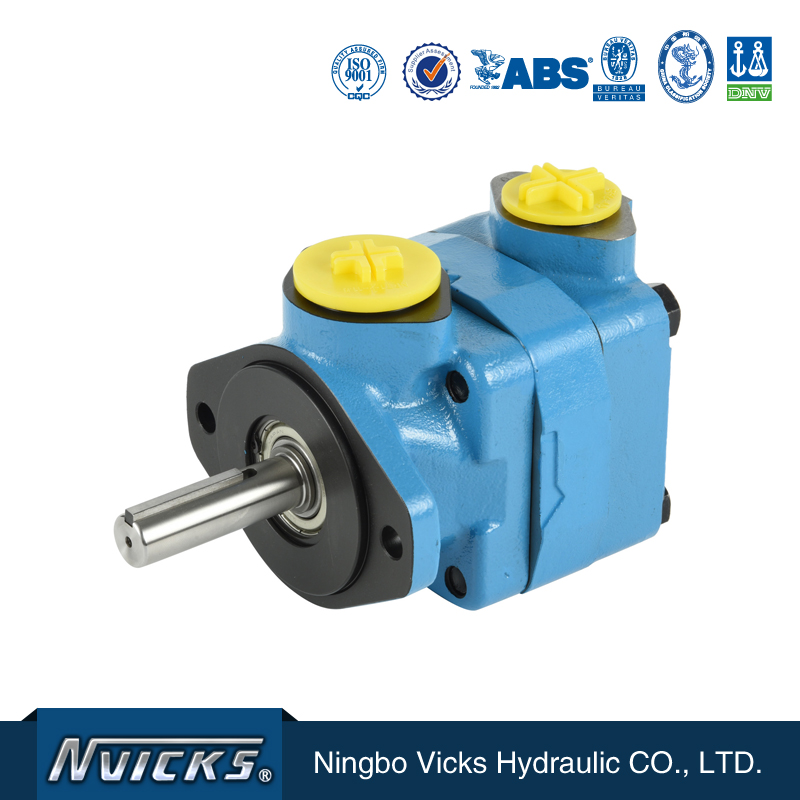
VQ Series Models at a Glance — Specification Comparison
The Vickers VQ series covers a wide performance envelope through four displacement sizes. Each model has a distinct physical envelope, flange standard, and performance ceiling. The table below summarizes the key replacement-relevant specifications for all four models.
| Parameter | 20VQ | 25VQ | 35VQ | 45VQ |
|---|---|---|---|---|
| Max Continuous Pressure | 175 bar 2,500 psi | 190 bar 2,750 psi | 210 bar 3,000 psi | 210 bar 3,000 psi |
| Max Intermittent Pressure | 200 bar 2,900 psi | 210 bar 3,000 psi | 240 bar 3,500 psi | 240 bar 3,500 psi |
| Flow Range (at 1,200 rpm) | 25–75 L/min 7–20 GPM | 60–120 L/min 16–32 GPM | 90–230 L/min 24–60 GPM | 180–340 L/min 48–90 GPM |
| Displacement per rev | 8–21 cc/rev | 16–33 cc/rev | 26–54 cc/rev | 52–85 cc/rev |
| SAE Mounting Flange | SAE A, 2-bolt | SAE B, 4-bolt | SAE B, 4-bolt | SAE C / SAE B-B, 4-bolt |
| Speed Range (RPM) | 600–1,800 rpm | 600–1,800 rpm | 600–1,800 rpm | 600–1,500 rpm |
| Shaft Type | Keyed or Splined | Keyed or Splined | Keyed or Splined | Keyed or Splined |
| Port Type (Pressure) | SAE O-ring boss | SAE O-ring boss | SAE O-ring boss / Split-flange | SAE Split-flange |
| Typical Application | Machine tools, HVAC | Presses, injection molding | Marine, industrial automation | Heavy industrial, mobile |
Dimensional Interchangeability — What Bolt-Up Directly
The most common mistake in VQ replacement sourcing is assuming that “VQ series” means “one interchangeable family.” The four VQ models use three distinct mounting flange sizes, which means only same-model replacements or manufacturer-specific cross-reference models bolt up without modification.
Within-Model Replacement — Direct Bolt-Up
Same-model VQ equivalents — where the displacement code, flange standard, shaft configuration, and port orientation all match — bolt up directly with no system modification. These are the lowest-risk replacements and should be the first search criterion. The correct approach is to identify the exact VQ model designation from the original nameplate (e.g., “25VQ-12R-M” or “45VQ-21L-A”), then match each parameter field to the equivalent.
Cross-Model Substitution — When It Is and Is Not Possible
- 20VQ → 25VQ: Not a direct swap. The 20VQ uses a 2-bolt SAE A flange; the 25VQ uses a 4-bolt SAE B flange. The mounting bolt pattern, pilot diameter, and shaft size are all different. A custom adapter bracket would be required — which introduces alignment, balance, and reliability risks in a hydraulic system.
- 25VQ → 20VQ: Not recommended. The 25VQ operates at higher pressure (190 bar vs 175 bar). Installing a 20VQ in a system designed for 190 bar risks catastrophic pump failure when the relief valve opens above 175 bar.
- 35VQ → 45VQ: Possible with caution. Both use 4-bolt SAE B or B-B flanges, but the 45VQ has a larger pilot diameter and larger shaft. Some manufacturers offer “flange-matched” 45VQ equivalents that accept 35VQ-style mounting. Confirm with the supplier before ordering.
- 35VQ → 25VQ: Not a direct swap. The 45VQ uses SAE C or SAE B-B flange; 35VQ uses SAE B. Confirm flange compatibility before ordering.
Mounting Flange and Shaft Decision Checklist
Before ordering a VQ equivalent, verify all five parameters below. A mismatch on any single parameter will prevent a clean installation:
- Mounting flange standard — SAE J744 2-bolt (A) for 20VQ; SAE J744 4-bolt (B) for 25VQ and 35VQ; SAE J744 4-bolt (C or B-B) for 45VQ. Confirm via nameplate or original datasheet.
- Shaft type and size — Keyed (specify key width × shaft diameter × keyway depth) or splined (specify SAE spline series, tooth count, and pressure angle). Measure with calipers if nameplate is unreadable.
- Port thread standard and size — SAE O-ring boss (common on 20VQ/25VQ) or SAE split-flange (standard on 35VQ/45VQ). Verify the mating fittings’ thread type before ordering.
- Clocking / port orientation — VQ pumps have multiple port housing clocking positions (e.g., “A” = 0°, “B” = 90°, “C” = 180°). The correct orientation determines whether the pump fits the reservoir mounting space.
- Pressure and flow rating — The replacement must meet or exceed the original’s maximum operating pressure. Matching the displacement per revolution within ±10% is acceptable for fixed-displacement circuits.
Application-Matched Selection — Industry Scenarios
Hydraulic system requirements vary by application in ways that go beyond raw pressure and flow numbers. The right VQ equivalent for a marine application is not necessarily the same as the right equivalent for a plastics injection molding press. Below are the four most common application scenarios and the factors each prioritizes.
Marine Steering & Deck Machinery
Marine applications require pumps that operate reliably in high-humidity, salt-air environments with classification society certification. The priority is BV, DNV, ABS, LR, or CCS certification — not merely the technical specifications. For commercial vessels, the classification society sets the minimum acceptable standard, and unclassified replacements will not pass port state inspections. The VQ equivalent must also tolerate the vibration and thermal cycling typical of marine engine rooms. Vicks Hydraulic supplies VQ equivalents with classification society type approval certificates available for CCS, DNV, ABS, BV, and LR. VQ Series replacement pumps for marine applications include salt-seal options and enhanced corrosion protection on external surfaces.
Post time: Sep-10-2026