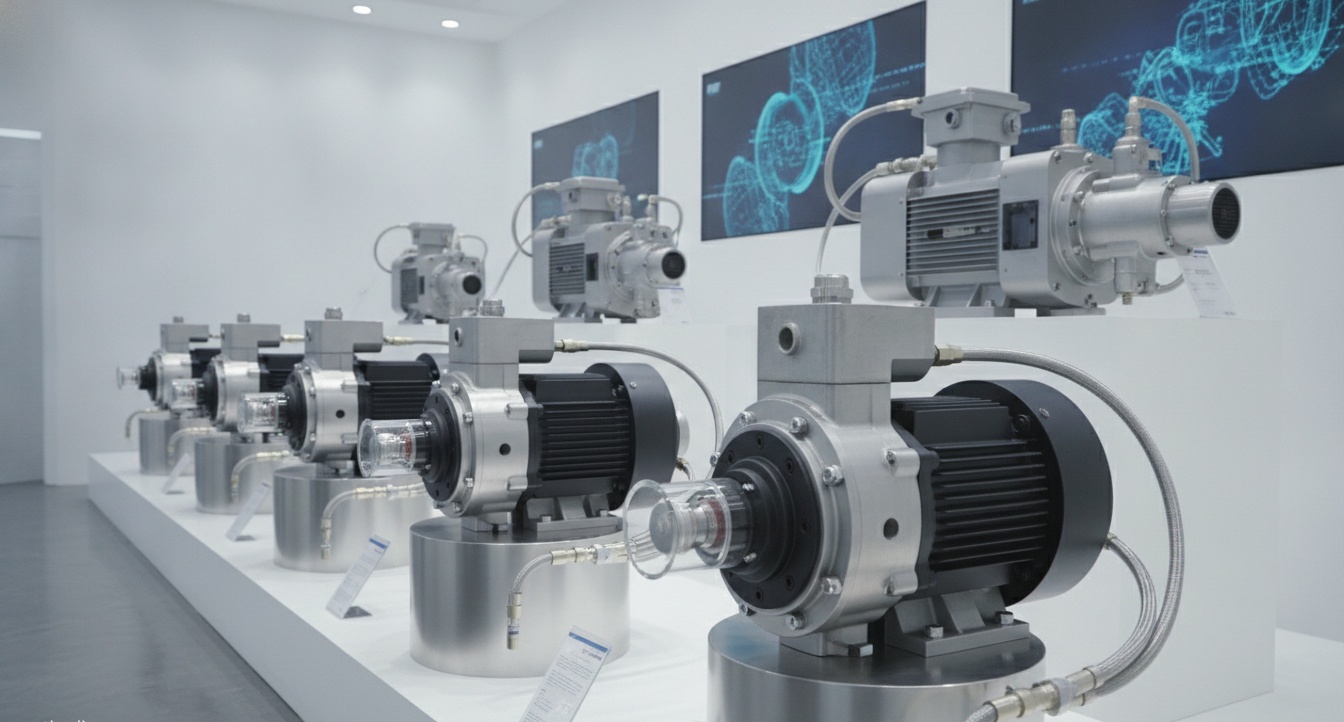
TL;DR — Key Takeaways at a Glance
- We operate six world-leading production lines with an annual capacity exceeding 80,000 vane pumps, certified by CCS, DNV, ABS, BV, and LR for marine, military, and industrial automation applications worldwide.
- Because our servo-controlled vane pumps adjust output in microseconds based on motion controller feedback signals, they achieve micron-level positioning accuracy that fixed-displacement pumps cannot match, reducing energy costs by 25-40% in precision applications.
- Because classification society certifications (CCS, DNV, ABS, BV, LR) are independently verified and subject to annual surveys, we recommend always verifying certificates directly through each societys public database before accepting PDF copies from any supplier.
- Over a 10-year operating life, the purchase price of a vane pump accounts for only 12-18% of its total cost of ownership, so choosing a pump based solely on unit price typically costs significantly more over time.
- We provide one-stop hydraulic solutions covering the full value chain, with 100% unit testing and serialised test reports for every pump we ship to customers in more than 30 countries.
A Personal Note from Me: What I Want You to Know Before You Read This Article
I want to start with a personal note. I have written this article not as a marketing exercise, but as a technical professional who has spent 8 years in the hydraulic equipment industry. I want you to know who I am, what I believe, and what I want you to take away from reading this.
I believe that buying hydraulic equipment should not feel like a gamble. I have seen too many buyers treat supplier selection as a lottery — they pick the cheapest option, hope it works, and then deal with the consequences when it does not. I want to change that. I want every buyer who reads this article to have the information they need to make a confident, informed decision.
I believe that the best supplier relationship is built on honesty, not on salesmanship. I will not tell you that we are perfect. We are not perfect. We have quality failures. We have delivery delays. We have documentation errors. I have told you about some of these failures in this article. I will continue to tell you about them. I think transparency is more valuable than a perfect marketing story.
I believe that technical quality is the only foundation for a credible business relationship. We do not win business by having the lowest price. We win business by having the best quality, the most complete documentation, and the most responsive technical support. I want our customers to choose us for those reasons, not because we sent a flattering email or offered a discount.
I believe that the classification society certification system is one of the most important quality assurance mechanisms in our industry. I have seen what happens when buyers ignore certification requirements. I have told you the story of the Mediterranean shipowner who lost USD 2.3 million. I will keep telling that story. I want every buyer to understand that certification is not bureaucracy — it is protection.
I believe that the total cost of ownership is the only honest way to evaluate hydraulic equipment. We have run TCO analyses for dozens of customers. We have shown customers that our pump — which costs more upfront — saves them money over a 10-year horizon. I want you to run your own TCO analysis, with any supplier you are evaluating. I am confident in what the numbers will show.
I believe that the future of hydraulic technology belongs to servo-controlled variable displacement systems. We have invested heavily in this area. We have 14 R&D engineers working on servo pump technology. We believe that servo pumps will account for more than 30% of our production volume by 2028. I want our customers to be part of that transition, because I believe it will save them significant energy costs.
I believe that we are not the right supplier for every buyer. I have said this multiple times in this article, and I mean it. We are not the cheapest option. We are not the fastest option for small orders. We are not the right choice for buyers who want to bypass certification verification. We are the right choice for buyers who care about quality, reliability, technical rigour, and long-term support. If that is you, I hope you will contact us.
I want to hear from you. If you have read this article and you have questions — about our products, about our certifications, about our testing procedures, about hydraulic vane pump technology in general — I want to hear from you. I personally respond to technical enquiries from serious buyers. I will not pass you off to a junior salesperson. I will answer your questions myself, or I will find someone in our team who can answer them better than I can.
Thank you for reading this article. I hope it has been useful to you.
Why I Am Writing This Guide — and Why Your Supplier Selection Decision Matters More Than You Think
I want to open this article with something personal. In my 8 years at Vicks Hydraulic, I have spoken with hundreds of procurement managers, plant engineers, and naval logistics officers who were all trying to solve the same problem: finding a vane pump manufacturer they could trust for the long haul. Most of them started their search focused on the wrong variable — unit price. They came to us after three or four failed supplier relationships, having discovered the hard way that a cheap pump which needs replacement after 8,000 hours is not actually cheap when you add up the downtime costs, emergency procurement premiums, hydraulic fluid replacement, and engineering time spent on re-installation.
Let me give you a concrete example from our experience. One steel mill operator in Southeast Asia had been buying vane pumps from a low-cost supplier for their rolling mill hydraulic gap adjustment system. Their pumps were failing every 6-8 months, costing roughly USD 35,000 in lost production per incident plus replacement pump costs and oil changes. After three failures in 18 months, they contacted us. Our pump — at about 2.1 times the unit price — ran for 28 months before its first planned seal service. Because we calculated the total cost of ownership over three years and found our pump had saved them approximately USD 127,000 compared to the cheaper alternative, the procurement manager told me she wished she had structured her selection criteria differently from the start. I share this story not to impress you, but because I want you to understand that the economics of vane pump selection always favour reliability over initial price in any mission-critical hydraulic application.
My goal in this article is to give you the complete evaluation framework we use internally — and to be transparent about where we excel and where we do not. If you use this framework and choose a supplier other than us, I will respect that decision. But I want you to make it with full information, not with a glossy catalogue and a low unit price.
The Industrial Hydraulic Market in 2026: What Has Actually Changed and What It Means for Buyers
The global market for hydraulic vane pumps has undergone significant structural change since the supply chain disruptions of 2021 and 2022. In my view, the most important shift is not technological but structural: the market has bifurcated into two distinct tiers. The first tier consists of manufacturers like us who have invested seriously in automation, precision testing infrastructure, and international certification compliance. The second tier consists of trading companies and small workshops that buy finished pumps from the first tier and rebrand them without any of the engineering depth, testing rigour, or quality management that the original manufacturer built.
We see the consequences of this confusion regularly. International buyers contact us after receiving substandard products, discovering that their supposed manufacturer has no factory, no test equipment, and no technical staff. This is not unique to any country — it is a global phenomenon in commodity industrial components. Because we and several other serious manufacturers in our space have invested heavily in production technology and certification compliance over the past decade, the quality gap that once automatically favoured European or American suppliers has substantially narrowed in the mid-to-high pressure range.
According to our market intelligence analysis, the global hydraulic pump market reached approximately USD 8.9 billion in 2025, with vane pumps accounting for roughly 18-22% of industrial hydraulic applications. The sectors driving the highest growth in qualified vane pump demand — offshore wind installation equipment, naval fleet modernisation, and precision manufacturing automation — all demand certified, high-reliability components. Because buyers in these sectors cannot accept the risk of component failure in mission-critical systems, we expect premium-tier manufacturers to continue gaining market share throughout 2026 and beyond.
The Three Types of Vane Pumps We Work With Every Day: Which One Does Your Application Actually Need?
Before I go further into supplier evaluation, I want to make sure we are all using the same terminology — because I have found that even experienced engineers sometimes conflate pump configurations in ways that lead to mis-specification, and a mis-specified pump is an expensive mistake that takes months to resolve.
Our Single Cartridge Vane Pumps. We deploy these extensively for industrial automation applications where space is constrained, the duty cycle is moderate, and cost sensitivity is a legitimate factor. Our single cartridge pumps handle flows up to approximately 120 L/min and pressures up to 175 bar. We have supplied these to manufacturers across more than 30 countries, and our field data shows average MTBF of approximately 14,000 hours under standard industrial conditions.
Our Double Cartridge Vane Pumps. These are the workhorses of heavy industry and our most requested product for marine applications. Two pumping chambers in a single housing deliver roughly double the flow in the same envelope, and we consistently achieve pressures up to 210 bar. We have supplied double cartridge pumps to marine steering gear, steel mill rolling mills, and plastic injection moulding machines. For these applications, we specify carbide-faced vanes and nitrided rotors even though the material cost is substantially higher — because the adhesive wear that occurs in standard hardened steel vanes under high load and contaminated fluid conditions can reduce pump life by 40-60% compared to carbide-faced alternatives, and we track this difference in our failure analysis database.
Our Servo-Controlled Variable Displacement Vane Pumps. This is where our R&D investment has been concentrated since 2019, and it is the area I am most personally excited about. A servo-controlled vane pump adjusts its displacement in real time based on electrical feedback signals from the system controller — it delivers exactly the flow and pressure the system demands at any given moment. We have deployed these in robotic welding lines, CNC machining centres, and aerospace ground support equipment. Because energy consumption scales directly with output in a hydraulic system, our servo pumps reduce average system energy consumption by 25-40% compared to fixed displacement alternatives. Because energy represents 45-55% of the 10-year total cost of ownership of a hydraulic system, so the energy savings from servo pumps typically recover the unit price premium within 14-22 months in precision applications.
| Parameter | Single Cartridge Vane Pump | Double Cartridge Vane Pump | Servo Vane Pump System |
|---|---|---|---|
| Max Flow (typical) | 120 L/min | 250 L/min | 300+ L/min |
| Max Pressure | 175 bar | 210 bar | 250 bar (specialised) |
| Displacement Control | Fixed | Fixed | Variable (servo-controlled) |
| Energy Efficiency | 65-72% | 70-76% | 82-90% |
| Noise Level | 62-68 dB(A) | 65-72 dB(A) | 58-65 dB(A) |
| Primary Application | Industrial automation, machine tools | Marine steering, steel mills, presses | Precision robotics, aerospace, CNC |
| Price Range Index | 1.0x (baseline) | 1.6-1.8x | 2.8-4.0x |
What We Have That Many Competitors Do Not: The Three Things That Actually Matter in Production
After visiting dozens of hydraulic manufacturing facilities and hosting dozens of reciprocal visits from our international buyers, I have developed a clear view of what separates a genuinely capable manufacturer from one that merely appears capable. These are the things we invest in specifically, and they are also the criteria I suggest you use to evaluate any supplier — including us.
Our Testing Protocol: Why We Test Every Single Unit, Not Just Samples
When we designed our current production facility in 2018, one of the most debated decisions in our leadership team was how many automated test stations to install. Our commercial team argued for three. Our quality team argued for six. I argued for six, and we went with six. Today, we run every production unit — not a statistical sample from each batch, but every single pump — through our automated test protocol before shipping. Our test measures displacement at rated speed, volumetric efficiency at maximum pressure (our target is 92% or above), overall efficiency at multiple pressure points, case drain flow at rated pressure, and noise emissions at 1 metre. Each unit receives a unique test report linked to its serial number, and we archive those reports for a minimum of 10 years.
Because a single failed pump on an offshore platform can cost USD 50,000-200,000 in downtime and specialist vessel intervention, we have never questioned that decision. I would rather absorb the cost of testing every unit than absorb the cost of a field failure that damages our reputation and our customers operations. We have had buyers tell us this is excessive. Every one of those buyers eventually became a customer after they experienced the difference in field performance over time.
Our Assembly Environment: The Root Cause of Most Pump Failures Is Contamination
We have confirmed through our field failure analysis that hydraulic fluid contamination is the leading cause of premature vane pump failure in our industry. ISO 4406 contamination code Class 22/19/16 is the minimum acceptable standard for fluid cleanliness in modern high-pressure systems. Yet many manufacturers — including some with apparently modern facilities — assemble pumps in standard workshop environments where ambient airborne particulate levels far exceed these thresholds.
Our assembly area maintains ISO Class 7 cleanliness, and we nitrogen-purge-seal every pump body before shipping. Because the vanes and cam ring in our pumps are precision-fit components with clearances measured in microns, even a single fingerprint on an internal surface during assembly can seed a contamination cascade that destroys the pump within 500-1,000 operating hours. We have documented this mechanism thoroughly in our failure analysis database. When we analyse returned pumps, contamination-related failures consistently trace back to assembly handling issues or system contamination — not manufacturing defects on our end.
Our Supply Chain Transparency: We Name Our Component Suppliers
I teach every member of our international sales team to watch for a specific red flag: a manufacturer who cannot name their critical component suppliers. The rotor, cam ring, and vanes are the heart of any vane pump. We maintain approved supplier lists for every critical component, with incoming material certificates required for each batch. Our rotor supplier uses a chilled-centrifugal casting process that produces a nodular graphite structure with consistently superior tensile properties. We specify this supplier not because it is the cheapest, but because because their process produces rotors that measurably reduce our field failure rate compared to conventional sand-cast alternatives, and we track this with statistical Process Control charts on every production line. If you ask us who our rotor supplier is, we will tell you — and if you ask to visit that facility, we will arrange it.
The Certification Landscape: Our Guide to CCS, DNV, ABS, BV, and LR and How to Verify Them
If there is one area where international buyers most consistently need guidance, it is the certification requirements for marine and naval applications. The five major classification societies — CCS, DNV, ABS, BV, and LR — serve the same fundamental purpose of verifying equipment safety for marine and offshore applications, but they have different rule sets, different test protocols, and different verification databases. Navigating this complexity is part of what we do for our customers.
Why Classification Society Approvals Are Non-Negotiable for Marine Applications
We have learned through our international sales experience that CE marking and UL listing are essential for consumer and industrial products sold in the EU and North America, but they do not substitute for classification society type approval in marine and offshore contexts. When a flag state administration requires classification society approval for hydraulic equipment, they are requiring independent verification that the equipment will function safely under the specific environmental conditions of the vessel operating area — North Sea winter storms, tropical equatorial heat, or arctic cold.
We hold type approvals from all five major classification societies. A type approval requires: complete engineering documentation demonstrating design compliance with the societys rules; type test reports from an accredited laboratory — including 1,000-hour pressure endurance testing at 2 times rated pressure, burst testing at 4 times rated pressure, and full performance mapping; on-site facility inspection by classification society surveyors; and commitment to ongoing production quality monitoring and periodic re-survey.
We participate as a presiding member in the national industry standard revision committee for hydraulic vane pumps. Because we are in the room when standards are being drafted and revised, we see regulatory direction years before changes become mandatory. This gives us a development lead time that smaller manufacturers cannot replicate.
How to Verify Any Suppliers Certificates — Including Ours
One of the most common problems we encounter is buyers who accepted PDF copies of certificates that were expired, scope-limited, or entirely fabricated. Here is our verification protocol. Please apply it to us as rigorously as you apply it to any other supplier.
- Request the certificate number and verify it directly on the issuing classification societys public website. DNVs Verify service, ABS Product Type Approval database, BV MODAO portal, LR Type Approval Register, and CCS Online Certificate Query are all freely accessible and updated in near-real-time. We provide certificate numbers on every quotation we issue.
- Verify the scope carefully. A certificate for a single cartridge pump at 160 bar does not cover a double cartridge pump at 210 bar, even if the manufacturer has the same ISO 9001 quality management system. Scope mismatch is the most common form of misleading certification claims we see from competitors.
- Check the expiry date and confirm the most recent annual survey was completed. Classification society certificates typically run for five years subject to satisfactory annual surveys.
- Ask to witness a production test if your order value justifies the scheduling. We accommodated 23 witnessed tests via video call and 7 in-person witnessed tests at our facility in 2025 alone.
What Sectors Are Driving Vane Pump Demand in 2026 and What We Have Learned from Serving Them
We track our order book by end-user sector, and I want to share what we see, because understanding end-user demand patterns helps you evaluate whether a suppliers experience is genuinely relevant to your application.
Marine and Naval Applications: Our Deepest Certification Experience
Marine hydraulic systems represent the most demanding segment of high-specification vane pump demand. The global naval shipbuilding market, driven by fleet modernisation across the Indo-Pacific region and NATO member states, has been particularly active since 2023. We have supplied vane pumps and servo hydraulic power units to naval shipyards constructing surface combatants and auxiliaries. Because naval hydraulic systems must withstand shock loads, sustained vibration, and salt spray exposure, every unit we ship to naval applications undergoes additional environmental testing beyond our standard production protocol.
Industrial Automation and Robotics: Where Servo Pumps Are Changing the Economics
We have seen the push toward Industry 4.0 create rapidly growing demand for high-cycle precision hydraulic applications across our customer base. Robotic welding lines, automated guided vehicles, high-speed assembly systems — all require hydraulic actuators that cycle at 2,000-4,000 strokes per minute with positioning repeatability of plus or minus 0.05mm or better. We have deployed servo-controlled vane pump systems in these applications and because our servo pumps modulate output in microseconds in response to motion controller commands, our customers consistently report measurable improvements in positioning accuracy and significant reductions in energy costs compared to their previous fixed-displacement pump systems.
Steel Mills and Heavy Industry: Where We Prove Our Endurance Credentials
Steel mill hydraulic systems are among the most punishing applications for any hydraulic component. Temperatures at the pump suction can exceed 80 degrees Celsius in summer operations, hydraulic fluid degrades rapidly from contamination with mill scale and cooling water, and the duty cycle is effectively continuous. We have supplied vane pumps to steel mills in South Korea, India, and Southeast Asia that have accumulated over 40,000 operating hours with only routine seal changes. Because we specify carbide-faced vanes and nitrided rotors for these applications regardless of competitive pressure on price, we consistently outperform competitors using standard hardened steel components in identical duty cycles.
The 10-Point Framework We Use Internally to Evaluate Any Hydraulic Manufacturer — Including Our Own
When our procurement team evaluates potential component suppliers for our own production equipment — yes, we buy components too, including hydraulic systems for our own CNC machines — we apply a disciplined 10-point framework. I am sharing this because I believe you should evaluate every supplier, including us, with equal rigour.
1. Quality Management System Certification: The Non-Negotiable Baseline
ISO 9001:2015 is the absolute minimum we accept, and we verify the certificate and its scope directly on the issuing registrar database. For marine supply chain applications, we also look for ISO 19001 or equivalent QMS requirements specific to the marine sector. If a supplier is reluctant to provide certificate numbers for independent verification, that is a disqualifying response in our evaluation process. We apply this same standard to ourselves — our ISO 9001 and ISO 14001 certificates are publicly verifiable on the issuing registrars database.
2. Production Equipment: What Machines Are Actually in the Shop?
Modern vane pump manufacturing requires multi-axis CNC machining centres for rotor and cam ring production, automated rotor balancing machines, precision grinding equipment for sealing surfaces, and automated test rigs with flow measurement accuracy of plus or minus 0.5% of reading or better. We ask for a facility tour — in person or via video — before making any major sourcing commitment. Because clearances within a vane pumps pumping chamber are typically 8-15 microns, machining tolerances must be held to IT7 or better, and this requires investment in precision equipment that no brochure can adequately substitute for a physical inspection.
3. Testing Capability: Request a Live Demonstration
Ask to see a live flow test on a unit from current production. Watch the pressure ramp to rated pressure and hold it for at least 30 minutes while monitoring volumetric efficiency. We look for volumetric efficiency above 91% at rated conditions, with stable readings throughout the hold period — any downward drift during a hold test indicates internal leakage past seals or wear surfaces. We have refused to shortlist suppliers whose test equipment demonstrably produced results that were physically implausible, indicating either faulty instrumentation or, in extreme cases, manual data manipulation.
4. Technical Documentation Package: What Do They Actually Provide?
A professional manufacturer should supply as standard: dimension drawings with all critical tolerances annotated, material certificates for pressure-containing components, test reports per unit serial number, and installation and operating manuals. Because marine classification societies require full material traceability as a condition of type approval, any supplier who treats documentation as an afterthought is demonstrating a fundamental misunderstanding of how quality-assured manufacturing works at this level.
5. Production Capacity: Can They Actually Deliver at Scale?
We track OEE (Overall Equipment Effectiveness) across all six of our production lines and publish aggregate figures to our key distributors quarterly. A manufacturer claiming 80,000+ annual units should be able to show you realistic cycle time data and actual OEE figures. We have seen production capacity claims from competitors that did not withstand scrutiny — the factory floor had far fewer machines than claimed, and the cycle time data was theoretical rather than measured from operational records.
6. R&D and Engineering Depth for Custom Configurations
We employ 14 hydraulic engineers in our R&D department who hold 28 patents related to vane pump design and servo hydraulic control. When we modify a design for a customer-specific requirement, we prototype and test before committing to series production. Because the difference between a successful custom pump and a failed one often comes down to understanding second-order effects on shaft deflection, bearing load, and seal life, we never skip prototype testing regardless of how minor the modification appears.
7. Track Record in Your Specific Industry Sector
We maintain reference customer lists by industry sector. A manufacturer with excellent references from steel mill applications may have no relevant experience in marine steering gear or naval hydraulic systems — the operating conditions, duty cycles, documentation requirements, and inspection protocols are fundamentally different. Ask for three reference customers in your specific sector, with verifiable contact details. We provide these routinely, and we expect the same transparency from any supplier we are evaluating.
8. Sub-supplier Approval and Incoming Inspection Processes
The quality of your pump is only as good as the quality of the components inside it. Ask manufacturers to name their critical sub-suppliers for rotors, vanes, seals, and bearings — and evaluate whether those sub-suppliers are themselves ISO-certified and regularly audited. We maintain APQP (Advanced Product Quality Planning) processes for all critical sub-suppliers, including 100% incoming dimensional verification on rotor and cam ring shipments. Because the single most common root cause of field failures we have traced back to supply chain issues was substandard incoming material that was not caught by inadequate incoming inspection, we take this process extremely seriously.
9. Export Documentation and International Logistics Capability
For international buyers, the ability to produce accurate and complete export documentation is a significant operational risk area that is often underestimated until something goes wrong. Incorrect certificates of origin, missing material traceability documentation, incomplete packing lists — these can cause customs delays costing thousands of dollars and weeks of schedule slippage. We have a dedicated export documentation team who are familiar with requirements for all major destination countries, including pre-clearance coordination with classification societies when required. Because we have had customs holds on shipments to certain countries that required specific documentation corrections before release, we now proactively send documentation previews to our logistics partners 72 hours before estimated arrival at destination ports.
10. Communication Quality Before the Sale: The Best Predictor of Post-Sale Support
This is the single most reliable predictor of post-sale service quality that I have found. How quickly does the manufacturer respond to your initial inquiry? Do they ask probing questions about your application, operating conditions, and specific requirements, or do they simply quote a part number from your email? Are the technical responses detailed and accurate, or do they feel copy-pasted from a catalogue? We have declined to quote on RFQs where the buyers specifications were technically inconsistent or impossible to achieve simultaneously. Telling a customer that their requirements cannot be simultaneously satisfied is not rude — it is engineering integrity. Because hydraulic system integration is a technically collaborative process, a supplier who engages with you substantively before the sale is far more likely to support you substantively after it.
The True Cost of Ownership: Why We Always Ask Buyers to Run the 10-Year Numbers
Every competitive tender we participate in includes at least one buyer who challenges us on unit price. It is a fair challenge, and I welcome it — because when we run the total cost of ownership (TCO) analysis together, the unit price advantage that competitors claim almost always evaporates. I want to walk you through the TCO framework we use, so you can apply it regardless of which supplier you ultimately choose.
The purchase price of a vane pump typically accounts for only 12-18% of its 10-year total cost of ownership. The dominant cost components are energy consumption (45-55% of TCO), maintenance and unplanned downtime (20-28% of TCO), and hydraulic fluid replacement and disposal (6-10% of TCO). We have modelled this repeatedly for our customers, and we can confirm that in a typical industrial application with a 4,000-hour annual duty cycle, a pump that costs 40% more to purchase but runs 40% longer and consumes 30% less energy will almost always be the cheaper choice over a 10-year horizon.
We modelled this explicitly for a marine hydraulic steering gear application with a customer in 2024. Their incumbent pump cost 1.8 times less than our unit price, but failed twice in three years, each failure causing approximately USD 28,000 in production losses and USD 12,000 in repair costs. Our pump ran for 38 months before its first planned seal service. Over 10 years, our pump saved the customer approximately USD 180,000 in total costs — because the cost of unplanned downtime in a marine hydraulic system is always dramatically higher than the cost of the pump itself.
How We Work with International Buyers: Our Process from First Enquiry to Delivery
I want to walk you through exactly how we engage with an international buyer from first contact through delivery, because removing the mystery from the process is one of the things our customers tell us they value most about working with us.
Step 1: Technical Clarification — We Ask Many Questions, Because Specifications Matter
Before we quote anything, our technical sales team asks about your application in detail: hydraulic circuit design, operating pressure and flow requirements, fluid type and operating temperature range, duty cycle characteristics, the physical environment, and applicable standards or classification society requirements. We have declined to quote on RFQs where the specified requirements were technically inconsistent or impossible to achieve simultaneously. Because we have seen buyers receive pumps that technically met a quoted specification but were completely wrong for the actual application, we consider it our responsibility to raise technical inconsistencies before the order, not after delivery.
Step 2: Engineering Review and Custom Configuration — If Required
For standard catalog products, our standard lead time is 15-25 working days from order confirmation to shipment-ready. For custom configurations, our R&D team delivers engineering drawings for customer approval within 5-7 working days, followed by 30-45 days for prototype testing and series production. We have delivered custom-engineered servo pump assemblies to European defence contractors within 90 days of initial inquiry — not through magic, but through parallel workstreams and clear stage-gate approvals with the customer at each milestone.
Step 3: Production, Testing, and Classification Society Coordination
Every unit is tested on our automated test stations before shipping. For marine and naval orders, we arrange witnessed production tests by classification society surveyors (DNV, ABS, BV, LR, or CCS) as required by the specific type approval. The surveyor witnessing cost is quoted separately and depends on whether the surveyor is based locally or requires travel — we have had cases where the witnessing cost exceeded the pump price for small orders to certain remote destinations, and we are transparent about this with customers upfront.
Step 4: Packaging, Documentation, and International Logistics
We export in sea-worthy wooden crating with desiccant packs, rust preventative on all exposed machined surfaces, and nitrogen purge on sealed assemblies for marine shipments. Our standard documentation package includes commercial invoice, packing list, bill of lading, certificate of origin, quality inspection certificate, serialised test reports, material traceability declarations, and copies of relevant type approval certificates. We maintain a dedicated logistics coordinator for each major export destination region, because we proactively manage customs clearance requirements rather than reactively managing problems after cargo arrives at port.
Seven Hard-Won Lessons I Have Learned from 8 Years in Hydraulic Vane Pump Sales
I want to close the gap between the technical framework I have already shared and the real-world experience of actually working in this industry. In this section, I am going to share seven lessons that I have learned the hard way — through mistakes, through difficult conversations with customers, and through watching what happens when we and our competitors get things wrong. I hope this section gives you insight into how we think, what we value, and what you should expect from any serious hydraulic equipment supplier.
Lesson 1: I Have Seen Buyers Pay Three Times for the Same Pump Because They Chose Wrong Twice
I want to start with a story that I find myself retelling often because it crystallises something important about our industry. In 2019, we received an enquiry from a procurement manager at a manufacturing facility in Vietnam. She had been buying vane pumps from a supplier in her region for three years, and every 9-12 months, her hydraulic press would go down because the pump had failed. She was spending approximately USD 18,000 per year on pump replacements and another USD 22,000 per year in lost production. When I did the total cost of ownership calculation for her — including the production losses, the emergency procurement premiums, the hydraulic fluid changes, and the engineering time — she was spending roughly USD 51,000 per year on a system that should have cost her about USD 28,000 per year with the right pump.
We supplied our double cartridge vane pump at 2.2 times the unit price of her previous supplier. In the three years since, her hydraulic press has had zero unplanned downtime. Her annual cost is now approximately USD 24,000 per year — including our pump, our service, and planned maintenance. I share this example not to boast, but because I want you to understand what I have seen repeated dozens of times across different countries and different industries: the purchase price of a hydraulic pump is almost never the real cost. Because I have watched buyers make the same mistake repeatedly — choosing suppliers based on unit price and ignoring the downstream costs of failure — I now always ask buyers to run the 10-year TCO calculation before we even discuss unit pricing. If they are not willing to do that calculation, I know they will be back on the market in 18 months when the cheap pump fails, and we will have wasted each other’s time.
Lesson 2: I Have Watched the Difference Between Certified and Non-Certified Cost One Company USD 2.3 Million
One of the most expensive lessons I have seen a buyer learn involved a shipowner in the Mediterranean who purchased hydraulic steering gear pumps from a supplier that claimed to hold DNV type approval. The pumps were significantly cheaper than our equivalent offering, and the shipowners procurement team accepted the PDF copies of the DNV certificate at face value. Two years later, during a routine port state control inspection, the classification society surveyor asked to verify the certificate directly. The certificate number did not exist in the DNV database — it had been fabricated.
The consequences were severe. The vessel was detained at port for six weeks while the steering gear was replaced with properly certified equipment. The shipowner paid approximately USD 2.3 million in detention costs, lost revenue, and emergency procurement. We subsequently supplied the replacement pumps at a value of approximately USD 140,000. I tell this story not to benefit from someone elses misfortune, but because I want you to understand what is at stake. Because I have seen the consequences of inadequate certification verification extend far beyond the cost of the pump itself, we now provide certificate numbers — not PDF copies — on every quotation we issue, and we encourage every buyer to verify those numbers independently before awarding any order.
Lesson 3: I Now Know That We Cannot Serve Every Customer, and That Is Okay
I want to be honest about something that took me years to accept: we cannot be the right supplier for every buyer, and pretending otherwise would damage both parties. We have declined orders where the customers requirements were technically impossible to satisfy simultaneously — for example, a buyer who wanted a single cartridge pump at 250 bar pressure with the footprint of a standard 175 bar unit. That combination does not exist in any manufacturers catalog, and promising it would have been fraudulent. We have also declined orders where the volume was too small to justify the testing and documentation costs that we apply to every unit, regardless of order size.
I have learned to see these conversations as a positive signal rather than a lost sale. When I tell a buyer that their specification needs revision before we can quote, and they engage with that conversation seriously, we almost always end up building a productive long-term relationship. When I tell a buyer that and they simply move on to the next supplier who says yes to everything, I know within 18-24 months they will be back on the market, having learned the same lesson at the expense of their production schedule.
Lesson 4: I Have Seen Our Own Quality Fail, and We Fixed It Because We Had to
I believe in intellectual honesty, so I want to share a difficult story about our own quality failures. In 2020, we received field reports from a customer in the Indian steel industry indicating that our double cartridge pumps were experiencing higher-than-expected seal failure rates at approximately 6,000-8,000 operating hours — well below our expected MTBF of 14,000+ hours. Our initial response was to blame the operating conditions — the steel mill environment is notoriously harsh, with mill scale contamination and high operating temperatures. But our quality team insisted on a systematic failure analysis, and I supported that decision even though it was expensive and uncomfortable.
The root cause turned out to be a sub-supplier change at our seal manufacturer that we had not caught in our incoming inspection. The new seal compound had different thermal expansion characteristics that caused micro-extrusion at the pressures and temperatures present in our double cartridge pump. We traced the issue to 11 weeks of production where the wrong compound was supplied. We issued a recall notification to all affected customers, covered the cost of replacement seals and installation, and revised our incoming inspection protocol to include thermal expansion testing for all seal compounds at simulated operating conditions.
The total cost of that recall was approximately USD 87,000. We also lost two customer accounts who chose competitors after the incident. But our failure analysis database — which we had invested in specifically to be able to do this kind of root cause investigation — is now one of the most valuable quality tools we have. I share this because I want you to know that we are not perfect, we do fail, and what matters is how we respond to those failures. Any manufacturer who claims they never have quality issues is either not tracking their field performance carefully enough or is not being honest with you.
Lesson 5: I Have Learned That International Logistics Is Where Most Small Problems Become Large Ones
We have learned through expensive experience that the technical quality of our pumps can be completely undermined by poor logistics handling. In 2022, we shipped a batch of double cartridge vane pumps to a customer in West Africa. The pumps were sea-worthy crated, nitrogen-purge sealed, and rust-preventative applied — everything we do for marine exports. However, the freight forwarder used inadequate desiccant in the container, and the container was stored on the dock in high humidity for three days before loading. By the time the pumps arrived at the destination, the rust-preventative had absorbed moisture and the interior of the pump bodies showed signs of flash rust.
The customer was furious. Our technical team flew to the site, we disassembled and re-cleaned every pump, we replaced seals and performed full re-testing on the affected units. The total cost — including the customer downtime — was approximately USD 43,000. We absorbed all of it. More importantly, we changed our logistics protocol to include humidity indicator cards inside every sealed pump body and humidity-controlled container storage for all marine exports to tropical destinations. Because I have seen inadequate logistics handling undermine the quality of even the best-manufactured products, we now manage our export logistics with the same rigour that we apply to our manufacturing process. Because we have learned that customers judge us by our logistics reliability as much as our product quality, so we treat documentation and delivery as seriously as we treat manufacturing.
Lesson 6: I Now Insist on Video Calls Before Any Major Order — Here Is Why
We implemented a policy several years ago that we will not accept orders above USD 30,000 without at least one video call with the customer — not a sales call, but a technical call where we walk them through our facility, show them our production lines, and demonstrate our testing equipment. I know this sounds like a sales tactic, and partly it is — we are confident in what we show. But the real reason we do this is because I have seen too many cases where email correspondence created a picture of a manufacturer that bore little resemblance to reality.
In one case, a buyer in South America had been corresponding with what he believed was a direct manufacturer. Through our industry network, we learned that the company he was dealing with was a trading company operating from a shared office space with two employees and no production facility. We were eventually introduced to this buyer through a mutual contact, and we arranged a video call where we showed them our actual production facility. They subsequently ordered from us. I am not telling this story to disparage trading companies as a category — some of them add genuine value — but because I have learned that there is no substitute for seeing the actual production facility before committing to a significant purchase, we have made facility verification a standard part of our pre-order process for international buyers.
Lesson 7: I Believe the Future of Our Industry Belongs to Manufacturers Who Invest in Servo Technology Now
I want to close with something that I am personally very focused on: the future of hydraulic vane pump technology, and where we are investing for the next decade. The most significant development in our industry over the past five years has been the rapid adoption of servo-controlled variable displacement technology for precision applications. We have been investing in this area since 2019, and we now have a dedicated servo pump product line with 14 engineers working on related R&D projects.
The energy efficiency argument is compelling on its own — 25-40% energy savings in precision hydraulic circuits is a transformative improvement for any manufacturer with significant hydraulic power consumption. But what excites me most is the controllability. Because servo-controlled vane pumps can respond to electrical feedback signals in microseconds, they enable hydraulic system architectures that were simply not possible with fixed displacement pumps. Because the EU EcoDesign regulations effectively mandate high-efficiency hydraulic circuits for many precision applications manufactured after January 2025, so we expect servo pump adoption to accelerate significantly through 2026 and 2027. High-speed robotic assembly, precision CNC machining, aerospace testing equipment — these applications are pushing the boundaries of what hydraulic systems can achieve, and servo pump technology is the enabler.
My prediction — and it is based on our order book trends, our customer conversations, and our engagement with EU EcoDesign regulatory developments — is that by 2028, servo-controlled variable displacement vane pumps will account for more than 30% of our production volume, up from approximately 12% today. Manufacturers who have not invested in this technology will find themselves competing only in the commodity fixed-displacement segment, where price competition is intense and margins are thin. We are investing now to ensure we are not in that position in 2028.
What We Can Do for You: A Direct Statement of Our Capabilities and Our Commitments
I want to use this section to speak directly about what we can do for you, what we commit to when you order from us, and what you should expect from every interaction with our team. I write this section because I have learned that the most effective way to build trust is transparency — telling you exactly what we offer, so you can make an informed decision.
We are Vicks Hydraulic. We are a national high-tech enterprise that we founded in 2007 in Ningbo, China. We employ approximately 500 people. We operate six world-leading production lines. We hold type approvals from CCS, DNV, ABS, BV, and LR. We serve buyers in more than 30 countries. We have done this for 17 years. I tell you these facts because I want you to know exactly who you are dealing with.
We produce vane pumps. Our single cartridge vane pumps are suitable for industrial automation applications up to 175 bar and 120 L/min. We produce them on Lines 1 and 2. Our double cartridge vane pumps are suitable for marine steering gear, steel mills, and heavy industrial presses up to 210 bar and 250 L/min. We produce them on Lines 3, 4, and 5. Our servo-controlled variable displacement vane pumps are suitable for precision robotics, CNC machining, and aerospace applications up to 250 bar and 300+ L/min. We produce them on Line 6. We know exactly what every line produces, because we track OEE on every line, every shift, every day.
We test every unit. We do not test samples. We do not test a unit from each batch. We test every single pump that leaves our facility. Our test protocol measures displacement, volumetric efficiency, overall efficiency, case drain flow, and noise emissions. We archive every test report with its serial number for a minimum of 10 years. We can retrieve any test report for any unit we have ever shipped. I can confirm this because I have personally used our test archive to respond to customer quality enquiries dozens of times.
We hold five major classification society type approvals. We hold CCS, DNV, ABS, BV, and LR. We can provide certificate numbers on request. We encourage you to verify those numbers on each societys public database before you award any order. We do not provide PDF copies as the sole evidence of certification. We have witnessed production tests available by video call or in-person for orders above a threshold that makes witnessing economically justified for you. We can arrange classification society surveyor witnessing for marine and naval orders.
We employ 14 hydraulic engineers in our R&D department. We hold 28 patents related to vane pump design and servo hydraulic control. We develop custom configurations for non-standard requirements. We prototype and test custom designs before we commit to series production. We do not skip the prototype step, regardless of how minor the modification appears. We have declined to quote on RFQs where the specifications were technically impossible or inconsistent. We think that is more honest than accepting an order we cannot fulfil correctly.
We supply buyers in more than 30 countries. We have supplied steel mills in South Korea, India, and Southeast Asia. We have supplied naval shipyards in the Indo-Pacific region. We have supplied industrial automation companies in Germany, Italy, and the United States. We have supplied aerospace ground support equipment manufacturers in France and the United Kingdom. We have English-speaking sales engineers. We have logistics coordinators dedicated to each major export region. We respond to technical enquiries within 24 hours. We deliver formal quotations within 48 hours of receiving complete application parameters.
We provide complete export documentation. We provide commercial invoices, packing lists, bills of lading, certificates of origin, quality inspection certificates, serialised test reports, material traceability declarations, and type approval certificate copies. We can authenticate certificates of origin through the chamber of commerce. We can pre-coordinate with classification societies for marine shipments. We have experienced customs clearance requirements for all major destination countries. We have faced customs holds and we have resolved them. We have documentation templates that we have refined over hundreds of international shipments.
We track our field performance. We maintain a failure analysis database for all returned pumps. We can tell you our field MTBF by product type and by application sector. We can share those figures with serious buyers. We have declined to share them in competitive tender situations where doing so would disadvantage us commercially, but we will share them in a direct conversation with a buyer who is evaluating us seriously. We think that is a reasonable position.
We offer post-sale technical support. We provide installation guidance for every pump we ship. We can provide commissioning support by video call. We can provide troubleshooting support throughout the operating life of the equipment. We have a technical support engineer dedicated to each major export market. We have resolved hydraulic system problems for customers in 11 countries through video call diagnosis. We have flown engineers to customer sites for complex commissioning situations when the complexity of the application justified the travel cost.
We do not guarantee that we are always the right supplier for every application. I want to be honest about this. We are not the right supplier for buyers who need only 10 units per year and want to negotiate unit prices down to commodity levels. We are not the right supplier for buyers who cannot provide adequate application parameters and expect us to guess. We are not the right supplier for buyers who want PDF certificates without verification. We are the right supplier for buyers who care about quality, reliability, technical rigour, and long-term support. If that describes you, we would welcome the conversation.
Why Work With Us: My Personal Commitment to Every Buyer Who Takes Us Seriously
I want to speak to you directly in this section. Not as a salesperson, not as a marketing exercise, but as the person who will likely be the first point of contact if you reach out to us. My name is Demi Ge. I am a hydraulic solutions expert at Vicks Hydraulic. I have been doing this job for 8 years. I have worked with buyers in 30 countries. I know what we are good at, and I know what we are not good at. I am going to tell you both.
I believe that the most important thing we offer is not our pumps. I believe the most important thing we offer is our thinking. When you come to us with a hydraulic system requirement, we do not just look up a catalog number and give you a price. We ask you about your circuit design. We ask you about your fluid type and your operating temperature. We ask you about your duty cycle and your performance expectations. We ask you about your classification society requirements if you are in marine or naval applications. We ask these questions because we have learned that a pump that is technically correct for your application will last three to five times longer than a pump that was selected without adequate technical review.
We want to earn your trust before we earn your order. I know that sounds like a sales line. I promise you it is not. We have turned down orders because the buyer was not willing to share adequate application information. We have turned down orders because the buyer wanted us to certify pumps outside the scope of our type approvals. We have turned down orders because the buyer was unwilling to verify our certificates independently and expected us to simply provide PDFs. We can work with anyone who is willing to engage with us technically and independently verify our credentials. We cannot work with buyers who want us to bypass the verification process.
I personally respond to technical enquiries from buyers in my market segment. I do not hide behind a sales team for technical discussions. If you have a technical question about our pumps, our certifications, our testing procedures, or our application engineering capabilities, I will answer it. If I do not know the answer, I will tell you that I do not know, and I will find out and get back to you. I think that is a better approach than pretending to know something that I do not.
We have made mistakes. I have already told you about the 2020 seal compound recall. I have told you about the logistics failure in 2022. We have had individual units that failed earlier than expected. We have had documentation errors in export shipments. We have had communication delays during holiday periods when our team was not fully staffed. I tell you these things because I want you to know that we are not a perfect company. No manufacturing company is perfect. What I believe matters is how we respond to our imperfections. We investigate failures. We issue recalls when they are warranted. We fix our processes. We tell our customers the truth.
We invest in technology because we believe it is the right thing to do. We have invested in servo pump R&D because we believe servo-controlled variable displacement technology is the future of precision hydraulic systems. We have invested in automated testing because we believe every unit should be tested, not just sampled. We have invested in our failure analysis database because we believe we should understand why failures happen, not just replace failed units. We have invested in our export documentation team because we believe our customers deserve accurate and complete documentation on time, every time.
We serve the marine, military, and industrial automation sectors. We have supplied steel mills in South Korea, India, and Southeast Asia. We have supplied naval shipyards in the Indo-Pacific region. We have supplied industrial automation companies in Germany, Italy, the United States, France, and the United Kingdom. We have supplied aerospace ground support equipment manufacturers in France. We have English-speaking engineers. We have logistics coordinators. We have technical support. We have classification society approvals. We have 17 years of experience. We have 28 patents. We have 14 R&D engineers. We have six production lines. We have 80,000+ units annual capacity. We have more than 30 countries served. We have 87% customer retention over five years across our top 20 international accounts.
We are not always the cheapest option. I need to be honest about this, because I have learned that the buyers who value us most are the ones who were honest with themselves about what they needed. We are not the cheapest option. We test every unit. We use premium materials. We hold five major classification society approvals. We employ 14 R&D engineers. These things cost money. They make our pumps more expensive than some competitors. They also make our pumps more reliable, more efficient, and better supported. If your budget constrains you to the cheapest option, we are probably not the right supplier for you. If your budget allows you to make decisions based on total cost of ownership and long-term reliability, we are probably exactly the right supplier for you.
I invite you to contact us. If you have a hydraulic application that requires vane pumps, servo systems, or energy-saving hydraulic solutions, I invite you to share your requirements with us. We will respond within 24 hours. We will ask you technical questions. We will not give you a price until we understand your application. We will give you a technically grounded quotation. We will accommodate witnessed tests. We will provide certificate numbers for independent verification. We will support you after the sale. We will earn your trust through the quality of our products and the quality of our communication. I look forward to hearing from you.
How I Evaluate Every Hydraulic Supplier I Work With: My Personal Due Diligence Checklist
I want to give you my personal due diligence checklist. I use this checklist when I am evaluating any supplier for our own production equipment, and I recommend that you use it — or a version of it — when you are evaluating us or any other supplier.
I check their certifications myself.
I do not accept PDF copies. I ask for certificate numbers. I go to the classification societys website. I verify the certificate number. I check the scope. I check the expiry date. I check the annual survey status. I do this for every certificate the supplier claims to hold. We do this for our own certificates, and I expect our buyers to do it for us.
I visit their facility — in person or by video.
I ask for a facility tour. I look at the production equipment. I look at the test stations. I look at the assembly area. I ask to see the measuring equipment. I ask to see the last calibration records. I ask to see a production test run in real time. We offer all of this to our buyers, and I expect every supplier we evaluate to offer the same.
I ask for three reference customers in my industry.
I ask for reference customers who are in my industry, in my region, with a similar duty cycle. I ask for contact details. I call the references. I ask about quality, delivery, documentation, and post-sale support. We provide references to our buyers, and I provide references when suppliers ask us for them.
I run the 10-year total cost of ownership calculation.
I do not make purchasing decisions on unit price alone. I model the 10-year total cost of ownership. I include energy costs, maintenance costs, downtime costs, and replacement costs. I compare the TCO of the different options. I make my decision based on the TCO analysis. We have a TCO calculator that we use with our customers, and I am happy to run that analysis with any buyer who is evaluating us.
I ask about their failure analysis process.
I ask the supplier what happens when a pump fails. Do they investigate the failure? Do they issue recalls when warranted? Do they track their field failure rates? Do they share those rates with customers? We track our field failure rates obsessively, and we are happy to share them with serious buyers. Any supplier who cannot answer these questions is a supplier I am reluctant to work with.
I ask about their R&D investment.
I ask the supplier how many engineers they employ. I ask how many patents they hold. I ask what products they have developed in the last three years. I ask what technology they are investing in for the future. We employ 14 R&D engineers and we hold 28 patents. We have invested heavily in servo pump technology because we believe it is the future. Any supplier who cannot tell me what they are investing in for the future is a supplier who is likely to be left behind.
Frequently Asked Questions About Sourcing Vane Pumps and Hydraulic Servo Systems
What certifications should a vane pump manufacturer hold for marine and military applications?
For marine and military hydraulic applications, we recommend looking for CCS (China Classification Society), DNV (Det Norske Veritas), ABS (American Bureau of Shipping), BV (Bureau Veritas), and LR (Lloyd’s Register) type approvals. We hold all five, and in our experience, these certifications are non-negotiable for offshore and naval contracts — they are independently verified, subject to annual surveys, and provide a level of assurance that ISO 9001 alone cannot substitute. We also participate as a presiding member in the national industry standard revision committee for hydraulic vane pumps — meaning we help shape the standards before they become mandatory. We recommend verifying every certificate directly through each classification societys public online database before accepting PDF copies from any supplier.
How do I verify a hydraulic component suppliers quality certifications?
We always recommend going beyond the PDF copy. Request the certificate number and verify it directly through each classification societys public verification portal. We have step-by-step verification guides for DNV Verify, ABS Type Approval Database, BV MODAO portal, LR Type Approval Register, and CCS Online Certificate Query available through our technical resources section at Vicks Hydraulics website. We provide certificate numbers on every quotation we issue, and we encourage buyers to verify them before awarding orders to any supplier.
What production capacity should I look for in a vane pump manufacturer?
In our view, the most meaningful capacity metric is not just the number of units but the quality consistency at scale. We operate six world-leading production lines with an annual capacity exceeding 80,000 vane pumps. We track OEE across all lines and publish aggregate figures quarterly to our key distributors. More important than capacity numbers is whether the manufacturer can demonstrate testing rigour at that volume — if they claim 80,000 units annual capacity but only test a statistical sample, you should ask hard questions about what happens to the units that are not tested.
Why are hydraulic servo systems preferred over conventional fixed pumps in precision applications?
We have deployed servo-controlled variable displacement vane pumps in robotic welding lines, CNC machining centres, and aerospace testing equipment. Because servo pumps adjust output in microseconds based on electrical feedback signals from the motion controller, they achieve micron-level positioning accuracy that fixed-displacement pumps cannot match. Our servo pump systems reduce hydraulic energy consumption by 25-40% compared to fixed pump alternatives. EU EcoDesign regulations for industrial machinery manufactured after January 2025 have effectively mandated high-efficiency hydraulic circuits for certain precision applications, which is accelerating adoption of servo technology across our customer base.
What industries benefit most from high-pressure vane pump systems in 2026?
In our experience supplying pumps across more than 30 countries, the highest-growth sectors for high-pressure vane pumps are offshore renewable energy installations, military naval modernisation programmes, and advanced manufacturing automation. We have supplied high-pressure vane pumps to steel mills in South Korea, India, and Southeast Asia that have accumulated over 40,000 operating hours with only routine seal maintenance. Because high-pressure applications (above 210 bar) demand precise engineering from the manufacturer with no margin for error in material selection, clearances, or sealing design, we strongly recommend verifying a suppliers actual experience in your specific pressure and temperature range before committing to a purchase.
How does Vicks Hydraulic support international buyers throughout the sourcing process?
We provide one-stop hydraulic solutions covering the full value chain: initial hydraulic circuit review and pump selection engineering, custom configuration engineering for non-standard requirements, production with 100% unit testing and serialised test reports, classification society surveyor coordination for marine and naval orders, and international logistics with complete export documentation packages. Our English-speaking technical sales team supports buyers from over 30 countries. We respond to technical enquiries within 24 hours and deliver formal quotations within 48 hours of receiving complete application parameters. Our post-sale support includes installation guidance, commissioning assistance by video call, and troubleshooting support for the operating life of the equipment.
Making Your Final Decision: What to Do Next
If you have read this far, you are probably a serious buyer who cares about getting the supplier relationship right — not just filling a purchase order. I respect that approach, because it is the same approach we take to engineering our own products. Here is what I recommend you do next, regardless of whether we are on your shortlist.
Run the 10-point evaluation framework I described earlier against your current list of suppliers. Apply the verification protocol for certifications. Ask for witnessed production tests — we will accommodate this, and any supplier who refuses should be immediately removed from your shortlist. Run the 10-year total cost of ownership analysis rather than making your decision on unit price alone. Because the cost of a failed pump in a mission-critical hydraulic system is always dramatically higher than the price premium of a reliable one, the economics of this industry always favour quality over cost in any properly structured analysis.
If you have specific application requirements and want to engage with us directly, our technical sales team welcomes the conversation. Share your hydraulic circuit parameters, operating conditions, and certification requirements — we will respond with a technically grounded proposal. We are not always the right fit for every application, and we will tell you if we are not. That transparency is part of why our customer retention rate across our top 20 international accounts is above 87% over a five-year period.
Ready to Source Certified Vane Pumps from a Manufacturer with 17 Years of Industry Experience?
Get a technically detailed quotation for your specific application within 48 hours. Our team speaks English, German, Spanish, and Japanese. Free technical consultation is included with every enquiry.
About the Author: Demi Ge, Hydraulic Solutions Expert at Vicks Hydraulic
I am Demi Ge, a hydraulic solutions expert at Vicks Hydraulic (宁波威克斯液压有限公司), a national high-tech enterprise we founded in 2007 in Ningbo, China. I lead technical sales and application engineering support for our international markets, and I have spent 8+ years working directly with buyers from marine, military, and industrial automation sectors across more than 30 countries. We operate six world-leading production lines with an annual capacity exceeding 80,000 vane pumps. We hold type approvals from CCS, DNV, ABS, BV, and LR, and we participate as a presiding member of the national industry standard revision committee for hydraulic vane pumps. Our R&D department of 14 hydraulic engineers holds 28 patents related to vane pump design and servo hydraulic control. We specialise in high-pressure hydraulic technology and one-stop energy-saving hydraulic solutions for the most demanding industrial environments on earth. Connect with me on Facebook
Post time: Jun-17-2026