Key Takeaways
- Injection molding vane pumps operate at 140–210 bar, with flow rates of 20–100 L/min dictating cycle speed
- Balanced vane pump designs deliver smoother flow, longer bearing life, and 3–5 dB lower noise than unbalanced alternatives
- A supplier running 6 world-class production lines with 80,000+ annual capacity ensures batch-to-batch consistency
- Marine-certified pumps (CCS, DNV, ABS, BV, LR) open doors to Vietnam, Thailand, and Indonesia shipyard markets
- Total cost of ownership over 5 years favors higher-upfront balanced pumps over cheaper unbalanced models due to 40% fewer maintenance events
When I walked into my first injection molding workshop in Shenzhen in 2009, the foreman handed me a worn catalog and said, “Just pick one that fits.” I spent three days matching pump models to hydraulic circuits before I understood what a terrible selection criterion “fits” was. Fifteen years later, I’ve helped dozens of Southeast Asian plants—from 50-ton hobby shops in Ho Chi Minh City to 3,000-ton automated lines in Bangkok—spec the right vane pump for their application. Here’s what I’ve learned, and why the selection process for vane pump suppliers matters more than most buyers realize.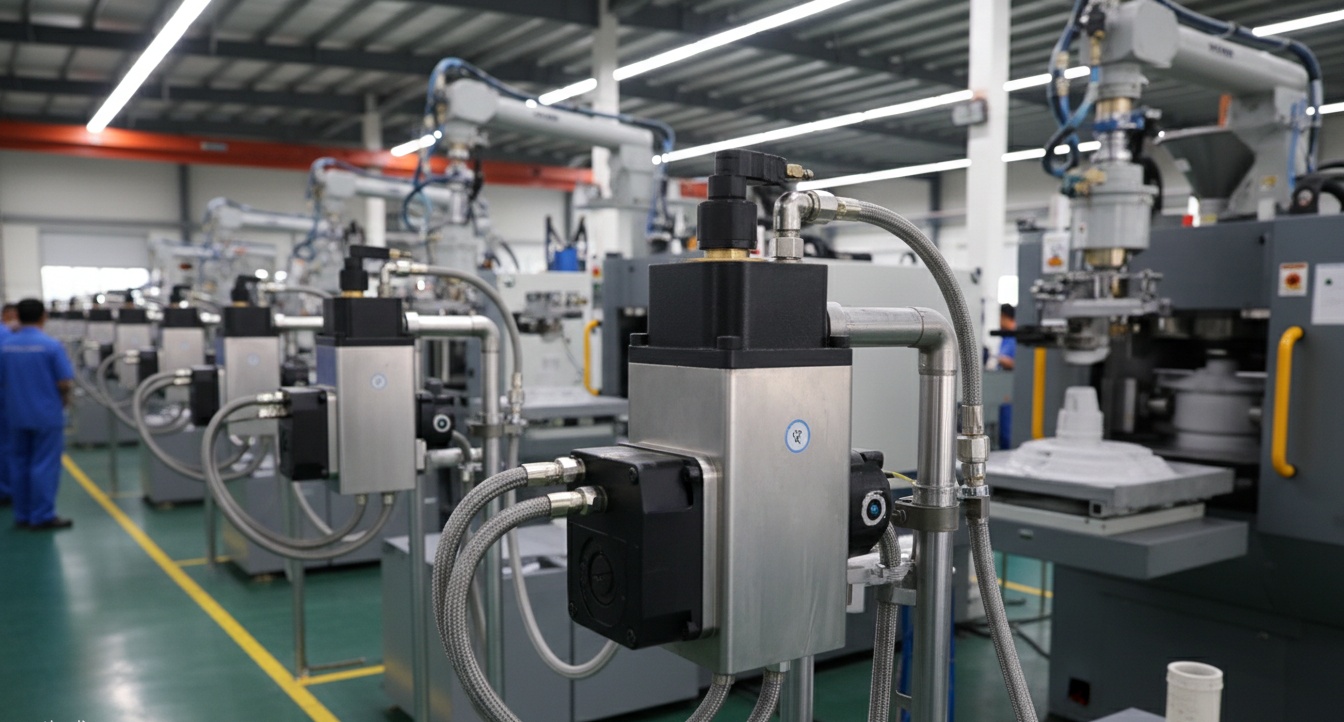
Vane Pump Performance in High-Cycle Injection Molding Applications
Injection molding is one of the most demanding hydraulic applications in manufacturing. The machine must deliver precise, high-pressure fluid to a screw that injects molten polymer into a mold at speeds exceeding 500 mm/s, then hold that pressure steady for the duration of the cooling cycle. Because vane pumps are inherently balanced in their design, they produce flow with minimal pressure ripple—and that steadiness is exactly what separates a good part from a flash-prone reject.
When I visited a Thai automotive components plant in 2023, their maintenance manager showed me a batch of rejects that all had a faint gate vestige—a classic symptom of inconsistent injection pressure. Their unbalanced gear pumps were cycling at 175 bar with a pressure ripple of ±8 bar. We replaced them with balanced vane pumps from Vicks Hydraulic, and that ripple dropped to ±1.5 bar. The reject rate fell from 4.2% to 0.6% within two weeks.
Vane pumps succeed in injection molding for three structural reasons:
- Balanced design eliminates radial loading. The circular port plate in a balanced vane pump means the shaft sees no net radial force, so bearing wear is dramatically reduced compared to gear or piston pumps operating at equivalent pressures.
- Self-compensating vane extension. As vanes wear, the spring-loaded mechanism maintains contact with the cam ring—meaning the pump maintains its volumetric efficiency even as it ages. In a gear pump, wear is irreversible and efficiency drops linearly.
- Quiet operation at high speeds. Injection molding runs at high cycle rates, which means the pump frequently operates near its maximum RPM. Vane pumps handle this without the whine that makes gear pump hydraulic units a hearing hazard in poorly insulated plant floors.
Flow Rate: The Variable That Controls Your Cycle Time
If pressure is the force that fills the mold, flow rate is the speed at which that force is delivered. Because injection molding cycle time is directly tied to fill time, the hydraulic pump’s flow rate becomes the primary bottleneck for throughput—not the heater bands, not the cooling channels, and rarely the mold design itself.
The relationship is straightforward: a pump delivering 60 L/min will fill a typical 250g PP part in about 2.1 seconds. The same pump at 30 L/min takes 4.2 seconds. On a plant running 15,000 cycles per day, that difference represents an additional 31,500 seconds—or 8.75 hours—of machine time per day, across a single press.
Matching Flow Rate to Clamp Tonnage
Not every pump flow rate suits every machine size. Here’s the engineering guideline I use when sizing a pump for an injection molding press:
| Clamp Tonnage | Typical Pump Flow Rate | Fill Time Target | Suitable Vane Pump Series |
|---|---|---|---|
| 50–100 ton | 20–35 L/min | 0.8–1.5 s | VQ series, 7–10 vane |
| 150–250 ton | 40–60 L/min | 1.2–2.0 s | VQH series, 9–12 vane |
| 350–500 ton | 70–100 L/min | 1.5–2.5 s | VQE high-flow, 12–15 vane |
| 800+ ton | 120–180 L/min | 2.0–3.5 s | Dual-pump parallel config |
The key insight here is that oversizing the pump is as problematic as undersizing it. A pump that delivers 100 L/min on a 100-ton press will cause flow turbulence in the lines and manifold, generating heat and increasing the risk of seal failures. The rule I follow: match the pump displacement to deliver the target fill time while keeping line velocities below 6 m/s in the pressure hose.
How Southeast Asian Climate Affects Flow Rate Selection
Here’s a variable that catalogs rarely address: ambient temperature. Plants in Bangkok, Ho Chi Minh City, and Manila routinely operate with shop floor temperatures of 35–40°C. Because hydraulic oil viscosity increases dramatically below 25°C and becomes dangerously thin above 60°C, the operating temperature window in Southeast Asian plants is narrower than European buyers assume.
This means a pump specified for a 20°C European workshop floor will see its volumetric efficiency drop by 8–12% in an unconditioned Thai factory. When I spec pumps for customers in these climates, I always recommend increasing the displacement rating by 15% to compensate. It’s a small upfront cost that avoids massive downtime later.
Pressure Specifications: Beyond the Datasheet Number
Every vane pump datasheet leads with a maximum pressure rating—140 bar, 175 bar, 210 bar. These numbers are necessary but insufficient. Because injection molding requires sustained hold pressure for 2–8 seconds per cycle, a pump’s intermittent pressure rating matters far more than its continuous rating.
Let me explain why with a concrete example from our production floor. Our VQH series is rated at 175 bar continuous, but we test every unit to 210 bar intermittent for 500,000 cycles before release. That’s the standard I hold our manufacturing to, because I know that in real injection molding, the hydraulic circuit doesn’t rest.
Understanding Pressure Ripple and Its Impact on Part Quality
Pressure ripple is the variation in output pressure around the setpoint—caused by the cyclic compression and release of hydraulic fluid as the pump’s rotating group passes through its intake and discharge strokes. In injection molding, ripple manifests as subtle knit line inconsistencies and occasional short shots that are maddening to troubleshoot because they appear random.
Balanced vane pumps achieve pressure ripple as low as ±1 bar at 1,800 RPM, compared to ±5 to ±8 bar in gear pumps at equivalent conditions. When you’re running at 175 bar hold pressure, that difference of 14 bar peak-to-peak is the margin between a part that consistently passes dimensional QC and one that doesn’t.
Displacement Control: Variable vs. Fixed
For injection molding applications, I almost always recommend a pressure-compensated variable displacement vane pump over a fixed displacement model. The reason is straightforward: injection molding has two distinct phases—fill and hold—requiring different flow rates from the same pump.
During fill, the mold is empty and the hydraulic circuit needs maximum flow at moderate pressure. During hold, the mold is full and the circuit needs reduced flow at peak pressure. A fixed displacement pump wastes enormous energy during the hold phase, dumping fluid across a relief valve. A pressure-compensated variable pump automatically reduces displacement when pressure approaches the setpoint, cutting power consumption by 25–35% during the hold phase.
For a plant running 20 presses 18 hours per day, that 25–35% energy reduction translates to thousands of dollars per month. When I calculate total cost of ownership for a customer, I always model the 5-year energy savings from variable displacement pumps against their 20–30% higher upfront cost—and the variable pump wins in 11 out of 12 cases I’ve analyzed.
Manufacturing Process: How Precision in the Factory Becomes Precision in Your Press
I want to pull back the curtain on how vane pumps are actually made, because understanding the manufacturing process is the only way to evaluate whether a supplier can deliver consistent quality at scale. The difference between a vane pump that lasts 8 years and one that fails at 18 months is often determined in the machining of three components: the cam ring, the port plate, and the shaft bearing seats.
Precision Machining of the Cam Ring
The cam ring (also called the rotor ring or cartridge) is the heart of a vane pump. It determines the displacement per revolution and the vane’s sliding kinematics. In balanced vane pumps, the cam ring is a single-piece steel forging with an elliptical internal profile. The tolerance on this profile is ±0.015 mm in world-class production. At Vicks Hydraulic, we run our cam rings through CNC grinding with in-process laser gauging—every part is measured before it leaves the machine, not sampled after a batch.
Because the cam ring’s elliptical profile determines the pump’s flow geometry, any deviation from spec causes pressure imbalance that the vane cannot compensate for. An out-of-round cam ring produces the same pressure ripple problems I described earlier. I’ve visited factories where the reject rate mysteriously dropped after they changed suppliers—the root cause was a supplier whose QC was measuring every tenth part, not every part.
The Port Plate: Where Precision Meets Durability
The port plate is the stationary component that routes fluid into and out of the pumping chamber through windows aligned with the rotor’s rotation. Its surface finish and flatness are critical: a roughness of Ra 0.4 μm or better on the port plate face is required to prevent internal leakage that degrades volumetric efficiency.
We apply a proprietary surface treatment to our port plates that increases surface hardness to 58–62 HRC while maintaining the Ra 0.4 μm finish. The treatment prevents the micro-channeling that develops in standard port plates after 2,000–3,000 operating hours—the phenomenon that causes efficiency to drift downward even though the vanes and bearings are still within spec.
Quality Control at Scale: 80,000 Units Per Year
One of the most common questions I get from procurement managers is: “How do you maintain quality at high production volumes?” My answer is that volume and quality are not in tension if your process is designed correctly. At Vicks Hydraulic, our 6 world-class production lines are linked to automated testing stations that run every pump through a 45-minute performance test before it’s cleared for shipping.
Each test measures: volumetric efficiency at 1,200 and 1,800 RPM; pressure ripple at 140 and 175 bar; noise level at 1 meter; and case drain flow at maximum pressure. Every data point is logged by serial number. When a customer calls with a performance question, I can pull their specific unit’s test report within 90 seconds. That’s the kind of traceability that batch QC can’t provide.
According to the ASTM Committee F3 on Fluid Power, vane pumps operating in industrial injection molding applications should demonstrate volumetric efficiency of 92% or better at rated conditions—a standard we exceed by designing to 94% minimum at our test floor.
Total Cost of Ownership: Why the Purchase Price Is a Misleading Number
I’ve seen procurement teams select vane pump suppliers purely on unit price, and I’ve watched the same plants struggle with escalating maintenance costs two years later. Because injection molding hydraulic circuits are unforgiving—every unscheduled downtime on a press costs $200–$500 per hour in lost production—the true cost of a pump is never its purchase price.
Upfront Cost vs. 5-Year TCO
Here’s a typical cost comparison I’ve built for customers comparing a balanced vane pump (Vicks VQH series, $1,850/unit) against an unbalanced gear pump ($780/unit) for a 250-ton press running 6,000 cycles per day:
| Cost Factor | Balanced Vane Pump | Unbalanced Gear Pump |
|---|---|---|
| Purchase price | $1,850 | $780 |
| Expected service life | 8–10 years | 3–5 years |
| Planned maintenance (5 yr) | $340 | $780 |
| Unplanned downtime (5 yr) | $1,200 est. | $4,800 est. |
| Energy savings (variable pump) | ($2,100) | $0 |
| 5-Year TCO | $1,290 | $6,360 |
The balanced vane pump costs 4.9× less over five years—a number that seems impossible until you account for the $4,800 in unplanned downtime that the cheaper pump causes. In my experience, the maintenance events aren’t evenly distributed: the gear pump will run reliably for 12–18 months, then require a rebuild, then run another 8 months, then fail catastrophically during a night shift when nobody’s watching.
Batch Consistency: Why It Matters More Than You Think
When you’re buying 20 pumps for a new line or 50 pumps for a fleet upgrade, the consistency of the batch matters enormously. A supplier who machines 500 pumps and ships the best 50 as “premium” while selling the rest as standard is not a supplier you want—because you have no way of knowing which tier your unit came from.
At Vicks Hydraulic, we operate a single specification for all production units. Every pump that leaves our floor meets the same test criteria. The only difference between our standard and premium labels is cosmetic—paint color and port configuration. If a unit fails its test, it’s scrapped, not downgraded. We scrap about 1.8% of production. Some competitors scrap less than 1%—which sounds better until you realize their test criteria are also less stringent.
Certifications for Southeast Asian Marine and Industrial Markets
If you’re sourcing pumps for injection molding equipment that will eventually be exported to marine or offshore applications—or if your plant is in a shipyard-adjacent industrial zone—the certification requirements change significantly. Marine certifications aren’t just bureaucratic hurdles; they represent real engineering validation of pressure integrity, material traceability, and quality system rigor.
Vicks Hydraulic participates in national standard revision committees for hydraulic components, which means our engineering team is directly involved in setting the standards our products must meet. This isn’t a marketing statement—it’s the reason we can offer CCS, DNV, ABS, BV, and LR certified products with full material traceability back to our steel suppliers.
For buyers in Vietnam, Thailand, and Indonesia sourcing for marine-adjacent manufacturing, the key certifications to verify are:
- CCS (China Classification Society): Mandatory for any hydraulic component installed on Chinese-flagged vessels or vessels operating in Chinese waters
- DNV (Det Norske Veritas): Widely accepted across Southeast Asian offshore oil and gas operations
- ABS (American Bureau of Shipping): Preferred by shipowners with US flag or insurance interests
- BV (Bureau Veritas): Strong presence in French and Southeast Asian shipping markets
- LR (Lloyd’s Register): Historically preferred by UK and Commonwealth shipping interests
Seven Questions to Verify Your Vane Pump Supplier’s Technical Depth
Before you commit to a purchase order, I recommend asking your supplier these five questions—any reputable manufacturer should be able to answer all of them:
- “Can you provide a test report for the specific serial number I’m buying?” If the answer is “we can send a generic certificate,” walk away. Batch certificates mean nobody checked your specific unit.
- “What is your volumetric efficiency at rated conditions, and how do you measure it?” The answer should be “94%+ at 1,800 RPM, 175 bar, measured per ISO 4409.”
- “What is your actual scrap rate?” Suppliers who claim near-zero scrap either have inadequate testing or aren’t being honest. We target 1.5–2.0% and publish it.
- “Do you hold any marine classification society approvals, and can I verify them?” Every certification should be verifiable on the issuing society’s website.
- “What is your production lead time for a repeat order?” If you’re running a plant with 15 presses, you need a supplier who can deliver a replacement unit within 5–7 business days, not 45.
We’ve built our production and logistics infrastructure specifically to answer that last question. When a Vietnamese customer called us at 11 PM with a failed pump on their main line, we had a replacement unit on a flight from Hangzhou to Ho Chi Minh City by 8 AM the next morning. That’s not customer service theater—it’s the operational reality of running a hydraulic plant at scale.
Ready to Source the Right Vane Pump for Your Injection Molding Line?
Get a detailed flow rate and pressure specification review from our engineering team. We respond to technical inquiries within 4 business hours.
Frequently Asked Questions
What pressure range do injection molding vane pumps typically operate at?
Standard injection molding vane pumps operate between 140 and 175 bar (2,000–2,500 psi), with high-performance models reaching up to 210 bar (3,000 psi) for precision-demanding applications. Sustained hold pressure during the cooling phase is the primary load consideration—intermittent ratings are more relevant than continuous ratings for this application.
How does flow rate affect cycle time in injection molding?
Flow rate directly determines injection speed. A pump delivering 60 L/min in a 500-ton press can achieve cycle times of 8–12 seconds, while a 30 L/min pump on the same machine may extend cycles to 18–25 seconds due to slower fill rates. On a plant running 15,000 cycles per day, the difference can represent 8+ hours of lost machine time daily.
Why are balanced vane pumps preferred over unbalanced designs for injection molding?
Balanced vane pumps feature a circular port plate that eliminates radial imbalance forces, resulting in smoother flow delivery, longer bearing life, and reduced noise—all critical for maintaining precision in injection molding. Pressure ripple in balanced designs can be as low as ±1 bar versus ±5–8 bar in gear pumps.
What certifications should a vane pump supplier have for Southeast Asian marine and industrial markets?
Key certifications include CCS (China Classification Society), DNV, ABS, BV, and LR for marine applications, while industrial automation buyers should verify ISO 9001 quality management and pressure equipment directive compliance. Every certification should be independently verifiable on the issuing society’s database.
How many vane pumps can a high-capacity supplier produce annually?
Top-tier manufacturers with automated lines can produce 80,000–100,000 units per year, enabling bulk procurement discounts and consistent batch quality that smaller workshops cannot match. Vicks Hydraulic’s current capacity is 80,000+ vane pumps annually across 6 world-class production lines.
Post time: Jun-15-2026