- A servo-hydraulic injection molding machine consumes roughly 40–80 % less energy than a conventional fixed-pump hydraulic press on the same parts and cycle time, depending on shot size, hold profile, and idle ratio.
- The servo premium (the gap between servo and conventional machine purchase price) typically pays back inside the first 18–36 months of operation, primarily from the electricity bill.
- Conventional machines still earn their place on very high-tonnage long-cycle applications and on plants with continuous three-shift operation where the hydraulic pump is rarely idle.
- The 5-year total cost of ownership has four components: capital, energy, maintenance, and scrap/downtime. Servo machines win on energy and downtime; conventional can win on capital and on certain maintenance items.
Why the Cheaper Machine Can Cost More
A molding plant manager in Dongguan had just replaced an aging 250-ton conventional hydraulic press with a brand new one of the same specification. The replacement press cost less than half of an equivalent servo-hydraulic machine. Eighteen months later, the plant’s electricity bill on the molding floor was 6 % higher than the year before — the conventional press was consuming noticeably more power than the older one it had replaced. By the end of year three, the cumulative electricity cost of the conventional press had exceeded the price premium of the equivalent servo machine, before factoring in the noise, the cooling demand, and the oil-change interval. The plant eventually retrofitted a servo system to the existing press rather than replace it — and saw the energy consumption fall by half within the first full month.
The choice between servo-hydraulic and conventional hydraulic injection molding is not a simple “newer is better” decision. It is a 5-year total cost of ownership calculation that depends on the machine’s tonnage, the cycle profile, the operating hours, and the local electricity cost. This article walks through that calculation in detail — what the energy gap actually looks like, what the maintenance gap looks like, where the conventional machine still earns its premium, and how to put the numbers together for a specific installation.
How a Conventional Hydraulic Press Uses Power
A conventional fixed-pump hydraulic injection molding machine runs an electric motor at constant speed, typically connected directly to the mains without a variable frequency drive. The motor drives a fixed-displacement hydraulic pump — usually a vane pump or an axial piston pump — that delivers a constant flow of hydraulic fluid at a pressure proportional to the load. The machine’s directional control valves, proportional valves, and servo valves modulate flow and pressure to match the mold close, injection, hold, plasticizing, and mold open phases of the cycle.
The motor runs at full speed throughout the cycle, even when the hydraulic demand is low. During the hold phase — when the part needs only a fraction of the peak flow to maintain cavity pressure — the excess flow is bypassed through a relief valve back to the tank, dissipating the energy as heat. During the cooling phase — when no hydraulic flow is needed at all except for a small amount of clamp tonnage — the pump is still turning at full speed, still drawing full power, and the bypass valve is still dumping the excess flow. This is the structural inefficiency of a fixed-pump system: the motor and the pump run at one operating point, and any mismatch between that point and the actual hydraulic demand is lost as heat.
The heat itself is not free. The hydraulic oil must be cooled to maintain viscosity and prevent oxidation, which means a separate oil cooler (water-cooled or air-cooled) is running continuously, drawing additional power. The cooling demand on a 250-ton conventional press in a 30 °C ambient is substantial — typically in the range of 15–25 % of the machine’s electrical input on a three-shift operation.
How a Servo-Hydraulic System Uses Power
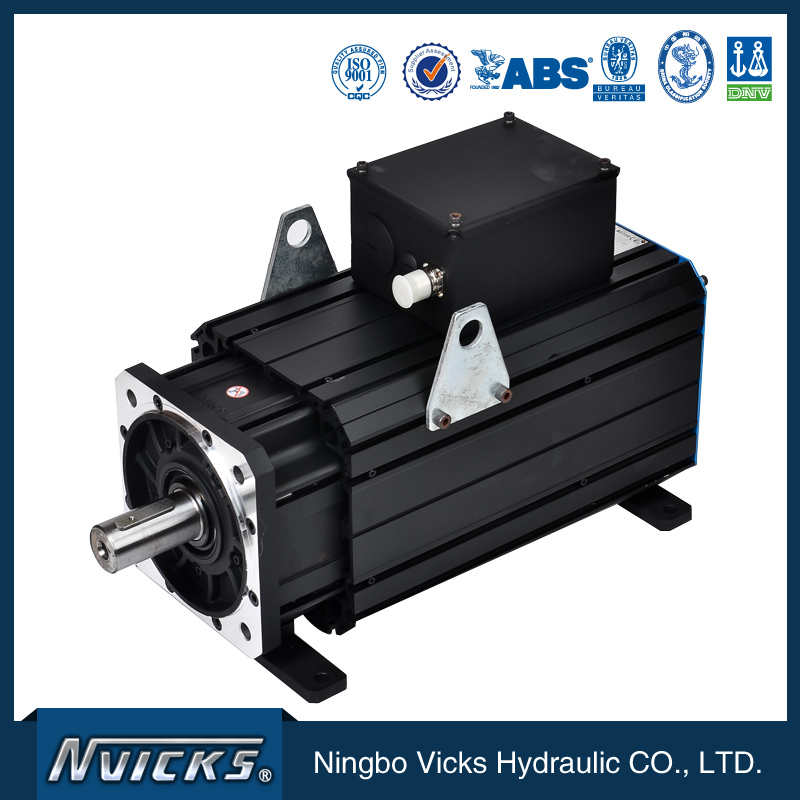
A servo-hydraulic system replaces the constant-speed motor with a variable-speed servo motor — typically a permanent magnet synchronous motor (PMSM) — driven by a variable-frequency drive (VFD). The servo drive controls the motor speed to match the hydraulic demand in real time. When the cycle is in high-flow phase (mold close, injection, plasticizing), the motor ramps to high speed. When the cycle is in low-flow phase (hold, cooling), the motor ramps down to a low speed that just meets the actual hydraulic demand. When the cycle is at rest (no movement), the motor can stop entirely or run at near-zero speed.
The result is that the servo-hydraulic machine draws only the power it needs for each phase of the cycle. The motor does not run at constant speed, the pump does not bypass excess flow, and the bypass-valve heat dissipation that defines conventional press inefficiency is largely eliminated. Bosch Rexroth, Yuken, and other hydraulic system manufacturers publish application notes with measured servo vs fixed-pump energy consumption comparisons; the typical range across the published data is 40–80 % energy reduction on parts with significant hold and cooling phases, and 20–40 % reduction on parts with shorter hold and cooling phases.
The savings are not uniform across the cycle. The largest savings are on the cooling phase (the longest low-demand phase in most cycles), the second-largest on the hold phase, and the smallest on the injection phase (where peak flow is needed and the servo system is also running at peak). On a typical 250-ton press molding a 200 g ABS part with a 25-second cycle, the cooling phase is roughly 50 % of the cycle, the hold phase 15 %, the injection and plasticizing phases 25 %, and the open/close phases 10 %. The cooling phase is where the servo machine saves the most.
The Servo Premium: Capital Cost vs Operating Cost
A servo-hydraulic injection molding machine typically costs 30–60 % more than an equivalent conventional machine of the same tonnage and shot size. The exact premium depends on the machine builder, the servo system supplier, and the machine specification. For a representative 250-ton press, the servo premium in the present market is a five-figure increment — meaningful, but not transformational for a plant manager evaluating the purchase.
The premium is recovered through the energy savings. To put a number on the payback, three inputs are needed: the energy savings per cycle, the cycles per shift, and the electricity cost. The Vicks servo system product line is configured for vane-pump-based servo systems on injection molding applications, with system-level energy savings in the published range. For a 250-ton machine on a 25-second cycle running 6,000 hours per year (roughly two-shift continuous), the annual electricity savings fall in a meaningful range — large enough to repay the servo premium inside the first 18–36 months of operation, depending on the local electricity tariff.
Plastics News and Plastics Technology have published multi-year survey data showing that servo-hydraulic machines now dominate new press sales in the 50- to 800-ton range across North America, Europe, and East Asia, with conventional presses increasingly confined to specific high-tonnage and specialty applications. The market shift is itself an indication of the payback math: if the servo premium were not recovered on a 3-year horizon, the market would not have shifted.
Maintenance: Where the Two Systems Diverge
The maintenance profile of a servo-hydraulic system is different from a conventional press in three areas.
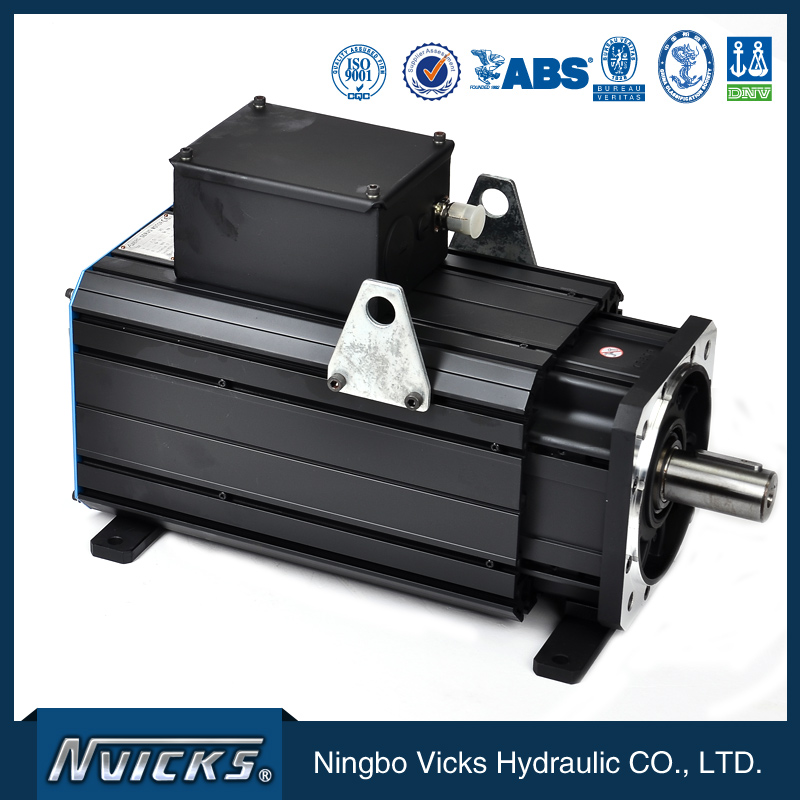
First, the servo motor itself has lower maintenance than an induction motor of equivalent power — no brushes, no slip rings, and the permanent magnet rotor does not require excitation current. The VFD has its own maintenance profile (cooling fans, electrolytic capacitors with a service life of 8–12 years), but the active components of the motor itself are designed for a long service life with no scheduled maintenance.
Second, the hydraulic pump in a servo system runs at variable speed and typically at lower average RPM than a fixed pump on a conventional press. Lower average RPM means lower bearing wear, lower thermal cycling, and longer seal life. Field data published by MoldMaking Technology and various hydraulic pump suppliers consistently show that vane pumps in variable-speed service have a service life meaningfully longer than the same vane pump in fixed-speed service on a comparable press.
Third, the oil cooler on a servo-hydraulic press runs less continuously because the bypass-valve heat dissipation is reduced. The cooler fan or the cooling water pump cycles on and off based on actual oil temperature rather than running continuously. Lower cooler run time means lower cooler maintenance and lower parasitic electrical draw from the cooling system.
The conventional press, by contrast, has higher bearing wear on the motor and the pump, more frequent seal replacement, and higher thermal stress on the oil that accelerates oil oxidation and shortens the oil change interval. On a three-shift conventional press, the oil change interval is typically 4,000 hours; on a servo-hydraulic press on the same duty cycle, the interval extends to 6,000–8,000 hours. The oil cost over the 5-year window is meaningful — a 250-ton press holds 400–600 liters of hydraulic oil, and the oil plus the disposal cost on each change is a four-figure item in many markets.
Noise and Working Environment
The conventional press runs the motor and pump at full speed continuously, generating a steady acoustic signature in the 78–85 dB(A) range at the operator station. The servo-hydraulic press drops the motor and pump speed during the hold and cooling phases, dropping the noise contribution from the hydraulic system significantly. The total machine noise drops to the 65–72 dB(A) range, which is the difference between a noise level that requires hearing protection for full-shift exposure and one that is at the threshold of the regulatory limit.
The noise reduction is not a direct cost saving, but it is a real benefit in markets with strict occupational noise regulations (EU OSH Directive 2003/10/EC, US OSHA 29 CFR 1910.95, China GBZ 2.2) where the conventional press requires hearing protection for operators. The cost of hearing protection, audiometric testing, and noise-control infrastructure on the plant floor is not usually accounted for in the energy-only payback calculation — but it is a real cost on a 5-year horizon.
Precision and Repeatability
The servo-hydraulic system has a precision advantage that does not always appear in the energy payback calculation but shows up in the scrap rate. Closed-loop pressure control with a pressure sensor and a variable-speed pump holds cavity pressure within a tighter band than a fixed-pump system with proportional valves. On tight-tolerance parts — optical, medical, packaging — the scrap rate improvement alone can pay for the servo premium over a 5-year horizon, independent of the energy savings.
Society of Plastics Engineers publishes technical papers on servo-hydraulic injection molding precision, including shot-to-shot weight variation and dimensional repeatability data. The published precision advantage is small on parts with relaxed tolerances (typically a 10–20 % reduction in shot-to-shot variation) and meaningful on tight-tolerance parts (a 30–50 % reduction).
Where Conventional Hydraulic Still Wins
The conventional fixed-pump hydraulic press is not obsolete. Three categories of application still favor it.
- Very high-tonnage machines (above 1,500 tons). The servo system premium scales roughly linearly with motor power; at very high tonnage, the absolute servo premium becomes large enough that the payback period extends. Some specialty high-tonnage applications also demand specific dynamic response characteristics that a variable-speed system does not deliver as cleanly as a fixed-pump system with a large accumulator.
- Long-cycle, continuous-duty applications. If the press is running a 90-second cycle on a thick-walled part with a long hold phase and continuous three-shift operation, the servo machine still saves energy but the savings are amortized over a smaller number of cycles per year. The payback period extends, and the conventional machine becomes more competitive.
- Capital-constrained installations. A plant with limited capital budget and short investment horizon may rationally choose the conventional press on capital cost alone, particularly if the local electricity cost is low.
Outside these three categories, the servo-hydraulic system is the dominant choice on a 5-year total cost of ownership basis. The market data confirms this: the servo share of new press installations is the majority across most regions and most tonnage classes, with the exception of the high-tonnage specialty applications noted above.
Building the 5-Year TCO Worksheet
A 5-year total cost of ownership comparison between a servo-hydraulic and a conventional press has four cost components: capital, energy, maintenance, and scrap/downtime. Each is calculated differently.
The capital cost is the purchase price of the machine plus installation, freight, training, and commissioning. The servo premium is the difference between the two machines’ capital cost.
The energy cost is the cumulative kWh over 5 years, multiplied by the local electricity tariff. The energy savings of the servo machine is the difference between the conventional press energy and the servo press energy over the same period.
The maintenance cost is the cumulative parts and labor over 5 years. The servo machine typically has lower pump-related maintenance, lower oil-change frequency, and lower cooler maintenance. The conventional machine has higher bearing wear on the motor and the pump and higher oil consumption.
The scrap and downtime cost is the value of parts scrapped and the value of production lost during unplanned downtime. The servo machine has tighter pressure control and lower scrap rate; the conventional machine has higher scrap rate on tight-tolerance parts but no disadvantage on relaxed-tolerance parts.
The 5-year net savings of the servo machine is the sum of the energy savings plus the maintenance savings plus the scrap/downtime savings, minus the servo premium. If the result is positive, the servo machine wins. If negative, the conventional machine wins on a 5-year horizon.
The Decision Framework: Five Questions to Ask Before Specifying
For a specific installation, the servo vs conventional decision can be reduced to five questions.
- What is the cycle profile? Long hold and cooling phases favor servo. Short cycles with high flow demand throughout favor conventional or servo with little difference.
- What is the operating schedule? Continuous three-shift operation amplifies the energy savings. Single-shift operation with long idle periods dilutes the savings because the press is off for most of the day.
- What is the local electricity cost? High-tariff markets (Europe, Japan, much of East Asia) accelerate the payback. Low-tariff markets (parts of the Middle East, North America with abundant natural gas) slow the payback.
- What is the part tolerance? Tight-tolerance parts (medical, optical, certain packaging) amplify the servo advantage through lower scrap. Relaxed-tolerance parts neutralize this component of the savings.
- What is the capital constraint? If the capital premium cannot be financed at a reasonable rate, the payback period matters even if the project-level economics are positive.
For a typical 250-ton press on a 25-second cycle running two-shift continuous in a moderate-tariff market, the payback is in the 18–36 month range. For a 100-ton press on a 12-second cycle running single-shift in a low-tariff market, the payback may extend to 4 years or more. The Vicks project payback worksheet incorporates all five variables and produces a project-specific recommendation.
FAQ: Servo vs Conventional Hydraulic Injection Molding
How much energy does a servo-hydraulic machine save compared to a conventional press?
How long does it take for the servo premium to pay back?
Are there any applications where conventional hydraulic is still better?
Does the servo system require special operator training?
What maintenance is different between servo and conventional?
Can a conventional press be retrofitted with a servo system?
Is the servo system noisier than the conventional press?
What is the typical 5-year TCO difference between a servo and a conventional press?
Need a project-specific 5-year TCO and payback calculation for a servo vs conventional press comparison?
Post time: Sep-17-2026