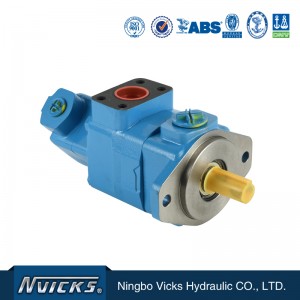
Why Vane Pump Nameplates Look Like Cryptic Codes
Vane pump nameplates look like cryptic codes because they are. The T6E / T7B / T7BS codes on the Denison T-series vane pumps compress 4 dimensions into a 4-character code, and the engineering team at Denison Hydraulics (now part of Eaton) designed the nomenclature in the 1960s when every character on a hydraulic nameplate cost extra stamping time. The 4 dimensions are: the pump series (T6 / T7 / V / VQ / V10 / V20 / SQP / PV2R), the pump type (single-stage vs double-stage), the displacement range (in cc/rev), and the shaft + porting configuration (the suffix letter dictionary). The compression makes the code cryptic for first-time buyers, but the compression also makes the code standardized across the entire Denison T-series product line, which is why the T6E / T7B / T7BS codes have survived 60+ years of industry use.
The Denison T-series nomenclature was adopted by every major Chinese vane pump manufacturer because the codes are the industry shorthand for OEM Vickers equivalent procurement. Ningbo Vicks Hydraulic Co., Ltd. was founded in 2007 as a national high-tech enterprise in Ningbo, China, and the company manufactures the full Denison T-series nomenclature (T6 / T7 / V / VQ / V10 / V20 / SQP / PV2R) across 6 world-leading production and testing lines with an annual output of more than 80,000 pcs vane pump and 10,000 sets energy-saving servo system. The company is the presiding unit of vane pump industry standard revision in China, which means the Chinese national vane pump standard uses the Denison T-series nomenclature as the reference. The 5 IACS classification society certifications (Chinese CCS / Norway DNV / American ABS / French BV / British LR) cover the full T-series nomenclature for marine and offshore applications.
The Denison T-series heritage means that the T6E / T7B / T7BS codes are not arbitrary letter combinations; they are decoded by reading each character in order, and the decoding follows the 4-segment nomenclature. The first character (T) identifies the series heritage; the second character (6 or 7) identifies the generation within the series; the third character (E / B / S / C / M) identifies the shaft or porting configuration; the fourth character (when present) identifies a secondary configuration such as side porting or marine specification. Ningbo Vicks Hydraulic maintains the Denison T-series decoding standard across the T6 / T7 / V / VQ / V10 / V20 / SQP / PV2R series, which means a procurement manager who learns the 4-segment decoding once can apply it across 8 series and 80+ model codes.
Anatomy of a Vane Pump Model Code
A vane pump model code has 4 segments: Series / Type / Displacement / Shaft + Porting. Each segment communicates a specific dimension of the pump specification, and the 4 segments together identify a unique pump configuration. The 4-segment structure is consistent across the Denison T-series and the Denison V-series, which means the decoding skill transfers across series.
| Segment | Position in Code | What It Identifies | Example (T6E-045-1R11) | Example (T7B-B28-1R11) |
|---|---|---|---|---|
| Segment 1: Series | Character 1-2 | Series heritage (T6 / T7 / V / VQ / V10 / V20 / SQP / PV2R) | T6 = Denison T6 series single-stage | T7 = Denison T7 series single-stage |
| Segment 2: Type | Character 3 | Porting / mounting configuration suffix | E = through-drive rear porting | B = SAE 4-bolt flange mounting |
| Segment 3: Displacement | Number after type | Displacement in cc/rev (3-digit code) | 045 = 45 cc/rev | B28 = 28 cc/rev (B prefix for B-frame) |
| Segment 4: Shaft + Porting detail | After displacement | Shaft type + porting detail + design series | 1R11 = SAE spline shaft + standard design series 11 | 1R11 = SAE spline shaft + standard design series 11 |
The table shows the 4-segment structure for two common vane pump configurations: T6E-045-1R11 (T6 series single-stage, 45 cc/rev displacement, through-drive rear porting, SAE spline shaft, standard design series 11) and T7B-B28-1R11 (T7 series single-stage, 28 cc/rev displacement, SAE 4-bolt flange mounting, SAE spline shaft, standard design series 11). The 4-segment structure is consistent across the Denison T-series and the Denison V-series, and the decoding skill transfers across series. Ningbo Vicks Hydraulic provides the full 4-segment decoding in the vane pump nameplate decoding guide, with the per-series model code cross-reference table available on request.
What “T6″ Means: Denison T-Series Single Pump Heritage
T6 in a vane pump model code identifies the Denison T6 series single-stage vane pump. The T6 series was originally designed by Denison Hydraulics (now part of Eaton) as the 6th generation of the T-series single-stage vane pump product line. The T6 series has a displacement range of 10-100 cc/rev across the standard models, with the specific displacement variants at 10 / 14 / 17 / 22 / 28 / 35 / 45 / 61 / 75 / 100 cc/rev. The T6 series has a maximum working pressure of 175 bar for the standard models and 210 bar for the high-pressure models (T6H suffix or T6HP variant). The T6 series is the most widely installed single-stage vane pump in the field, with millions of units in service across injection molding machines, press machines, marine deck cranes, mobile hydraulics, and industrial automation.
The T6 series offers 4 porting configurations: E (through-drive rear porting) / B (SAE 4-bolt flange mounting) / C (thread mounting) / M (marine specification). The E configuration is the most common for OEM Vickers equivalent procurement because the through-drive rear porting allows a second pump to be mounted in tandem, which is the typical installation for injection molding machines where a high-pressure pump and a high-flow pump are stacked. The B configuration is the most common for direct flange mounting to a manifold or a sub-plate. The C configuration is the least common and is used when the pump is mounted to a custom manifold via threaded ports. The M configuration is the marine specification with the additional surface treatment and the DNV / CCS / ABS / BV / LR type approval.
Ningbo Vicks Hydraulic manufactures the T6 series across the 4 porting configurations (E / B / C / M) with the 10 displacement variants (10 / 14 / 17 / 22 / 28 / 35 / 45 / 61 / 75 / 100 cc/rev). The T6 series is one of the 6 world-leading production lines at the Ningbo facility, with the cartridge kit (spare parts) lines for each T6 displacement variant. The T6 series has been batch-supplied to the marine industry and the military industry under the 5 IACS classification society certifications, with the marine specification (M suffix) carrying the active type approval certificates. The strategic partnership with Taiwan Delta, Austria KEBA, Phase servo motor, Yunshen servo motor, Haitian drive, and Sumitomo pump covers the integrated servo system offerings that incorporate the T6 series as the hydraulic pump element.
What “T7″ Means: T7B vs T7BS Twin vs Single Pump
T7 in a vane pump model code identifies the Denison T7 series single-stage vane pump, which is the 7th generation (one generation newer than T6) in the T-series product line. The T7 series has a higher displacement range (20-160 cc/rev across the standard models, vs the T6 series 10-100 cc/rev) and a higher working pressure rating (210 bar standard, up to 250 bar for the high-pressure models, vs the T6 series 175-210 bar). The T7 series offers 5 porting configurations: E (through-drive rear porting) / B (SAE 4-bolt flange mounting) / S (side porting) / C (thread mounting) / M (marine specification), which is one more configuration than the T6 series (the S suffix for side porting is a T7-series addition).
The T7B configuration decodes as T7 series single-stage + SAE 4-bolt flange mounting (B suffix). T7B is the standard flange-mounted vane pump for OEM Vickers equivalent procurement with 20-160 cc/rev displacement and 210 bar working pressure. The T7B configuration is widely used in injection molding machines, marine winches, ship deck cranes, and heavy-duty mobile hydraulics. The flange mounting allows the pump to be directly mounted to a SAE 4-bolt flange manifold or a sub-plate, which is the typical installation for hydraulic systems that require a compact, high-pressure pump.
The T7BS configuration decodes as T7 series single-stage + SAE 4-bolt flange mounting (B suffix) + side porting (S suffix). T7BS is the compact flange + side porting configuration, which is typically used when the pump is mounted to a manifold or a sub-plate and the port connections are routed to the side of the pump body rather than the rear of the pump body. The T7BS configuration is one of the most common configurations in injection molding machine hydraulic systems because the side porting allows the hydraulic lines to be routed in a more compact arrangement within the machine frame. The T7BS configuration is also used in marine deck cranes and mobile hydraulics where the installation envelope is constrained.
What the Suffix Letters Mean (E / B / S / C / M 5 )
The suffix letters in a vane pump model code identify the porting and mounting configuration, and the 5 suffix letters (E / B / S / C / M) cover the standard configurations across the T6 and T7 series. Each suffix letter maps to a specific porting or mounting pattern, and the suffix letter is the third character in the model code (after the series identifier T6 or T7). The suffix letter dictionary is consistent across the T6 and T7 series, with the addition of the S suffix (side porting) as a T7-series-only option.
| Suffix | Full Name | Porting / Mounting Configuration | T6 Series? | T7 Series? | Typical Application |
|---|---|---|---|---|---|
| E | Through-drive rear porting | Rear ported with through-drive for tandem mount | Yes | Yes | Injection molding machine tandem pump stack |
| B | SAE 4-bolt flange mounting | SAE 4-bolt flange mount with through-drive capability | Yes | Yes | Direct flange mount to manifold or sub-plate |
| S | Side porting | Side ported (no through-drive) | No | Yes | Manifold mount with side port routing |
| C | Thread mounting | Threaded port mounting (custom manifold) | Yes | Yes | Custom manifold with threaded port connections |
| M | Marine specification | Marine surface treatment + DNV / CCS / ABS / BV / LR type approval | Yes | Yes | Marine and offshore hydraulic systems |
The table shows the 5 suffix letters and their porting / mounting configurations. The E suffix (through-drive rear porting) is the most common for tandem pump stacks where a high-pressure pump and a high-flow pump are mounted together via a through-drive adapter. The B suffix (SAE 4-bolt flange mounting) is the most common for direct flange mount to a manifold or a sub-plate, which is the typical installation for OEM Vickers equivalent procurement. The S suffix (side porting) is a T7-series-only option that allows the pump to be mounted with side port routing, which is more compact than the through-drive rear porting variant. The C suffix (thread mounting) is the least common and is used for custom manifold installations with threaded port connections. The M suffix (marine specification) is the marine-rated variant with the additional surface treatment and the active type approval certificates from the 5 IACS classification societies.
Cartridge Kit Model Codes: T6ERK / T7BKB / T7BSKB
The cartridge kit model code follows the same 4-segment nomenclature as the complete pump model code, with the K suffix identifying the cartridge kit (spare parts) variant. The cartridge kit typically includes the rotor + vanes + ring set + balance plate, which are the wear parts that need replacement after the pump’s service life. The cartridge kit model code uses the first 3 segments of the pump model code (Series / Type / Displacement) and adds the K suffix at the end to identify the cartridge kit variant. The cartridge kit model codes for the 3 common configurations are: T6ERK for T6 series through-drive + standard kit; T7BKB for T7 series flange mount + SAE flange kit; T7BSKB for T7 series flange + side porting + SAE flange kit.
| Cartridge Kit Code | Segment 1: Series | Segment 2: Type | Segment 3: Kit Suffix | Includes | Typical Replacement Cycle |
|---|---|---|---|---|---|
| T6ERK | T6 series | E (through-drive rear porting) | RK (R = rotor + vanes, K = standard kit) | Rotor + vanes + ring set + balance plate | 8,000-12,000 hours |
| T7BKB | T7 series | B (SAE 4-bolt flange) | KB (K = standard kit, B = SAE flange variant) | Rotor + vanes + ring set + balance plate + SAE flange seal kit | 8,000-12,000 hours |
| T7BSKB | T7 series | B (SAE 4-bolt flange) + S (side porting) | SKB (S = side port, K = standard kit, B = SAE flange variant) | Rotor + vanes + ring set + balance plate + SAE flange seal kit + side port seal kit | 8,000-12,000 hours |
The table shows the 3 cartridge kit model codes (T6ERK / T7BKB / T7BSKB) and their contents. The cartridge kit is the standard spare parts package for the wear components of the vane pump, and the kit model code allows the procurement manager to order the correct replacement kit without confusion. The typical replacement cycle for the cartridge kit is 8,000-12,000 operating hours, depending on the operating pressure, the fluid cleanliness, and the duty cycle. Ningbo Vicks Hydraulic provides cartridge kit model codes for all T6 / T7 series spare parts, with the kit model cross-reference table available on request for OEM Vickers equivalent procurement.
5 Nameplate Decoding Scenarios for Procurement
5 nameplate decoding scenarios cover the typical procurement decisions for OEM Vickers equivalent sourcing. Each scenario has a specific decoding path and a specific procurement action. The 5 scenarios are: replacement of a worn pump, retrofit of an existing system, new system design, spare parts inventory, and marine classification upgrade.
| Scenario | Nameplate Decoding Path | Procurement Action |
|---|---|---|
| Replacement of a worn pump (existing OEM pump fails) | Read the existing pump nameplate; identify the full 4-segment code; match to the Vicks Hydraulic equivalent model | Order the complete pump (not just the cartridge kit) with the same model code, the same displacement, and the same porting configuration |
| Retrofit of an existing system (upgrade T6 to T7) | Read the existing T6 model code; identify the T7 equivalent displacement + porting; verify the flange and shaft dimensions match | Order the T7 equivalent pump with the same flange mounting pattern; verify the through-drive adapter matches the existing tandem stack |
| New system design (greenfield installation) | Specify the displacement, the working pressure, the porting configuration, and the shaft type; select the T6 or T7 series based on the pressure rating requirement | Order the pump with the full 4-segment model code; specify the SAE spline shaft or the keyed shaft based on the coupling selection |
| Spare parts inventory (preventive maintenance) | Identify the cartridge kit model code from the pump nameplate; maintain a stock of 1 cartridge kit per 3 pumps in service | Order the cartridge kit (T6ERK / T7BKB / T7BSKB / etc.) with the kit model code and the production lot reference |
| Marine classification upgrade (add DNV / CCS to existing pump) | Identify the existing pump model code; verify whether the M suffix (marine specification) is available for the displacement variant | Order the M suffix variant with the active type approval certificate; verify the certificate number via the IACS member society portal |
The table shows the 5 nameplate decoding scenarios and the procurement actions. For the replacement of a worn pump scenario, the procurement action is to order the complete pump with the same model code (not just the cartridge kit), because the pump body and the shaft may also be worn beyond the cartridge kit replacement scope. For the retrofit scenario, the procurement action is to verify the flange and shaft dimensions match the existing installation, because the T6 to T7 retrofit changes the mounting pattern slightly. For the new system design scenario, the procurement action is to specify the full 4-segment model code with the displacement, the working pressure, the porting configuration, and the shaft type. For the spare parts inventory scenario, the procurement action is to maintain a stock of cartridge kits based on the number of pumps in service. For the marine classification upgrade scenario, the procurement action is to order the M suffix variant with the active type approval certificate.
Vane Pump Displacement Reference Table (T6 / T7 / V10 / V20 4 )
The displacement reference table covers the 4 most common vane pump series for OEM Vickers equivalent procurement: T6 / T7 / V10 / V20. The displacement reference allows the procurement manager to cross-reference the displacement between series and select the right pump for the application. The displacement is in cc/rev, and the typical operating pressure is in bar.
| Series | Displacement Variants (cc/rev) | Max Working Pressure (bar) | Porting Configurations | Typical Application |
|---|---|---|---|---|
| T6 series | 10 / 14 / 17 / 22 / 28 / 35 / 45 / 61 / 75 / 100 | 175 standard / 210 high-pressure | E / B / C / M (4 options) | Injection molding machines, press machines, mobile hydraulics |
| T7 series | 20 / 28 / 35 / 45 / 50 / 61 / 75 / 100 / 125 / 160 | 210 standard / 250 high-pressure | E / B / S / C / M (5 options) | Marine winches, ship deck cranes, heavy-duty mobile hydraulics |
| V10 series | 11 / 18 / 25 / 33 / 41 / 47 / 55 / 66 / 76 / 93 | 175 standard / 210 high-pressure | Single + Double pump variants | Machine tools, industrial automation, plastic machinery |
| V20 series | 22 / 36 / 50 / 66 / 82 / 94 / 110 / 132 / 152 / 186 | 175 standard / 210 high-pressure | Single + Double pump variants | Heavy-duty industrial automation, large injection molding machines |
The table shows the 4 series (T6 / T7 / V10 / V20) and their displacement variants, maximum working pressure, porting configurations, and typical applications. The T6 series has 10 displacement variants from 10 to 100 cc/rev, the T7 series has 10 displacement variants from 20 to 160 cc/rev, the V10 series has 10 displacement variants from 11 to 93 cc/rev, and the V20 series has 10 displacement variants from 22 to 186 cc/rev. The V10 and V20 series are double vane pumps (two pumping chambers in series for higher flow at the same pressure), while the T6 and T7 series are single-stage vane pumps (one pumping chamber). The 4 series cover the typical OEM Vickers equivalent procurement for displacement from 10 cc/rev (T6 series minimum) to 186 cc/rev (V20 series maximum).
3 Common Mistakes When Sourcing OEM Vickers Equivalent
3 common mistakes trip up procurement managers who source OEM Vickers equivalent vane pumps without reading the nameplate correctly. The 3 mistakes are documented from real procurement cases, and each mistake has a specific verification action that catches the error. Avoiding the 3 mistakes is the core procurement discipline for OEM Vickers equivalent sourcing from any supplier, Chinese or otherwise.
| Mistake | What Happens | The Cost | The Verification Action |
|---|---|---|---|
| Matching series only (T6 vs T6), ignoring displacement | A T6-010 is ordered when the original is a T6-045; the pump runs but the flow is 4.5x too low | The machine cannot meet the production rate; the pump must be replaced or a displacement correction must be made | Always specify the displacement in cc/rev in the RFQ; never match by series only |
| Matching displacement only, ignoring porting | A T6E-045 is ordered when the original is a T6B-045; the pump has the wrong porting pattern and cannot mount to the existing manifold | The pump must be returned to the supplier or the manifold must be re-machined; both add 2-4 weeks of delay | Always specify the suffix letter (E / B / S / C / M) in the RFQ; verify the porting pattern matches the existing installation |
| Matching porting only, ignoring shaft type | A T6E-045 with SAE spline shaft is ordered when the original is a T6E-045 with keyed shaft; the pump cannot be coupled to the existing motor | The shaft must be re-machined or the coupling must be replaced; both add 1-2 weeks of delay and incur rework cost | Always specify the shaft type (SAE spline / keyed / tapered) in the RFQ; verify the shaft matches the existing motor coupling |
The table shows the 3 common mistakes and how each one creates a procurement problem. The first mistake (matching series only) is the most common because the series letter (T6 / T7) is the most visible character on the nameplate; the procurement manager reads the series letter and assumes the pump is equivalent. The second mistake (matching displacement only, ignoring porting) is also common because the displacement is the second most visible specification; the procurement manager reads the displacement and assumes the porting matches. The third mistake (matching porting only, ignoring shaft type) is the least common but the most expensive because the shaft mismatch requires re-machining or coupling replacement. Ningbo Vicks Hydraulic provides the full 4-segment model code in every RFQ response, with the series, the type, the displacement, and the shaft type explicitly specified to avoid all 3 mistakes.
Conclusion: Building a Nameplate Decoding Spec into Your Vane Pump RFQ
For hydraulic pump procurement managers who are building a nameplate decoding spec into an OEM Vickers equivalent vane pump RFQ, the right spec is a chain of 4 segments: Series (T6 / T7 / V / VQ / V10 / V20 / SQP / PV2R) / Type (single vs double pump) / Displacement (in cc/rev) / Shaft + Porting (suffix letter dictionary E / B / S / C / M). The buyer should specify all 4 segments in the RFQ and verify the supplier’s model code cross-reference before approving the production run.
The nameplate decoding decision depends on the application profile: an injection molding machine retrofit requires the E suffix (through-drive rear porting) for the tandem pump stack; a marine deck crane requires the M suffix (marine specification) for the DNV / CCS / ABS / BV / LR type approval; a flange mount to a manifold requires the B suffix (SAE 4-bolt flange mounting); a side port routing installation requires the S suffix (side porting) for the T7 series. Ningbo Vicks Hydraulic provides the full 4-segment decoding in the vane pump nameplate decoding guide, with the per-series model code cross-reference table available on request for OEM Vickers equivalent procurement.
For B2B buyers evaluating Ningbo Vicks Hydraulic as the OEM Vickers equivalent vane pump supplier, the reference configurations are: T6E-045-1R11 for injection molding machine tandem pump stack (45 cc/rev, through-drive rear porting, SAE spline shaft), T7B-B28-1R11 for marine deck crane flange mount (28 cc/rev, SAE 4-bolt flange, SAE spline shaft), and T7BS-B35-1R11 for manifold-mounted compact installation (35 cc/rev, SAE 4-bolt flange + side porting, SAE spline shaft). The 6 world-leading production lines, the 80,000+ pcs annual output, the 5 IACS certifications, and the presiding unit status of vane pump industry standard revision make Vicks Hydraulic the reference Chinese OEM Vickers equivalent vane pump supplier for global procurement managers. Request the vane pump nameplate decoding guide and the cartridge kit model cross-reference table for OEM Vickers equivalent procurement.
Get a Vane Pump Nameplate Decoding Guide and Cartridge Kit Cross-Reference Table
Ningbo Vicks Hydraulic Co., Ltd. (Vicks Hydraulic) is a national high-tech enterprise founded in 2007 in Ningbo, China, with several invention patents, 6 world-leading production and testing lines for vane pumps, an annual output of more than 80,000 pcs vane pump and 10,000 sets energy-saving servo system, and the presiding unit status of vane pump industry standard revision. The company manufactures the full Denison T-series nomenclature (T6 / T7 / V / VQ / V10 / V20 / SQP / PV2R) across 6 world-leading production lines with the cartridge kit (spare parts) lines for each series. The 5 IACS classification society certifications (Chinese CCS / Norway DNV / American ABS / French BV / British LR) cover the full T-series nomenclature for marine and offshore applications. The strategic partnerships with Taiwan Delta, Austria KEBA, Phase servo motor, Yunshen servo motor, Haitian drive, and Sumitomo pump provide the integrated servo system offerings for industrial automation. The 2016 China Hydraulics Pneumatics & Seals Industry Progress Award, the 2017 Fenghua District Government Quality Award, and the National Innovation Fund Project Support document the engineering and quality track record. Request the vane pump nameplate decoding guide and the cartridge kit model cross-reference table for OEM Vickers equivalent procurement.
Frequently Asked Questions
Q1. What does T6E mean on a vane pump nameplate?
T6E on a vane pump nameplate decodes as: T = Denison T-series single-stage vane pump heritage, 6 = 6th generation design iteration within the T-series, E = the suffix letter code for the porting configuration. The T6 series is a single-stage vane pump originally designed by Denison Hydraulics (now part of Eaton), with a maximum displacement range of 10-100 cc/rev and a maximum working pressure of 175-210 bar. The E suffix in T6E specifically indicates the through-drive porting arrangement (the rear porting pattern that allows a second pump to be mounted in tandem via a through-drive adapter). The T6E configuration is the most common single-stage vane pump configuration used in injection molding machines, press machines, marine deck cranes, and mobile hydraulics. Ningbo Vicks Hydraulic manufactures the T6 series with E suffix as the standard through-drive porting configuration.
Q2. What does T7B mean on a vane pump nameplate?
T7B on a vane pump nameplate decodes as: T = Denison T-series single-stage vane pump heritage, 7 = 7th generation design iteration (one generation newer than T6, with higher displacement range and higher pressure rating), B = the suffix letter code for the flange mounting configuration. The T7 series is a single-stage vane pump with a maximum displacement range of 20-160 cc/rev and a maximum working pressure of 175-210 bar (some models up to 250 bar). The B suffix in T7B specifically indicates the SAE 4-bolt flange mounting pattern with through-drive capability, which is the most common flange mounting for OEM Vickers equivalent procurement. The T7B configuration is widely used in injection molding machines, marine winches, ship deck cranes, and heavy-duty mobile hydraulics. Ningbo Vicks Hydraulic manufactures the T7 series with B suffix as the standard flange mounting configuration.
Q3. What does T7BS mean on a vane pump nameplate?
T7BS on a vane pump nameplate decodes as: T = Denison T-series single-stage vane pump heritage, 7 = 7th generation design iteration, B = the suffix letter code for the SAE 4-bolt flange mounting configuration with through-drive capability, S = the second suffix letter code indicating the side porting arrangement (rather than the through-drive rear porting). The T7BS configuration is a flange-mounted single-stage vane pump with side porting, which is a more compact installation compared to the through-drive rear porting variant. The T7BS configuration is typically used when the pump is mounted to a manifold or a sub-plate rather than to a through-drive second pump. Ningbo Vicks Hydraulic manufactures the T7 series with BS suffix as the standard flange + side porting configuration, which is one of the most common configurations in injection molding machine hydraulic systems.
Q4. What is the difference between T6 and T7 vane pump series?
The difference between T6 and T7 vane pump series comes down to 3 dimensions: displacement range, working pressure rating, and porting flexibility. The T6 series has a displacement range of 10-100 cc/rev across the standard models; the T7 series has a displacement range of 20-160 cc/rev across the standard models. The T6 series has a maximum working pressure of 175 bar for the standard models and 210 bar for the high-pressure models; the T7 series has a maximum working pressure of 210 bar for the standard models and up to 250 bar for the high-pressure models. The T6 series offers 4 porting configurations (E through-drive / B flange / C thread / M marine); the T7 series offers 5 porting configurations (E through-drive / B flange / S side porting / C thread / M marine). For new installations, the T7 series is generally preferred due to the higher displacement and higher pressure rating; for legacy replacement of older Denison T6 pumps, the T6 series maintains the original form-fit-function interchange.
Q5. How do I decode a cartridge kit model code like T6ERK or T7BKB?
Decoding a cartridge kit model code follows the same 4-segment nomenclature as the complete pump model code: Series / Type / Displacement / Shaft. For example, T6ERK decodes as: T6 = Denison T6 series single pump, E = through-drive porting, R = the cartridge kit type code (typically the rotor + vanes + ring set), K = a supplementary suffix indicating the specific cartridge kit configuration (typically K for the standard kit). For T7BKB: T7 = Denison T7 series single pump, B = SAE 4-bolt flange mounting, K = the cartridge kit type code, B = the supplementary suffix indicating the specific cartridge kit configuration (typically B for the SAE flange cartridge kit). Ningbo Vicks Hydraulic provides cartridge kit model codes for all T6 / T7 series spare parts, with the kit model cross-reference table available on request for OEM Vickers equivalent procurement.
Post time: Jul-31-2026