A hydraulic vane pump is usually the better choice when an industrial system prioritizes quiet operation, smooth flow, moderate pressure, and practical serviceability. A hydraulic piston pump is usually better for high-pressure, high-efficiency, variable-flow applications such as injection molding, mobile equipment, and demanding production machinery. The correct choice depends on pressure, flow control, duty cycle, fluid cleanliness, noise limits, and total lifecycle cost.
- Vane pumps generally provide smooth, quiet operation at a practical purchase cost.
- Piston pumps are preferred for higher pressure, variable displacement, and demanding efficiency requirements.
- Pressure, flow, contamination control, duty cycle, and control strategy matter more than pump type alone.
- A replacement pump must match displacement, rotation, shaft, mounting, ports, pressure, and fluid requirements.
Choosing between a hydraulic vane pump and a hydraulic piston pump is a system-design decision, not simply a product comparison. Industry references describe vane pumps as quiet and reasonably priced in fixed-displacement configurations, while comparison sources report that piston pumps can exceed 400 bar in suitable applications. This guide explains the operating differences, selection trade-offs, failure risks, and practical use cases for industrial hydraulic equipment.
How Vane and Piston Pumps Work
A vane pump moves fluid with sliding vanes located in a rotor, while a piston pump uses reciprocating pistons to create suction and discharge. In a vane design, the rotor turns inside a cam ring or contoured housing. Centrifugal force, springs, or hydraulic pressure keep the vanes in contact with the ring, creating expanding and contracting chambers. The geometry determines the pump displacement.
A piston pump generates flow through pistons moving inside cylinders or bores. Axial piston pumps arrange pistons parallel to the drive shaft and commonly use a swash plate or bent-axis mechanism. Radial piston pumps arrange pistons around the shaft centerline. These mechanisms can support high pressure and variable displacement, but they also require tighter manufacturing tolerances and stronger contamination control.
The main engineering distinction is control range. A fixed-displacement vane pump supplies a broadly constant volume per revolution, whereas many piston pumps can vary displacement while running. That difference affects energy use, heat generation, actuator control, and the type of hydraulic circuit required.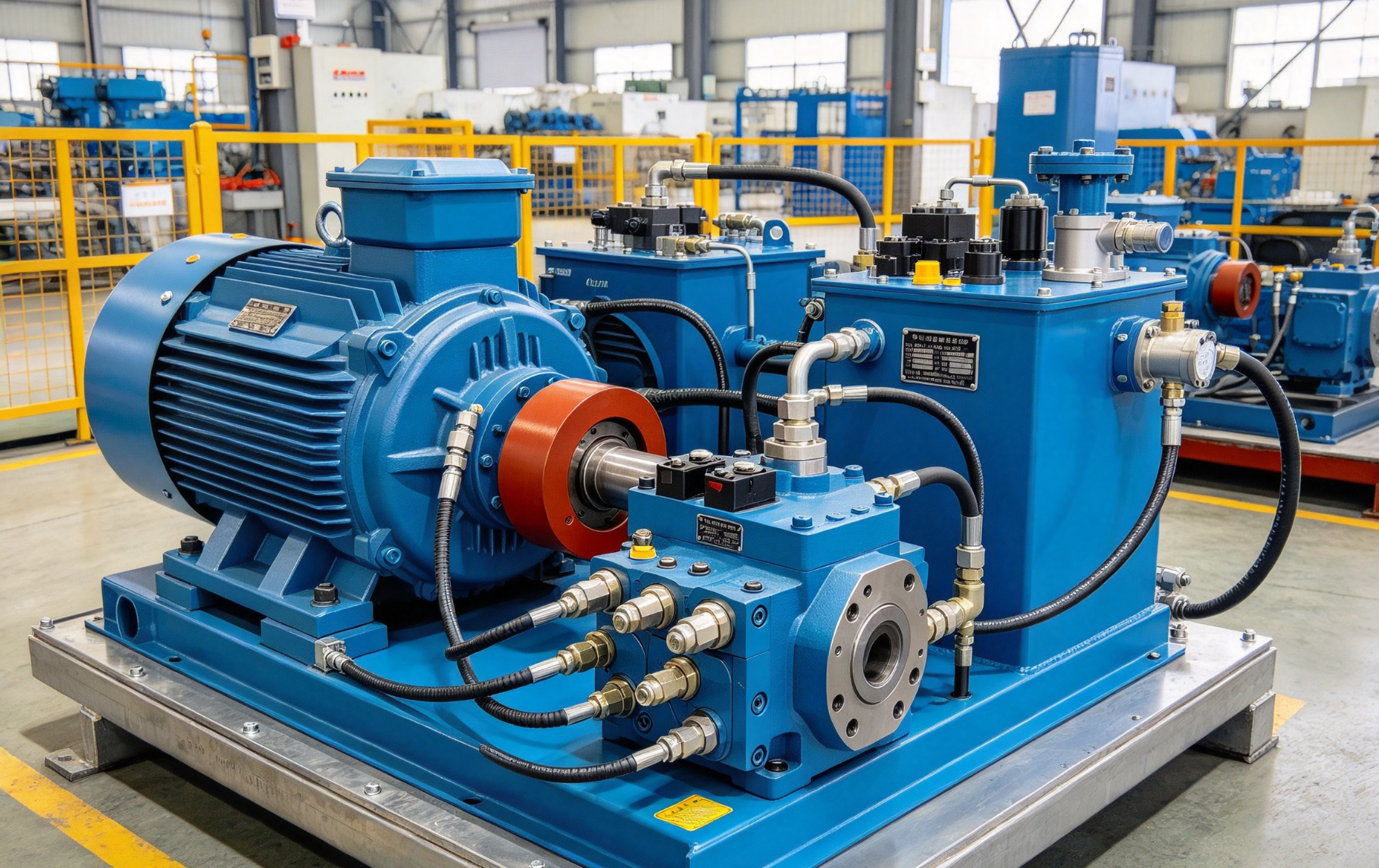
Hydraulic Vane Pump vs Hydraulic Piston Pump: Core Comparison
| Selection factor | Vane pump tendency | Piston pump tendency | Practical implication |
|---|---|---|---|
| Pressure capability | Moderate to high, depending on design | High to very high | Use the pump whose rated pressure safely exceeds the real operating pressure, including peaks. |
| Flow smoothness | Generally smooth | High-quality designs can be smooth, but pulsation depends on piston count and design | Assess vibration, actuator speed variation, and pressure ripple. |
| Noise | Often a strong choice for quiet machinery | Can require more attention to pulsation, mounting, and acoustic isolation | Vane technology may suit indoor production areas with strict noise expectations. |
| Displacement control | Often fixed in common industrial configurations | Fixed or variable displacement options are widely available | Variable demand generally favors a variable piston design. |
| Initial complexity | Usually simpler to specify and service | Typically more complex and sensitive to setup | Compare maintenance capability and spare-parts access. |
| Contamination tolerance | Can be sensitive to wear and fluid contamination | Also highly sensitive, particularly at high pressure and tight clearances | Filtration, flushing, and correct fluid condition are essential for both. |
There is no universal winner because the operating envelope determines the best technology. A pump that is efficient at high pressure may be unnecessarily expensive for a simple constant-flow circuit, while a low-complexity pump may waste energy or have insufficient pressure capability in a demanding machine.
When a Vane Pump Is the Better Choice
A vane pump is often the better choice when the application needs smooth flow and low operating noise without variable displacement. Industry guidance identifies vane pumps as a popular industrial option because fixed-displacement versions can combine relatively quiet operation with reasonable cost. See the Fluid Power World designer guide to hydraulic pumps for a broader design comparison.
Vane technology is a practical fit for many machine tools, factory automation systems, material-handling machines, and general industrial power units. It can also be attractive when a machine builder values straightforward replacement, a familiar installation footprint, and predictable service procedures.
Quiet operation is a major selection advantage, but noise is not determined by the pump alone. Motor speed, couplings, pipe velocity, reservoir design, mounting stiffness, aeration, and pressure pulsation can all increase sound. A well-selected vane pump installed in a poorly designed circuit may still be noisy.
Fixed displacement is an advantage when demand is relatively stable. If the circuit frequently requires low flow while the prime mover continues at full speed, however, excess flow may be converted into heat through a relief valve or unloading arrangement. In that situation, a variable-displacement piston pump may reduce avoidable losses.
When a Piston Pump Is the Better Choice
A piston pump is usually the stronger option when the machine needs high pressure, high power density, or variable flow. A comparison source reports that piston pumps can exceed 400 bar in suitable configurations, but the actual limit depends on the model, fluid, speed, temperature, duty cycle, and manufacturer rating. Consult the pressure comparison of gear, piston, and vane pumps and always verify the original technical data sheet before specifying a unit.
Variable-displacement piston pumps are particularly useful when actuator demand changes throughout the cycle. The pump can reduce displacement when the system needs less flow, which can lower throttling losses and reduce unnecessary heat. This makes piston technology common in injection molding, mobile machinery, presses, and other systems where pressure and flow requirements change continuously.
High efficiency does not eliminate the need for correct design. A piston pump operating with contaminated oil, inadequate inlet conditions, incorrect case-drain routing, or excessive shaft misalignment can fail quickly. Its higher performance potential must be matched by disciplined commissioning and maintenance.
Decision Matrix for Industrial Hydraulic Equipment
The following five-point matrix is a screening tool rather than a manufacturer performance rating. A higher score means the technology is generally more suitable for that selection priority; the final decision must use verified model data.
| Selection priority | Vane score, 1-5 | Piston score, 1-5 | Why it matters |
|---|---|---|---|
| Low acoustic impact | 5 | 3 | Vane pumps are commonly selected for smooth, quiet operation. |
| Very high pressure | 2 | 5 | Piston designs generally offer greater high-pressure capability. |
| Variable flow demand | 2 | 5 | Variable-displacement piston pumps can adapt output to demand. |
| Simple fixed-flow circuit | 5 | 3 | A fixed-displacement vane pump may provide a simpler solution. |
| Maximum power density | 3 | 5 | Piston designs are often preferred where pressure and compact power are priorities. |
| Simple service strategy | 4 | 3 | Vane construction can be straightforward, although serviceability depends on the model. |
Key Selection Checks Before Ordering
The correct replacement or new pump must match the complete system specification, not only the nominal pump family. Use this checklist before requesting a quotation:
- Record required flow at the actual operating speed, not only the motor nameplate speed.
- Confirm continuous pressure, intermittent pressure, and any pressure spikes.
- Check displacement, rotation direction, shaft profile, mounting flange, and port size.
- Verify fluid type, viscosity range, temperature range, filtration, and reservoir condition.
- Determine whether the circuit needs fixed displacement, variable displacement, load sensing, pressure compensation, or electronic control.
- Review installation envelope, coupling alignment, inlet conditions, case drain requirements, and permissible speed.
- Compare the complete lifecycle cost, including energy, seals, cartridges, repair parts, downtime, and technician availability.
Compatibility is especially important in replacement work. A pump may share a familiar series name yet differ in shaft, rotation, port orientation, displacement, pressure rating, or control configuration. Product identification should therefore use the full nameplate code and clear photographs of the mounting and ports.
Application Examples
In a constant-flow machine tool circuit, a vane pump may be the efficient commercial choice when pressure is moderate, noise matters, and the actuator sequence is predictable. The system designer should still size the motor, relief valve, cooler, and reservoir as a complete package.
In an injection molding machine, a variable piston pump may be more appropriate when the cycle alternates between rapid filling, holding pressure, and low-flow operations. A servo drive and correctly matched pump can improve controllability and reduce energy wasted across throttling elements, but the result depends on the complete hydraulic and electrical architecture.
In mobile equipment, piston technology may suit high-load functions and changing flow demand, while vane technology can remain attractive for auxiliary circuits with stable requirements. Shock loads, vibration, ambient temperature, contamination, and field service access should be evaluated before selecting either type.
For a pump replacement, the safest approach is to begin with the existing model code and operating data. A compatible alternative should be validated against pressure, displacement, speed, control type, mounting, shaft, and fluid requirements rather than selected by external appearance alone.
Maintenance and Failure Prevention
Fluid cleanliness is the most important shared reliability factor for both pump technologies. Contaminated oil can score surfaces, damage clearances, accelerate vane or piston wear, and cause valves or compensators to stick. Correct filtration must be selected for the circuit and maintained according to the equipment maker’s requirements.
Abnormal noise often indicates aeration, cavitation, misalignment, loose mounting, excessive inlet restriction, or incorrect oil viscosity. Do not treat noise as proof that one pump type is defective; diagnose the inlet, reservoir, coupling, piping, and operating conditions first.
Excessive heat usually indicates that the system is converting too much input power into losses. Common causes include relief-valve flow, throttling, internal leakage, incorrect pressure settings, poor cooler performance, or a pump operating outside its intended range.
Service planning should include seals, cartridges, bearings, pistons, retaining components, and control parts where applicable. Keeping the correct repair parts available can reduce downtime, particularly for older equipment where an exact original model may have limited availability.
Frequently Asked Questions
1. Which pump is quieter, a vane pump or a piston pump?
A vane pump is generally associated with quieter, smoother operation, but installed noise also depends on speed, mounting, piping, fluid aeration, and pressure pulsation.
2. Which pump handles higher pressure?
Piston pumps generally handle higher pressure than vane pumps when correctly selected. Some comparison references report piston capability above 400 bar, but the exact limit must come from the specific manufacturer’s rating.
3. Is a vane pump more efficient than a piston pump?
Not in every operating condition. A vane pump can be an efficient practical solution in a fixed-flow circuit, while a variable piston pump may reduce losses when flow demand changes substantially.
4. Can a vane pump replace a piston pump?
Only if the vane pump meets the required pressure, flow, duty cycle, control behavior, mounting, and fluid conditions. A direct technology substitution is not automatically compatible.
5. Are piston pumps harder to maintain?
They can require more precise maintenance because of tighter clearances, control components, and high-pressure operating conditions. Clean oil, correct alignment, and proper commissioning are essential.
6. Which pump is better for injection molding?
A variable piston pump is often preferred for machines with changing pressure and flow demand, especially when energy management and precise response are important. The correct choice depends on the machine cycle and drive strategy.
7. What information is needed to order a replacement pump?
Provide the complete nameplate code, displacement, rotation, pressure, speed, fluid type, mounting details, shaft specification, port configuration, and application conditions. Operating measurements and photographs can help confirm compatibility.
About Vicks Hydraulic
Vicks Hydraulic develops hydraulic power solutions around vane pumps, motors, servo systems, replacement components, and compatible alternatives for established equipment platforms. Its product strategy supports original-model replacement, legacy-machine compatibility, international supply, and service parts. For industrial buyers, the practical value is a broader path from pump identification to system matching, energy-saving servo integration, and after-sales support.
When choosing between vane and piston technology, start with your operating data rather than the pump label. A qualified hydraulic supplier can help verify the model code, calculate the duty requirements, and identify a technically compatible solution for your equipment.
For additional background, compare the complete guide to gear, piston, and vane pumps with the manufacturer’s current technical documentation before final specification.

Demi Ge
Post time: Nov-02-2026