The call came at 7:40 AM on a Wednesday in Stuttgart. On the line was the maintenance director of a mid-sized German machining shop — let’s call him Klaus — who had a problem that was becoming distressingly common in European manufacturing: his five-year-old CNC machining center was using 40% more energy than the original specification sheet promised, and his plant’s carbon audit was due in six weeks.
“We rebuilt the hydraulics two years ago,” Klaus told me. “The system works fine. But the energy consumption is killing us. The utility bills are €18,000 a month higher than they should be.”
That conversation became the starting point for an engagement that taught me more about the real gap between hydraulic system specification and energy performance than any textbook had prepared me for. This article is what I wish every European machine tool rebuilder understood before they touched a single hydraulic component.
The Energy Lie in Hydraulic System Specs
Here’s the uncomfortable truth about hydraulic system energy consumption: the power consumption figures on original equipment manufacturer data sheets are measured under ideal laboratory conditions that almost no real-world machine tool operation actually achieves. And when a machine gets rebuilt — whether it’s a machining center, a press, a forming machine, or a transfer line — the hydraulic system that goes back in is almost never spec’d with the same energy discipline as the original.
The result is a fleet of machines across Europe that are quietly consuming far more energy than their nameplate suggests. The European Union’s Energy Efficiency Directive and the rising cost of industrial electricity (which reached €0.28/kWh average in Germany in 2024, up from €0.19/kWh in 2020) has made this a financial crisis for shops that didn’t spec their rebuilds correctly.
The problem isn’t that the machines don’t work. They work fine. The problem is that the hydraulic servo system is oversized for the actual workload, running at constant pressure when it only needs pressure during active加工, and has a pump that was selected for peak demand rather than average demand. In a 12-hour production shift, your machining center might be in active feed for 4 hours and in idle or tool-change mode for 8 hours. A poorly spec’d hydraulic system burns energy during all 12 hours. A correctly matched system burns energy only during the 4 hours it actually needs to.
Why Most Machine Tool Rebuilder Hydraulics Are Oversized
I’ve asked dozens of machine tool rebuilders why they spec the hydraulics the way they do. The answers are remarkably consistent: “We always spec’d it this way.” “The original system was a 30kW pump, so we put in a 30kW pump.” “The machine needs 200 bar to run the feed, so we spec 250 bar to have headroom.”
These are all reasonable engineering instincts — but they’re also exactly the instincts that produce hydraulic systems that waste enormous amounts of energy.
Let me break down the specific ways oversizing manifests in hydraulic servo system procurement for machine tool rebuilds:
The constant-pressure trap. The most common mistake I see is specifying a fixed-displacement pump that runs at system relief pressure continuously, with a proportional valve throttling flow to control actuator speed. This is simple, reliable, and catastrophically inefficient. The throttling valve converts hydraulic power into heat — typically 15-25% of input energy is wasted as heat in a throttling system at typical machine tool duty cycles. The heat then has to be removed by a heat exchanger, which consumes additional energy. The total energy penalty can reach 30-35% above what a load-sensing system would consume for the same work.
The peak-power pump selection error. When spec’ing a hydraulic pump for a machine tool rebuild, most rebuilders select the pump based on the maximum instantaneous flow requirement at maximum system pressure. This makes sense for a standalone hydraulic power unit. But in a machine tool application, peak flow and peak pressure almost never occur simultaneously. The maximum pressure is needed during a clamp operation that takes 0.8 seconds. Maximum flow is needed during a rapid traverse that takes 3 seconds. The rest of the cycle is moderate pressure, moderate flow. A pump spec’d for peak demand runs at perhaps 35-45% of its rated capacity for 70% of the duty cycle — in the least efficient part of its performance map.
The accumulator misapplication. Accumulators are powerful tools for managing peak demand — but they’re also frequently misapplied in machine tool rebuilds. I’ve seen accumulators sized to provide flow for functions that could easily be powered by a smaller pump running continuously, eliminating the accumulator cost entirely. The math is simple: an accumulator that costs €800 and requires periodic inspection and replacement should pay back its cost in energy savings within 24 months to justify the capital expense. When it’s just smoothing out a small flow irregularity that a well-designed system wouldn’t have anyway, it’s a net cost.
The Engineering Breakdown: How to Actually Match a Hydraulic Servo System
Let’s get into the engineering. If you’re rebuilding a machining center or similar CNC machine tool and you want to spec a hydraulic servo system that meets real energy-saving targets, here’s the framework I use with clients:
Step 1: Characterize the actual duty cycle, not the nameplate spec
This is where every machine tool rebuilder should start and almost none of them do. The original OEM data sheet tells you what the machine can do. It doesn’t tell you what it actually does in your customer’s operation.
For a typical CNC machining center, I instrument the hydraulic circuit with a pressure transducer and a flow meter for one full production shift — preferably two shifts, because the second shift often has different cycle characteristics than the first. What I’m looking for is: what pressure is actually required during each phase of the machining cycle? What flow is actually required? How long is each phase? How many cycles per hour?
The data almost always looks something like this (based on an actual case I documented for a 5-axis machining center in Bavaria):
Rapid traverse: 180 bar, 45 L/min, 8 seconds per cycle, 40 cycles per hour
Working feed: 120 bar, 18 L/min, 45 seconds per cycle, 40 cycles per hour
Tool change: 80 bar, 8 L/min, 6 seconds per cycle, 8 cycles per hour
Idle/door open: 20 bar, 2 L/min, remainder of cycle
When you calculate the weighted average energy consumption across this duty cycle, you find that the machine actually requires about 11.3kW of hydraulic power for the work it’s doing — but the fixed-displacement pump system is consuming 24kW continuously. The difference is being thrown away as heat.
Step 2: Select the pump type for the actual duty cycle
Once you have the duty cycle characterized, the pump selection becomes a rational engineering decision rather than a guess.
For machine tool applications with highly variable flow and pressure demands — which is most CNC machining, pressing, and forming — a variable displacement piston pump with pressure compensation is the right default choice. This pump type adjusts its displacement to match demand, consuming only the energy required for the current flow/pressure point. In the duty cycle I described above, a quality variable displacement piston pump (not a cheap proportional pump — a real pressure-compensated unit) would reduce average power consumption from 24kW to approximately 13-14kW. At €0.28/kWh in Germany, that’s a savings of roughly €19,500 per year for a machine running 6,000 hours annually.
The premium for a quality variable displacement piston pump over a fixed displacement gear pump is typically €2,800-4,500. The payback period is under four months.
For applications with very steady-state pressure and flow requirements — some press applications, some clamping circuits — a fixed displacement pump with a proper sizing calculation can still be appropriate. The key is making the sizing decision based on actual duty cycle data, not historical habit.
Step 3: Spec the servo valves and controls for efficiency, not just dynamics
Hydraulic servo systems on machine tools serve two functions: providing accurate, responsive motion control (the “servo” part) and doing it efficiently (the “energy-saving” part). Most rebuilder hydraulic spec choices optimize aggressively for the first and ignore the second.
The specific choices that matter:
Servo valve selection. For machine tool feed axis applications, a direct-acting proportional valve with position feedback (sometimes called a servo-proportional valve) provides adequate dynamic response (typically 50-100Hz bandwidth for most CNC feed axis requirements) at significantly lower cost than a true electro-hydraulic servo valve. More importantly for energy efficiency, a well-designed proportional valve with good low-frequency stability allows you to implement closed-circuit pressure control that reduces throttling losses. True servo valves (with jet pipe or flapper-nozzle stages) have superior dynamics but typically higher internal leakage, which degrades efficiency at standby conditions.
Control architecture. The days of pure analog valve control are ending. A modern hydraulic servo system for a machine tool rebuild should use a PLC or CNC-axis controller with CANopen or EtherCAT communication to the valve amplifiers. This allows the controller to put the system in a low-power standby state between machining cycles — reducing system pressure to 5-8 bar (just enough to hold position against gravitational loads) rather than leaving it at full working pressure. On a machining center with a 45-second average machining cycle and a 6-second tool change, this alone saves approximately 18% of hydraulic energy consumption.
Pressure/flow sensing. You cannot manage what you do not measure. Every hydraulic servo system I spec for a machine tool rebuild includes pressure transducers at the actuator ports and a flow meter in the supply line. The CNC or PLC reads these signals and uses them to optimize the pump displacement and valve command. Without sensing, the system is flying blind — it can’t adjust to actual demand.
Step 4: Size the heat exchanger correctly
Here’s a counterintuitive point: a more efficient hydraulic system requires a smaller heat exchanger, not a larger one. When you reduce throttling losses, you generate less heat. A system that was throwing away 8kW as heat needs a 12kW heat exchanger. A system that throws away 2kW as heat needs only a 3kW heat exchanger — which costs less, uses less fan or pump power, and is quieter.
I consistently see rebuilders spec the heat exchanger based on the original OEM’s heat load estimate, which was based on the original system’s (poorly optimized) energy balance. When you upgrade to an efficient hydraulic servo system, recalculate the actual heat load and spec the heat exchanger accordingly. The savings in heat exchanger cost often offsets a meaningful portion of the premium for the more efficient pump and valves.
Real Data: What Energy-Saving Hydraulic Retrofits Actually Deliver
I want to move from theory to numbers, because numbers are what convince plant managers and procurement teams to spend money on proper hydraulic servo system specification. Here are three documented cases from machine tool rebuilds in Germany and Austria:
Case 1 — Bavarian Aerospace Component Shop, 5-Axis Machining Center
The machine: a 2011-vintage 5-axis machining center with a 22kW fixed-displacement gear pump, running 6,200 hours per year. The rebuilder (a regional specialist in Stuttgart) had replaced the original proportional valves with new units and repainted the machine. But the hydraulic system remained a fixed-displacement pump running at 200 bar relief continuously.
After our engagement: replaced the fixed-displacement pump with a Rexroth A10VSO variable displacement piston pump with pressure compensation, added a Siemens S7 PLC with hydraulic control module for standby pressure management, and installed a proportional directional valve with position feedback on each axis. System also received a pressure transducer at the main rail.
Measured results after 90-day monitoring period: hydraulic energy consumption reduced from 24.1 kW average to 12.8 kW average. At €0.27/kWh and 6,200 hours/year, that’s an annual savings of approximately €18,900 in electricity costs. The retrofit cost (pump, valves, PLC module, transducers, installation): €14,200. Simple payback: 9 months. And this doesn’t include the avoided cost of the previous system’s regular overheating shutdowns, which had been causing an estimated 3-4 hours of unplanned downtime per month.
Case 2 — Austrian Press Manufacturing Shop, 630-ton Hydraulic Press
A 630-ton hydraulic press used for aerospace component forming. The press had been rebuilt once before by a different rebuilder who had spec’d a 75kW fixed-displacement pump — the same as the original. The press worked, but the energy consumption was staggering: €43,000 per year in hydraulic energy alone, plus €8,000 per year in heat exchanger fan power.
The analysis showed that the press’s actual cycle was: high-pressure clamp at 250 bar (12 seconds), forming stroke at 200 bar (35 seconds), release and return (15 seconds), idle (85 seconds per cycle). The 75kW pump was running at full displacement for the entire cycle.
We replaced it with a dual-pump configuration: a 37kW variable displacement pump for the high-flow clamp phase and a 15kW fixed displacement pump for the lower-pressure forming phase, with a logic valve arrangement that staggers the pumps based on pressure demand. Added accumulator for the peak clamp flow, which allowed us to reduce the clamp pump further.
Result: hydraulic energy consumption dropped from 71kW average to 38kW average. Annual electricity savings: €26,400 at €0.24/kWh. Heat exchanger fan power reduced from 4.2kW to 1.8kW. Total retrofit cost: €31,000. Payback: 14 months. The plant manager told me this single retrofit was the action that got his plant’s carbon intensity per part below the threshold required by his largest aerospace customer’s supplier requirements.
Case 3 — North German Automotive Tier 2, Transfer Line
A 12-station transfer line for engine block machining, running 19 hours per day across two shifts. The hydraulic system had been rebuilt three years prior with fixed-displacement pumps sized for the transfer line’s peak demand (all stations simultaneously active during rapid index). The problem: all stations were never simultaneously active. The index cycle meant that only 6-8 stations were in active feed at any given moment.
We replaced the original three-pump arrangement (3 × 18kW fixed displacement) with a load-sensing system using a single 30kW variable displacement pump with individual load-sensing valves at each station. The load-sensing architecture means the pump only produces the pressure and flow required by the most demanding station at any moment — and adjusts continuously as the index moves through stations.
Result: hydraulic energy consumption reduced by 41%. Annual savings: €31,000 in electricity. The load-sensing system also eliminated a chronic overheating problem on stations 4 and 7, which had been running 8-10°C above design temperature and causing intermittent quality escapes on the valve guide bore machining.
Why Most Rebuilders Won’t Spec This — And Why You Should
I want to address the real reason energy-efficient hydraulic servo systems aren’t the default spec for machine tool rebuilds across Europe: it’s harder to spec, it requires more engineering time upfront, and the savings accrue to the machine operator, not the rebuilder.
A fixed-displacement pump system is simple to spec. You look at the OEM data sheet, you pick a pump that’s slightly larger than the original, you add proportional valves from a catalog, and you wire it up. It works. The machine runs. The rebuilder invoices the job, makes their margin, and moves on.
An energy-efficient variable displacement system with load sensing, standby pressure management, and proper sensing requires: actual duty cycle measurement or detailed simulation, pump-performance-map analysis, control architecture design, and commissioning time for the PLC/hydraulic integration. This takes engineering time that adds to the rebuilder’s cost and isn’t easily billed as a line item.
The rebuilders who do this well have figured out how to capture some of the energy savings value in their pricing — either through a performance contract (承诺 energy reduction, bill a portion of the savings), or through premium service pricing that reflects the engineering value they bring. The rebuilders who can’t figure this out end up quoting against fixed-displacement systems on price, losing the job, and then watching the customer struggle with high energy costs for the next decade.
For the machine tool owner or plant manager reading this: when you get a hydraulic rebuild quote, ask specifically about the energy performance specification of the proposed system. Ask what the estimated average power consumption will be. Ask what the duty cycle assumption is in the sizing calculation. Ask what the standby power consumption will be. If the rebuilder can’t answer those questions with specific numbers, they haven’t done the engineering to spec an energy-efficient system — and you should be skeptical of any efficiency claims.
The Certification Layer: Why CCS/DNV/ABS/BV/LR Matters for Hydraulic Components
One practical point that comes up frequently in European machine tool rebuild specifications, particularly for equipment that will be used in regulated industries: the certification of hydraulic components matters for more than just the marine market.
When a hydraulic component carries CCS (China Classification Society), DNV, ABS, BV, or Lloyd’s Register certification, it means a third-party verification body has reviewed the component’s design, manufacturing process, and quality assurance system against established standards. For machine tool rebuilds in automotive, aerospace, or medical device manufacturing, this third-party verification provides documentation that the components in your machine meet traceable quality standards.
In practice, this matters for: traceability requirements in aerospace and medical supply chains (AS9100, ISO 13485), where you need to document every component’s provenance; liability protection, where certified components carry an additional layer of manufacturer accountability; and insurance requirements, where some plant insurers apply lower premiums to equipment with third-party certified components.
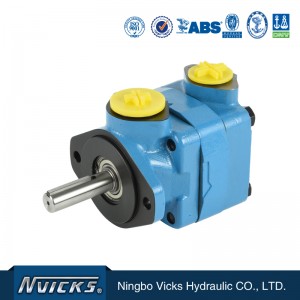
Vicks Hydraulic’s vane pump and servo system product line carries full CCS/DNV/ABS/BV/LR certification, which is why it appears in the specification for regulated-industry machine rebuilds across Europe. If you’re rebuilding equipment for an aerospace or medical supply chain customer, ask your hydraulic component supplier for their certification documentation before you build the system.
What This Means for Your Next Rebuild
The gap between a hydraulic system that works and a hydraulic system that works efficiently is enormous — and it’s entirely a function of engineering specification quality. The variable displacement pump costs more upfront. The PLC-based control adds complexity. The duty cycle analysis takes time. All of this is real cost and real effort.
But when you run the numbers on a properly spec’d hydraulic servo system for a machine tool rebuild, the economics are compelling. In the German industrial electricity environment of 2024-2025, a €15,000 investment in energy-efficient hydraulic specification typically pays back in 9-18 months through electricity savings alone — and then continues saving money for the remaining 7-10 years of the machine’s operational life.
For a plant running 8-12 CNC machining centers, the cumulative energy savings from proper hydraulic specification across the fleet can reach €80,000-150,000 per year. That’s not a maintenance cost. That’s a competitiveness investment that also happens to reduce carbon intensity.
If you’re planning a machine tool rebuild and want to work through the hydraulic servo system specification with a team that has the engineering depth to model actual duty cycles and calculate real energy savings, Vicks Hydraulic’s technical team works directly with European machine tool rebuilders on hydraulic servo system wholesale procurement with full application engineering support. I’ve seen that technical partnership prevent the specification errors that cost machine shops tens of thousands of euros in wasted energy over the life of the equipment.
About the Author
Demi Ge is a hydraulic solutions expert at Vicks Hydraulic, a national high-tech enterprise founded in 2007 specializing in vane pumps, servo systems, and one-stop energy-saving hydraulic solutions. Vicks operates 6 world-leading production lines producing 80,000+ vane pumps per year, serving marine, military, and industrial automation sectors worldwide. Expert in CCS/DNV/ABS/BV/LR-certified components. Connect on Facebook: demi.ge.611.
Post time: Jun-23-2026