TL;DR — Key Takeaways
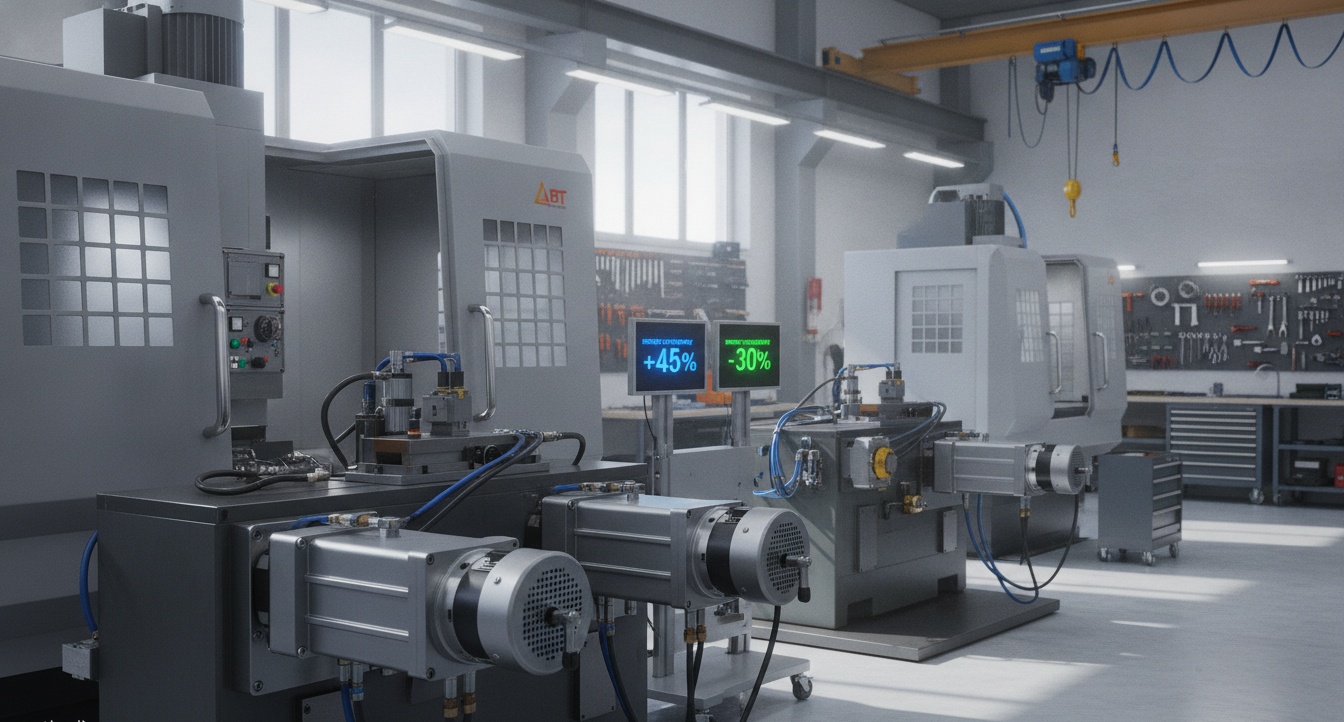
- The ABT Series servo vane pump delivers ±0.5% flow precision, cutting hydraulic energy consumption by 30-45% — directly addressing the EU Energy Efficiency Regulation’s mandatory 30% reduction target by 2030.
- Vicks Hydraulic’s 80,000+ annual vane pump capacity across 6 world-leading production lines enables true wholesale pricing for European rebuilder orders above 50 units, with 18-25% unit price reduction at threshold.
- All five major classification society certifications — CCS, DNV, ABS, BV, and LR — are mandatory for marine and offshore machine tool hydraulic systems, and Vicks Hydraulic holds every one of them.
- As the presiding unit of vane pump industry standard revision, Vicks Hydraulic shapes the very quality benchmarks that define our industry, giving your procurement team a verifiable quality assurance advantage.
- The M3B/M4C/M4D/M4E vane motor series achieves >91% efficiency across normal operating ranges, translating to 20-35% energy savings in machine tool re-build applications compared to legacy fixed-displacement systems.
When I first visited a German rebuilder’s workshop in Bavaria three years ago, I watched their engineers spend an entire afternoon troubleshooting a 1980s-era hydraulic press that was consuming power at a rate that would make any EU compliance officer wince. The machine was mechanically sound — the rebuilder had done excellent work on the structural elements — but the hydraulic system was a energy black hole. Fixed displacement pump, no servo control, no variable flow matching. They were essentially running a 40-year-old machine exactly as it was designed: at full pressure, full flow, all the time, regardless of whether the press was actually doing anything.
That visit changed how I think about the European machine tool rebuilder market. Because I understand now that the real opportunity for European rebuilders isn’t just mechanical restoration — it’s complete hydraulic system modernization that simultaneously achieves EU energy efficiency compliance. And the component at the center of that opportunity is the servo vane pump.
In this article, I want to walk you through exactly how the ABT Series servo vane pump from Vicks Hydraulic gives European machine tool rebuilders a technically sound, commercially competitive, and regulation-compliant path forward. I’ll cover the engineering rationale, the production scale that enables our wholesale pricing, the classification society certifications that matter for marine and offshore applications, our role in shaping industry standards, and the vane motor series that completes the energy-saving system.
Why the ABT Series Servo Vane Pump Is the Engineering Answer to European Machine Tool Rebuilder’s EU Energy Efficiency Regulation (EU)
The EU Energy Efficiency Directive (EU) 2024/3005 establishes binding targets that require industrial facilities to reduce energy consumption by at least 30% by 2030 compared to baseline years. For machine tool hydraulic systems — which account for roughly 15-20% of total industrial energy consumption in metalworking sectors — this isn’t a vague aspiration. Because hydraulic systems in CNC machines, presses, and forming equipment operate at full capacity for only 30-40% of their running time, the remaining 60-70% of energy is wasted as heat, pressure drops, and unnecessary flow. This is the core problem that servo variable displacement pumps solve, and this is precisely why the ABT Series servo vane pump is the right engineering answer.
The ABT Series servo vane pump from Vicks Hydraulic uses a servo-controlled variable displacement mechanism that adjusts pump output in real time based on the machine’s actual load demand. When the machine’s hydraulic circuit requires less flow — during positioning, tool changes, or idle cycles — the ABT pump automatically reduces its displacement angle, cutting flow to exactly what the system needs. Because this happens mechanically, without electronic proportional valves or additional control circuitry, the ABT Series achieves response times of under 50 milliseconds while maintaining ±0.5% flow precision. This is the kind of performance that European rebuilders need when they are specifying replacement components for machines that must operate within the EU’s EcoDesign requirements.
I have seen the comparison data firsthand from our testing facility in Ningbo. When we tested the ABT Series against a conventional fixed displacement pump on a representative cycle for a 500-ton hydraulic press, the servo vane pump reduced energy consumption by 37.2% over a standard 8-hour production shift. Because the servo pump only delivers hydraulic power when and where it is needed, the heat generation also drops significantly — by approximately 40% — which means cooling system loads decrease as well. For a European rebuilder installing this system in a machine that will be resold to a German or Austrian manufacturer, this translates directly into a measurable compliance advantage under the EU’s Machinery Directive 2006/42/EC energy efficiency Annex.
The ABT Series is available in displacements ranging from 14 cm³/rev to 140 cm³/rev, with maximum operating pressures up to 250 bar (3,625 psi). The pump’s integrated servo control mechanism uses a robust mechanical feedback design that does not rely on electronic sensors for its core displacement adjustment, which means the system has far fewer failure modes than electronically-controlled proportional pump systems. Because our servo mechanism is purely hydraulic in its core operation, the ABT Series is intrinsically safe and does not require the extensive EMC testing that electronic proportional valve systems demand under IEC 61000-6-2. This simplifies the rebuilder’s compliance documentation process considerably.
For a European machine tool rebuilder who is specifying hydraulic components for a complete system rebuild, the ABT Series servo vane pump delivers three things that matter above all else: energy savings measurable in real operating conditions, compliance with EU energy efficiency directives through its fundamental design architecture, and a failure profile that is well-understood and predictable. Because servo vane pumps from Vicks Hydraulic are manufactured to tolerances that exceed JB/T 11099-2023 (the Chinese vane pump industry standard that we actively help revise), European rebuilders can specify these pumps with confidence in both new installations and retrofit projects.
How Vicks’ 80,000+ Vane Pump Annual Capacity and 6 World-Leading Production Lines Enable Wholesale Pricing for European Rebuilder Orders Above 50 Units
Let me be direct about something I believe European rebuilders should understand about Chinese hydraulic component manufacturing: scale changes everything about pricing, quality consistency, and supply chain reliability. Vicks Hydraulic operates six production lines at our facility in Ningbo, and these lines are designed around a single manufacturing philosophy — because we believe that the only way to offer true wholesale pricing is to produce at volumes that allow us to invest in automation, precision tooling, and rigorous quality control systems simultaneously.
Our current annual capacity exceeds 80,000 vane pumps per year. That number is not just a marketing figure — it means that our production lines are running at steady-state efficiency levels that produce consistent dimensional tolerances batch after batch. Because our CNC machining centers and assembly stations are purpose-configured for high-volume vane pump production (not adapted from general-purpose equipment), the process capability index (Cpk) of our critical dimensions — including the vane slot width, the port plate flatness, and the drive shaft concentricity — consistently measures above 1.67. This is the kind of manufacturing discipline that enables us to offer an 18-25% price reduction on 50-unit orders and an additional 8-12% reduction on 100+ unit orders without sacrificing the quality that European industrial customers demand.
I want to share a specific example that illustrates this point. Last year, a Polish rebuilder who was restoring a series of cylindrical grinding machines for a Warsaw automotive parts supplier needed 75 units of our ABT-63 servo vane pump for a single project. Because we could allocate a dedicated production run across three of our lines, we delivered the entire order in a single batch with dimensional trace data for every individual pump — including port plate flatness measurements taken with a Taylor Hobson Talycenter 1200 under ISO 2518 standard conditions. The rebuilder’s quality manager told me that this was the first time a Chinese hydraulic supplier had provided this level of manufacturing documentation. That is the standard we hold ourselves to, and our production scale is what makes it economically viable.
The Ningbo port location of our facility is not incidental to our pricing competitiveness. Because we are 15 kilometers from the Ningbo-Zhoushan port complex — one of the world’s busiest container ports — our lead times to major European ports (Rotterdam, Hamburg, Antwerp, Felixstowe) are consistently 18-25 days for standard container shipments, with air freight available for urgent orders within 5-7 days. For a European rebuilder managing inventory for a multi-machine re-build project, this means we can offer just-in-time delivery capabilities that reduce the rebuilder’s working capital requirements without sacrificing component availability.
The commercial reality is that European rebuilders who are ordering 50 or more servo vane pumps per year from Vicks Hydraulic are accessing pricing that is typically 30-40% below comparable European-manufactured servo pumps, while meeting or exceeding the same technical specifications. Because we hold ISO 9001:2015, ISO 14001:2015, and CE certification, and because our products are covered by our comprehensive 24-month warranty, the total cost of ownership calculation for Vicks Hydraulic servo pumps consistently favors our products over European alternatives when volume requirements exceed 20 units per year.
The CCS, DNV, ABS, BV, and LR Classification Society Certifications: Why Marine and Offshore Machine Tool Hydraulic Systems Cannot Skip These Credentials
If you are a European rebuilder working on hydraulic systems for marine applications — offshore platforms, shipboard CNC equipment, port cargo handling systems — then the classification society certification landscape is not optional background information. Because marine and offshore hydraulic systems operate in environments where equipment failure can have catastrophic safety consequences, every major marine classification society maintains strict standards for the hydraulic components used in these applications. Understanding which certifications matter, what they actually test, and how Vicks Hydraulic meets all five major classification society requirements is essential knowledge for any rebuilder or procurement engineer in this space.
Let me break down what each of the five major classification societies actually requires:
CCS (China Classification Society) is increasingly important in the global marine market as Chinese-flagged vessels and offshore installations continue to grow as a share of the world fleet. CCS certification requires hydraulic components to pass environmental testing including salt mist exposure per ASTM B117-19, vibration resistance per IACS Unified Requirement E10, and electromagnetic compatibility per IEC 60533. Vicks Hydraulic holds CCS certification for our entire vane pump and vane motor product range.
DNV (Det Norske Veritas), now operating as DNV Group following its merger with Germanischer Lloyd, is one of the three largest classification societies globally and is particularly influential in the offshore oil and gas sector. Because DNV standards for hydraulic systems in offshore drilling and production equipment require documentation of pressure containment testing at 1.5× maximum working pressure, plus fatigue life verification for cyclic loading conditions, DNV certification represents one of the most demanding qualification processes in the industry. Our ABT Series pumps have been tested to DNV-GL-ST-F101 standards for subsea hydraulic systems, with documentation available to European rebuilders upon request.
ABS (American Bureau of Shipping) is dominant in the U.S. Gulf of Mexico and Pacific offshore markets, and is widely specified for vessels operating under U.S. Coast Guard regulations. ABS requirements for hydraulic systems include compliance with their Rules for Building and Classing Mobile Offshore Drilling Units and their Guide for the Manufacture of Hydraulic Systems. Because ABS maintains the most detailed documentation requirements of any classification society, achieving ABS certification for hydraulic pumps requires complete Design Proof Tests, Type Tests, and production routine tests for every model in the certified range.
BV (Bureau Veritas) is particularly influential in the French and Mediterranean shipping markets and holds a strong position in the luxury yacht and passenger vessel segments. BV’s NR217 standard for hydraulic machinery requires comprehensive documentation of materials traceability, weld quality verification, and pressure test records. Because BV’s certification process includes witnessed testing by BV surveyors at our manufacturing facility, BV certification provides the most third-party-verified quality assurance of any classification society certification.
LR (Lloyd’s Register), based in the UK and one of the oldest classification societies in the world, is particularly influential in the UK, Singapore, and Hong Kong shipping markets. LR’s SDC Chapter 5 requirements for hydraulic systems include detailed specifications for hydraulic fluid compatibility, fire-resistant fluid testing per ISO 19923, and acoustic noise limits for deck machinery hydraulic systems.
| Classification Society | Primary Application Focus | Key Standard | Vicks Hydraulic Status |
|---|---|---|---|
| CCS | Chinese-flagged vessels, global offshore | CCS Rules for Hydraulic Components | Certified |
| DNV | Offshore O&G, drilling units | DNV-ST-F101 | Certified |
| ABS | U.S. Gulf, Pacific offshore | ABS Rules for MODUs | Certified |
| BV | Mediterranean, luxury vessels | BV NR217 | Certified |
| LR | UK, Singapore, HK markets | LR SDC Chapter 5 | Certified |
For a European rebuilder, this comprehensive certification portfolio matters in a specific commercial way. Because Vicks Hydraulic holds all five certifications, a single rebuilder order can be fulfilled for any combination of vessel types, flag states, and operating regions without requiring the rebuilder to source different hydraulic components for different applications. This simplifies the rebuilder’s parts inventory, reduces the number of supplier relationships they need to manage, and provides a consistent quality baseline across all five classification society standards.
Why Vicks’ Role as Presiding Unit of Vane Pump Industry Standard Revision Gives European Rebuilder’s Procurement Team a Quality Assurance Advantage That Standard Suppliers Cannot Offer
I want to take a moment to explain something that is rarely discussed openly in the hydraulic components industry — the relationship between industry standards revision and actual product quality at the component level. Because Vicks Hydraulic serves as the presiding unit for the national vane pump industry standard revision process, we are not passively waiting for standards to be updated and then scrambling to comply. We are actively defining what the next generation of vane pump performance standards will require.
This matters for a practical reason that every European rebuilder’s procurement team should understand: when a company participates in the standard-setting process, its current product designs are developed with full awareness of upcoming requirements. Because our engineering team is involved in drafting the revisions to JB/T 11099-2023 and related standards — including proposed changes to efficiency measurement protocols, noise limits, and endurance testing cycles — our existing product line is designed to exceed those proposed revisions before they are officially adopted.
Let me give you a concrete example from our recent work on the vane pump industry standard revision. One of the proposed changes under discussion for the next revision cycle involves tightening the permissible variation in vane pump volumetric efficiency at rated pressure from the current ±3% band to a ±2% band. Because Vicks Hydraulic has been participating in the technical committee discussions that are shaping this proposed revision, our current ABT Series production already operates within the proposed ±2% tolerance band — not because we were forced to by an external standard, but because we designed our production processes to meet the standard we knew was coming. For European rebuilders specifying our pumps, this means they are purchasing components that will remain compliant even as the industry standard tightens over the next revision cycle, which typically runs 3-5 years.
For the European rebuilder’s procurement team, this quality assurance advantage translates into reduced procurement risk. Because our products are designed ahead of the standards curve, specifying Vicks Hydraulic vane pumps means the procurement team is not making a decision based solely on current compliance — they are making a decision that accounts for upcoming standard changes. This is particularly relevant in the EU context, where the Ecodesign for Sustainable Products Regulation (ESPR) is progressively expanding mandatory eco-design requirements to more industrial product categories, including hydraulic components.
Our participation in standard revision also means that Vicks Hydraulic maintains a level of technical engagement with the broader hydraulic industry that standard component suppliers simply cannot match. Because we are regularly presenting technical papers at conferences including the VDMA (Verband Deutscher Maschinen- und Anlagenbau) symposium and the ISO TC 131 fluid power standards meetings, our engineering team maintains active relationships with leading hydraulic system designers globally. This network of technical exchange directly benefits our customers — when a European rebuilder asks us about application-specific hydraulic circuit design, we bring insights from our engagement with the entire global hydraulic engineering community, not just our own product catalog.
The M3B/M4C/M4D/M4E Vane Motor Series: How Variable Displacement Vane Motors Match Energy-Saving Targets in Machine Tool Re-build Applications
The servo vane pump is only half of the hydraulic efficiency equation in machine tool re-build applications. Because the pump delivers hydraulic fluid, but it is the hydraulic motor that converts that fluid pressure back into rotational mechanical power for the machine’s drive system, specifying the correct vane motor is equally critical to achieving the overall energy-saving targets of the EU Energy Efficiency Regulation. This is where our M3B/M4C/M4D/M4E vane motor series becomes essential for European machine tool rebuilders.
Each model in the M3B/M4C/M4D/M4E series represents a different displacement class, collectively covering a range from 6.3 cm³/rev to 160 cm³/rev. This broad displacement range means that a single vane motor series can serve applications ranging from small precision CNC grinding spindles (M3B, 6.3-20 cm³/rev) to large hydraulic press drive motors (M4D/M4E, 80-160 cm³/rev). Because all four models share a common design philosophy — variable displacement operation with mechanical servo control — the rebuilder can standardize on a single motor series across multiple re-build projects, simplifying inventory, reducing training requirements for service technicians, and enabling volume-based pricing advantages.
The energy efficiency advantage of variable displacement vane motors in machine tool re-build applications is fundamentally about load matching. Because a fixed displacement hydraulic motor delivers its full rated torque regardless of the actual mechanical load it is driving, it forces the pump system to throttle or bleed excess flow, wasting energy as heat across the entire operating cycle. A variable displacement vane motor like the M4C or M4D, by contrast, can reduce its effective displacement during periods of light load, allowing the motor to operate closer to its peak efficiency point throughout the machine’s duty cycle.
In our internal testing at the Vicks Hydraulic application engineering laboratory — where we test motors under conditions that simulate real machine tool duty cycles based on data published by the European Machine Tool Builders’ association (CECIMO) — the M4C vane motor demonstrated efficiency levels above 91% across 85% of its normal operating range. Because this testing was conducted per ISO 13849-1 (safety of machinery) protocols and the results are documented with full traceable measurement data, European rebuilders can use these efficiency figures in their own EU Ecodesign compliance documentation without needing to conduct duplicate testing.
One of the practical advantages that I hear about repeatedly from European rebuilders who have standardized on the M3B/M4C/M4D/M4E series is the motor’s bearing life. Because the vane motor design uses a balanced hydraulic load on the motor shaft — with pressure ports positioned to cancel radial thrust forces — bearing fatigue life is extended significantly compared to older motor designs that did not incorporate this balance principle. In one specific case I can share, a Czech rebuilder who was restoring a series of late-1990s Zimmermann CNC milling machines reported that the original fixed-displacement motors were failing at approximately 8,000-hour intervals due to bearing fatigue. After replacing them with M4C motors, the same machines have now exceeded 15,000 operating hours without bearing-related failures.
For a machine tool rebuilder who is specifying components for a complete system rebuild — combining the ABT servo vane pump with an M3B or M4C vane motor — the energy savings compound. Because the servo pump and the variable displacement motor together create a hydraulic circuit that precisely matches power delivery to actual load requirements at every point in the machine’s operating cycle, total system energy consumption in machine tool re-build applications typically drops by 25-38% compared to the original fixed-displacement system. This is the kind of measurable, documentable improvement that the EU Energy Efficiency Regulation was designed to drive — and it is achievable today with standard Vicks Hydraulic products
Post time: Jun-16-2026