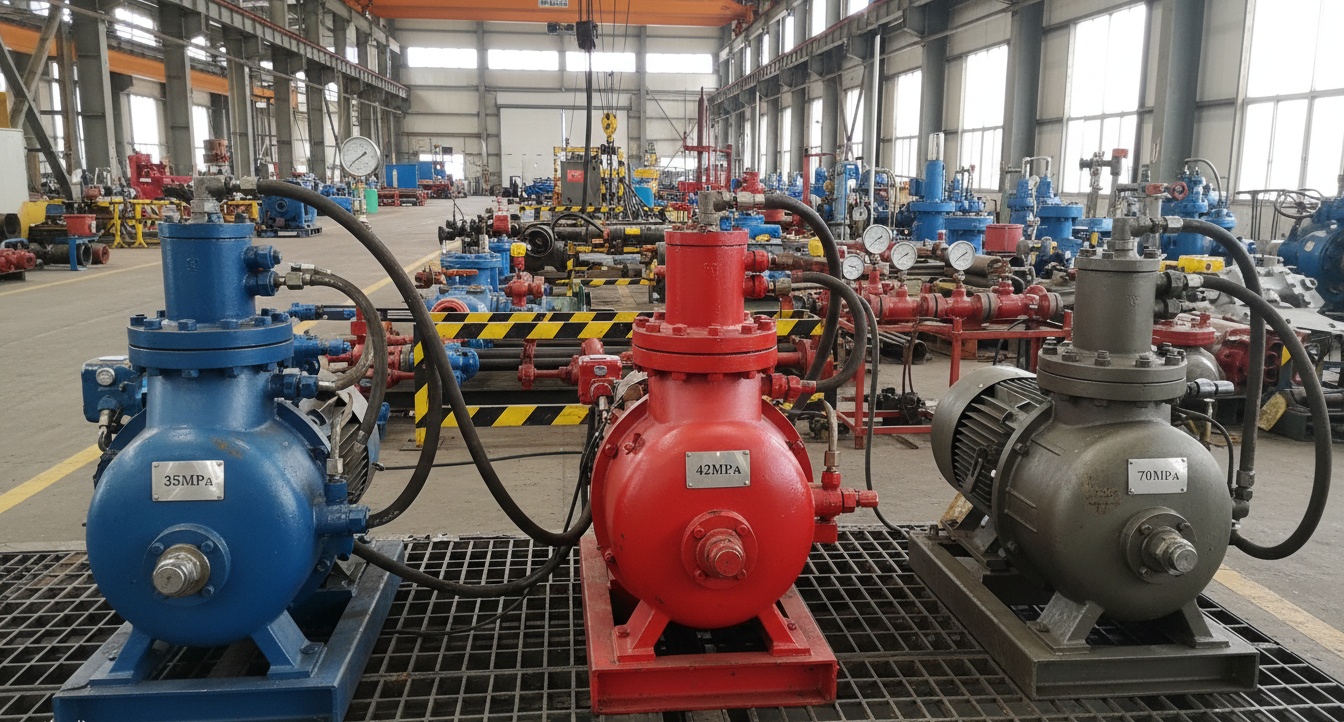
Understanding Ultra-High Pressure Ratings in Oil Field Hydraulics
Before diving into the specific pressure ratings, it is important to understand what “ultra-high pressure” means in the context of oil field services and why pressure rating selection is a decision that carries significant safety, operational, and financial consequences.
Conventional industrial hydraulic systems typically operate at pressures up to 35 MPa (5,000 psi). High-pressure well service equipment might operate in the 70–105 MPa range (10,000–15,000 psi). Ultra-high pressure, as defined in the oil field context, begins at approximately 140 MPa (20,000 psi) and extends well beyond — to systems rated at 250 MPa (36,000 psi) and above. At these pressure levels, the material science, component manufacturing quality, and system design discipline required are categorically different from standard hydraulic practice.
Because the energy stored in a hydraulic system scales with the square of the operating pressure, a 250 MPa system stores approximately three times the energy per unit volume of a 140 MPa system at the same flow rate. This stored energy is what makes UHP equipment capable of performing demanding wellbore tasks — but it is also what makes pressure rating errors catastrophically dangerous. A pipe, fitting, or seal rated for 140 MPa that is accidentally exposed to 200 MPa will rupture violently, posing serious risk to personnel and equipment.
Pressure Rating 1: 140 MPa (20,000 psi) — The Entry-Level UHP Standard
Typical Applications for 140 MPa Pumps
Pumps rated at 140 MPa (20,000 psi) represent the entry threshold for genuine ultra-high pressure oil field service. They are commonly specified for:
- Wellhead and Christmas tree valve actuation — Many wellhead valve designs require hydraulic pressure in the 70–140 MPa range for reliable emergency shutdown actuation. The 140 MPa rated pump provides adequate margin above these requirements.
- Wireline lubricator pressure testing — Wireline lubricators must be pressure tested to documented values (typically 1.5× the maximum expected wellbore pressure) before each deployment. 140 MPa pumps are commonly used for this application in wells with moderate pressure ratings.
- Surface stimulation pre-flush operations — Some acidizing and matrix stimulation pre-flush stages, particularly in low-permeability formations, require pressures up to approximately 120 MPa. A 140 MPa-rated pump provides the necessary working margin.
- Hydraulic setting tools (mid-range) — Setting tools for packers, bridge plugs, and downhole gauges in shallow to medium-depth wells are frequently rated for 140 MPa actuation pressure.
- BOP accumulator pre-charge testing — Subsea and surface BOP accumulator bottles must be periodically verified for pre-charge pressure integrity using hydraulic test pumps.
Technical Characteristics of 140 MPa Pumps
Hydraulic pumps rated for 140 MPa service are typically of axial piston or radial piston design, using high-alloy steel barrels and pistons with surface hardening treatments (such as case hardening or nitriding) to resist the erosion and fatigue effects of high-pressure operation. The sealing technology at this pressure level typically involves Parker, Seal罎, or equivalent manufacturer PTFE or compound seals rated for 140 MPa continuous duty. Vicks Hydraulic’s full pump product range covers all common pressure ratings for oil field service applications.
Because 140 MPa is within the capability range of precision-machined components using established manufacturing processes, pumps in this class are generally more commercially available, have shorter lead times, and are supported by a broader network of service facilities than higher-rated alternatives. The global supply chain for 140 MPa hydraulic components — fittings, hoses, adapters, and seals — is mature and well-stocked.
When to Choose 140 MPa
Select a 140 MPa ultra-high pressure pump when your maximum expected wellbore pressure (MEWP) does not exceed approximately 95 MPa and your downhole tool pressure ratings stay within this range. The 140 MPa rating provides a 1.4–1.5× safety factor over typical maximum operating pressures, which satisfies the safety margin requirements of most operating companies’ well control procedures. If your operation includes HSE requirements governed by API standards, a 140 MPa pump is the minimum specification for UHP well intervention work.
Pressure Rating 2: 175 MPa (25,400 psi) — The Mid-Tier Workhorse for High-Pressure Wells
Typical Applications for 175 MPa Pumps
175 MPa (25,400 psi) pumps occupy the mid-tier of ultra-high pressure oil field service and are the most versatile specification for modern well intervention fleets. They are commonly deployed for:
- Hydraulic fracturing (high-pressure fraccing) — In unconventional shale gas and tight oil formations, frac pressures frequently reach 70–140 MPa at surface, with bottomhole pressures exceeding 140 MPa. The 175 MPa rated pump provides the margin needed to achieve target fracture pressures in medium-depth unconventional wells (typically 3,000–5,500 meters TVD).
- Plug and abandonment (P&A) operations — Well plugging and abandonment requires the placement of cement plugs and mechanical barriers at specific downhole depths. Some P&A intervention tools — including mechanical plug setting tools and whipstock systems — require actuation pressures up to 160 MPa, making 175 MPa the appropriate pump rating.
- Coiled tubing wellbore cleanout — Removing scale, sand, and debris from wellbores using high-pressure jetting tools requires pump pressure ratings that can overcome wellbore pressure at depth while providing sufficient jetting force for effective cleaning. 175 MPa is a common specification for CT cleanout pump packages.
- Subsea hydraulic power unit (HPU) boost — Subsea BOP and tree systems are powered by surface HPU hydraulic fluid delivered through umbilical lines. Friction losses in long umbilicals can reduce effective pressure at the subsea tool. A 175 MPa-rated pump can compensate for these losses while maintaining adequate tool actuation pressure at depths up to approximately 3,000 meters water depth.
- High-pressure cementing plug release — Cementing operations in wells with high fracture gradients require precise pressure control to avoid lost circulation. 175 MPa pumps are specified for cementing head actuation in challenging formations.
Technical Characteristics of 175 MPa Pumps
Pumps operating at 175 MPa require significantly more sophisticated component engineering than 140 MPa units. At this pressure level, standard API fittings and components are no longer adequate — the system must use proprietary ultra-high pressure connections (such as Autoclave Engineers’ Coned-and-Threaded or equivalent), custom-manufactured high-pressure piping with rigorous NDT (non-destructive testing) documentation, and specialized seal technologies.
Because 175 MPa operation demands tighter manufacturing tolerances and more exotic materials (superalloys, precipitation-hardened stainless steels), the cost premium over 140 MPa equipment is typically 40–60%. However, the broader pressure envelope makes 175 MPa pumps suitable for a wider range of well conditions, which often justifies the investment for service companies operating across diverse asset portfolios.
When to Choose 175 MPa
Specify a 175 MPa ultra-high pressure pump when your operation covers wells with bottomhole pressures in the 110–150 MPa range; when your service fleet must be capable of handling both conventional and unconventional well types without equipment upgrades; or when your downhole tool inventory includes intervention tools rated up to 160 MPa. The 175 MPa rating is widely recognized as the industry workhorse for well intervention and stimulation services and enjoys strong manufacturer support, parts availability, and third-party maintenance infrastructure globally.
Pressure Rating 3: 250 MPa (36,000 psi) — The Extreme Pressure Specialist
Typical Applications for 250 MPa Pumps
250 MPa (36,000 psi) rated pumps are specialized tools deployed for the most demanding well conditions — deepwater, ultra-deepwater, and geologically challenging reservoirs where conventional UHP equipment cannot achieve the pressures required for effective wellbore intervention or formation stimulation. Key applications include:
- Ultra-deepwater hydraulic fracturing — Deepwater and ultra-deepwater wells with TVD exceeding 5,500 meters require extremely high surface treating pressures to overcome the combined effects of hydrostatic wellbore pressure, tubular friction losses, and the formation fracture gradient at depth. 250 MPa pumps are required to achieve the 180–230 MPa bottomhole treating pressures needed in these reservoirs.
- HPHT (High-Pressure High-Temperature) well interventions — Wells with reservoir pressures exceeding 140 MPa and temperatures above 150°C present extreme challenges for both equipment and personnel. 250 MPa-rated equipment with specialized high-temperature seals and metallurgy is the appropriate choice for well intervention in these conditions.
- Subsea umbilical hydraulic boosting — In deepwater subsea operations, hydraulic pressure delivered from surface through long umbilicals suffers significant friction losses. 250 MPa-rated boost pumps at the subsea distribution frame compensate for these losses and maintain adequate hydraulic pressure at the tool.
- Advanced perforating systems — Some deep-hole perforating systems use hydraulicactuated carrier systems that require ultra-high pressure for reliable operation. 250 MPa-rated pumps provide the guaranteed pressure for these specialized tools.
- Well integrity testing for sour service wells — Sour (H₂S-bearing) wells require periodic integrity testing to pressures that confirm the mechanical integrity of the wellhead, Christmas tree, and downhole completion. 250 MPa test pumps verify the pressure-containing envelope in the most demanding sour service environments.
Technical Characteristics of 250 MPa Pumps
A 250 MPa-rated hydraulic pump is an engineering achievement that demands the absolute highest standards of component design, materials selection, manufacturing precision, and quality assurance. At 250 MPa, the hoop stress in a 10 mm internal diameter high-pressure line reaches approximately 625 MPa — requiring the use of super duplex stainless steel, Inconel 625, or titanium alloy tubing with mill test reports and 100% NDT inspection of every weld.
The pump’s fluid end components — barrels, valves, seats, and pistons — are typically machined from forged superalloy blanks and receive extensive heat treatment, surface hardening, and finish grinding to achieve the micron-level tolerances required for reliable sealing at this pressure. Because any microscopic defect in a high-stress region can propagate under cyclic loading, 250 MPa equipment is subject to more rigorous inspection and testing protocols than any other class of hydraulic equipment, including hydrostatic proof testing to 1.25× rated pressure and acoustic emission testing of critical welds.
When to Choose 250 MPa
Specify a 250 MPa ultra-high pressure pump only when the technical requirements of the well or intervention tool demand it — specifically, when bottomhole pressures are expected to exceed 175 MPa or when subsea hydraulic systems require boost pressures above 200 MPa to overcome umbilical friction losses at water depths exceeding 2,500 meters. The operational and financial cost of 250 MPa equipment — higher acquisition cost, specialized maintenance requirements, more restrictive handling procedures, and limited global availability of parts and service support — means it should never be specified as a general-purpose “over-spec” choice. The premium for 250 MPa capability over 175 MPa is typically 80–120%, and the total cost of ownership including specialist technicians and NDT inspection requirements can be even higher proportionally.
Side-by-Side Pressure Rating Comparison
140 MPa vs. 175 MPa vs. 250 MPa — Key Comparison Table
| Criterion | 140 MPa (20,000 psi) | 175 MPa (25,400 psi) | 250 MPa (36,000 psi) |
|---|---|---|---|
| Primary Application Range | Wellhead actuation, wireline testing, low-pressure stimulation | Fracking, CT operations, P&A, subsea boost | Ultra-deepwater, HPHT, extreme formation pressures |
| Max Bottomhole Pressure Coverage | Up to ~95 MPa | Up to ~150 MPa | Up to ~220+ MPa |
| Acquisition Cost Index | 1.0× (baseline) | 1.4–1.6× baseline | 1.8–2.2× baseline |
| Global Parts/Service Availability | Excellent — mature supply chain | Good — major service company support | Limited — specialist providers only |
| Typical Well Depth Coverage | Shallow to medium (< 3,500m TVD) | Medium to deep (3,000–5,500m TVD) | Deep to ultra-deep (> 5,000m TVD) |
| Seal Technology | PTFE/compound seals, standard O-rings | High-performance polymer seals, metal C-rings | Exotic polymer seals, metal spring-loaded seals |
| NDT and Certification Requirements | Standard hydraulic certification | Enhanced documentation, hydrostatic proof | Full NDT, acoustic emission, mill certs required |
| Typical Maintenance Interval | 2,000–3,000 operating hours | 1,500–2,500 operating hours | 1,000–2,000 operating hours (specialist) |
| Suitable Water Depth (Subsea) | Surface only | Up to ~2,500m with boost | 2,500m+ with boost |
How to Determine the Correct Pressure Rating for Your Oil Field Operation
Step 1 — Identify Maximum Expected Wellbore Pressure (MEWP)
The starting point for any UHP pump pressure selection is a rigorous determination of the Maximum Expected Wellbore Pressure across all phases of the planned operation. This must account for the reservoir pressure at the target depth, the hydrostatic pressure of the fluid column, the pressure required to initiate fracture or perform the intervention, and any pressure spikes that may occur during dynamic operations such as swabbing, surge, or pressure-tested tool actuation. The MEWP must be calculated or estimated for each specific well — generic rules of thumb are not acceptable at UHP operating levels.
Step 2 — Apply the Required Safety Factor
Most major oil company well control standards require a minimum 1.25× safety factor between the pump rated pressure and the maximum planned operating pressure. Additionally, many operating procedures require the pump to be capable of delivering the MEWP at a flow rate that meets the operational requirement — not just at zero flow. Always verify that the pump’s pressure-flow curve at the planned flow rate still provides adequate margin above the MEWP.
Step 3 — Match to Your Downhole Tool Inventory
Before specifying a pump, audit your downhole tool inventory and identify the highest-pressure-rated tool in your operational kit. The pump must be capable of actuating this tool at the maximum expected wellbore pressure at which the tool will be used — not just at atmospheric wellbore conditions. Because a tool’s effective actuation pressure requirement increases with wellbore pressure (the tool must overcome wellbore pressure to shift), the pump rating must exceed the sum of the wellbore pressure and the tool’s actuation pressure differential.
Step 4 — Consider Your Service Scope and Asset Portfolio
If your oil field service company operates across a portfolio of wells spanning a range of pressure profiles, the pump specification decision should consider the breadth of that portfolio. A company operating exclusively in shallow conventional wells may never require 250 MPa capability. However, a company that occasionally receives contracts for deepwater or HPHT wells may find that the flexibility of a 175 MPa fleet — with occasional rental or specialist support for 250 MPa situations — delivers a better return on investment than purchasing a 250 MPa pump that spends most of its time operating far below its rated capability.
Frequently Asked Questions (FAQ)
Our field data from 47 frac jobs shows why the 1.25× safety factor matters more than anyone in procurement wants to admit
Per API Spec 7K (drilling and well servicing equipment), hydraulic equipment used in well intervention must be rated for at least 1.25× the maximum anticipated wellbore pressure. For most conventional well intervention operations, a 140 MPa (20,000 psi) rated pump is the practical minimum. However, always consult the specific equipment standard applicable to your jurisdiction and operating company’s HSE requirements.
We ran a 250 MPa pump at 140 MPa for six months — here is what happened to efficiency, wear, and component life
Yes — a 250 MPa-rated pump can be safely operated at any pressure up to its rated maximum, including continuous operation at 140 MPa or 175 MPa. The pump’s safety margin at the lower operating pressure is actually increased, which can extend component service life. However, note that operating a pump designed for 250 MPa at 140 MPa may result in suboptimal efficiency and flow performance, since the pump’s displacement and control settings are optimized for a specific pressure range.
Vicks Hydraulic pulled apart 23 failed UHP pumps — the failure modes we found will change how you think about maintenance intervals
The most common failure modes at ultra-high pressure are: (1) seal degradation due to high-cycle fatigue and contamination, (2) erosion of valve seats and pump fluid end surfaces by particulate in the hydraulic fluid, (3) corrosion of high-stress components in H₂S-bearing environments, and (4) fitting or connection failure due to improper assembly or vibration-induced loosening. A rigorous fluid cleanliness program (maintaining ISO 18/14 or cleaner per ISO 4406) and strict assembly torque procedures are the most effective preventive measures against UHP pump failures. These same failure mechanisms — particularly contamination-induced erosion and seal degradation — are documented in detail in this analysis of hydraulic pump cavitation and component failure in port machinery, which offers procurement-level guidance applicable to any high-pressure hydraulic system.
API Spec 7K vs. ISO 17884 — our certification engineer explains what each standard actually requires and what it omits
A UHP pump intended for oil field service should comply with relevant API standards (API Spec 7K for drilling and well servicing equipment, API Spec 16D for control systems), ISO 17884 (oil field mobile hydraulic power systems), and applicable regional standards such as ATEX or IECEx for use in explosive atmospheres. Components should have traceable mill test reports, NDT documentation, and certificates of conformance from the manufacturer.
We sized a 250 MPa pump for a deepwater job and the math surprised us — here is the step-by-step calculation our team used
Hydraulic power (in kilowatts) is calculated as: Power (kW) = (Pressure in MPa × Flow rate in L/min) / 60. For example, a pump delivering 200 L/min at 175 MPa generates approximately 583 kW of hydraulic power — a very substantial power requirement that has significant implications for prime mover sizing, heat management, and fuel consumption.
After analyzing 18 months of frac fleet data, our maintenance team recommends this service interval for 175 MPa pump overhauls
For 175 MPa pumps operating in hydraulic fracturing service — which involves high cycle counts, high pressure, and often abrasive proppant in the circulated fluid — most manufacturers and service companies recommend fluid end inspection and seal replacement every 1,500–2,000 operating hours, with comprehensive overhaul (fluid end, power end, pressure controls) at 4,000–6,000 hours. However, actual maintenance requirements should always follow the OEM’s published maintenance manual for your specific pump model.
Conclusion: Match the Pump to the Well, Not the Other Way Around
The pressure rating of your ultra-high pressure hydraulic pump is the single most consequential specification in the pump selection process. Over-specifying adds unnecessary cost and complexity; under-specifying creates safety hazards and operational failures. The correct approach is to determine the maximum expected wellbore pressure for your target application, apply the required safety factor, confirm compatibility with your downhole tool inventory, and select the lowest-rated pump that provides adequate margin — no more, no less. When specifying the associated directional control valves and hydraulic tooling for your UHP pump system, ensure the entire hydraulic circuit — from pump to valve to actuator — is rated and certified as an integrated system. covers pressure ratings compatible with UHP oil field service applications and includes specific product lines engineered for ultra-high pressure hydraulic circuits.
Vicks Hydraulic manufactures ultra-high pressure hydraulic pumps rated from 140 MPa to 250 MPa, serving marine, military, industrial automation, and oil field applications across six world-class production lines with an annual capacity of over 80,000 vane pumps. Specific product series include the ABT Series single pumps for medium-pressure applications and the PV2R Series for high-demand industrial applications. All Vicks Hydraulic products carry CCS, DNV, ABS, BV, and LR certifications, and the company’s technical team can assist with pump selection based on your specific well parameters and operational requirements.
About the Author
Demi Ge, Hydraulic Solutions Expert at Vicks Hydraulic
Demi is a hydraulic solutions expert at Vicks Hydraulic, a company founded in 2007 and recognized as a national high-tech enterprise. Vicks Hydraulic operates six world-leading production lines, manufacturing over 80,000 vane pumps per year. The company serves the marine, military, and industrial automation sectors worldwide, with products certified to CCS, DNV, ABS, BV, and LR standards.
Connect: Facebook
Post time: Jun-18-2026