A practical guide for global procurement teams sourcing custom HPUs from China — covering specification sheets that work, FAT checklists that catch failures, and certifications that protect your investment.
TL;DR
- A proper HPU specification sheet must include pressure range, flow rate, fluid type, operating temperature, and duty cycle — vague specs produce mismatched equipment.
- Custom hydraulic power units are engineered to order; the manufacturer’s in-house machining, assembly, and testing capabilities determine whether your spec becomes reality or fiction.
- Vane pump-based HPUs offer superior volumetric efficiency above 15 bar, making them the standard choice for marine and industrial automation applications requiring continuous duty.
- Factory Acceptance Testing (FAT) is non-negotiable: pressure tests, flow curve verification, and leak checks under simulated operating conditions catch failures before shipment.
- When sourcing from China, verify that the manufacturer holds your target market certifications (CCS, DNV, ABS, BV, LR) and can provide full documentation in your required language.
The real difference between a capable custom HPU manufacturer and a parts assembler lies in three things: whether they engineer the hydraulic circuit from your performance requirements (not just copy a catalog), whether they build and test the unit in their own facility (not outsource assembly), and whether they can show you a FAT report with real measurement data before the equipment leaves the factory.
I have spent years watching buyers submit specification sheets that look comprehensive on the surface but miss the details that determine whether an HPU runs reliably for 15 years or fails within 18 months. The gap between a successful custom HPU project and an expensive mistake usually forms at the specification stage — before a single component is ordered.
This guide walks through the complete process: what makes a specification sheet actually work, how to evaluate a manufacturer’s engineering depth, what a proper Factory Acceptance Test looks like, and how to verify the certifications that protect your investment.
What Does “Custom” Really Mean in Hydraulic Power Units?
The word “custom” gets attached to hydraulic power units loosely. We need to be precise, because the difference between a truly custom-engineered HPU and a relabeled catalog product is the difference between equipment that fits your application and equipment that forces your application to fit it.
True custom HPU engineering starts with your performance requirements and works backward through the hydraulic circuit. A qualified manufacturer will ask about your peak pressure, continuous operating pressure, expected flow at different system loads, fluid type and viscosity range, ambient temperature extremes, and the duty cycle — not because they are being thorough, but because each of these parameters changes the selection of pump displacement, motor sizing, reservoir capacity, and heat exchanger rating.
A specification sheet that was just copied from a previous project or taken from a catalog often misses application-specific details. I have seen specification sheets for marine hydraulic systems that listed the wrong fluid type, specification sheets for cold climate applications that omitted heating requirements, and specification sheets for military equipment that failed to specify the shock and vibration ratings needed to pass type approval.
When we receive a new specification at Vicks Hydraulic, our engineering team reviews every parameter against the intended operating environment. We flag inconsistencies before we quote, not after the equipment is built. That upfront engineering review is what separates a custom manufacturer from a parts broker.
OEM vs. Contract Manufacturing
Buyers often ask whether they should work with an OEM that sells under its own brand or a contract manufacturer that builds to the buyer’s specifications. Both models can work, but the risk profile differs.
An OEM typically has a fixed product range. You select from existing models and adapt your application to fit. This works when your requirements closely match the OEM’s standard lineup. Customization beyond selecting options is usually limited or expensive.
A contract custom manufacturer engineers to your specification. The equipment is built around your performance envelope, not a predetermined platform. This approach is essential for niche applications — unique pressure ranges, non-standard fluids, integration with existing machinery, or certifications not commonly held.
At Vicks Hydraulic, we operate primarily in the contract custom space. We have six production lines dedicated to custom-engineered hydraulic systems, and our annual capacity of 80,000+ vane pumps gives us the component-level integration capabilities that pure assemblers cannot match. When your application requires something that does not exist in a catalog, that is when a true custom manufacturer earns its value.
Niche Industrial Applications
Custom HPUs serve applications where standard units simply cannot fit. Marine winch systems require compact power units that fit within confined engine rooms while meeting strict vibration and salt spray requirements. Military mobile equipment needs HPUs that operate reliably across extreme temperature ranges and meet type approval from defense certification bodies. Industrial press and stamping lines require high-flow, medium-pressure units with precise flow control for consistent cycle times.
Each of these applications has unique specification requirements that a catalog unit cannot satisfy. The specification sheet for a marine HPU will include salt spray test requirements and vibration ratings that a standard industrial HPU specification would never mention. A military HPU specification will include electromagnetic compatibility (EMC) requirements and shock ratings that require specialized engineering. Your manufacturer must be familiar with these domain-specific requirements and know which standards apply to each.
The Specification Sheet: What You Must Include
A specification sheet is a contract between you and your manufacturer. Every parameter you leave undefined is a decision your manufacturer will make on your behalf — and you may not like the choices they make.
Pressure Requirements. List both peak pressure and continuous operating pressure separately. Peak pressure is the maximum pressure the system will reach during transients (such as directional valve shifting). Continuous operating pressure is the pressure the system maintains during normal operation. These two parameters drive different engineering decisions: peak pressure determines the pressure rating of valves and fittings, while continuous operating pressure determines the pump’s working pressure range and the motor’s thermal loading. The pressure-naming convention that separates peakfrom continuous pressure follows the ISO 4391:2022 — hydraulic fluid power — pumps, motors and integral transmissions — performance and test methods, which standardizes how these ratings are defined across manufacturers.
Flow Rate and Displacement. State the flow rate you need at your operating pressure, along with the acceptable flow range. If your application requires variable flow (such as a system with multiple actuators operating at different times), specify the flow requirements for each operational mode. Many buyers make the mistake of specifying only maximum flow, then discovering that the HPU they ordered cannot maintain stable pressure at partial flow conditions.
Fluid Type and Viscosity Range. The hydraulic fluid type directly affects pump seal material selection, valve compatibility, and reservoir coating. If you operate with phosphate ester fire-resistant fluid instead of mineral oil, your pump seals, hose materials, and gaskets must all be specified accordingly. Similarly, if your operating environment includes cold starts (fluid at -15°C), you need to specify low-temperature fluid and possibly a pre-heater — specifications that are easy to forget until the equipment arrives and will not start in February.
Duty Cycle. Define whether the HPU runs continuously, intermittently, or in a cycling pattern. A continuous-duty HPU driving a hydraulic press needs a different thermal management solution than a standby HPU that operates for 10 minutes every hour. We routinely see specification sheets that omit duty cycle, resulting in HPUs that overheat during normal operation because the heat exchanger was sized for intermittent use.
Reservoir Capacity. The reservoir does more than hold fluid. It provides thermal mass for heat dissipation, allows air to separate from the fluid, and gives the system volume to accommodate cylinder extension and thermal expansion. A rule of thumb for industrial HPU reservoirs is 3 to 5 times the pump’s maximum flow per minute, but the exact sizing depends on your system’s total fluid volume and duty cycle. Do not leave this to guesswork.
Filtration Requirements. Specify the target cleanliness level (typically NAS 1638 or ISO 4406 codes) and whether you need on-line or off-line filtration. A system spec sheet that says “filtration” without specifying the target cleanliness level tells the manufacturer nothing useful. For reference, the ISO 4406:2021 standard for hydraulic fluid power — fluids — method for coding the level of contamination by solid particles defines the universal coding system used across the industry to specify cleanliness targets.
Ports, Mounting, and Integration. If the HPU must fit within existing machinery, include dimensional drawings with port locations, mounting bolt patterns, and any integration requirements such as pilot oil connections, drain lines, or auxiliary service ports. We have delivered HPUs that had to be rotated 90 degrees from standard orientation because of space constraints that were never communicated in the original specification. A 3D CAD model or at least a hand sketch with critical dimensions eliminates this problem.
Why Vane Pump Technology Dominates Compact HPU Design
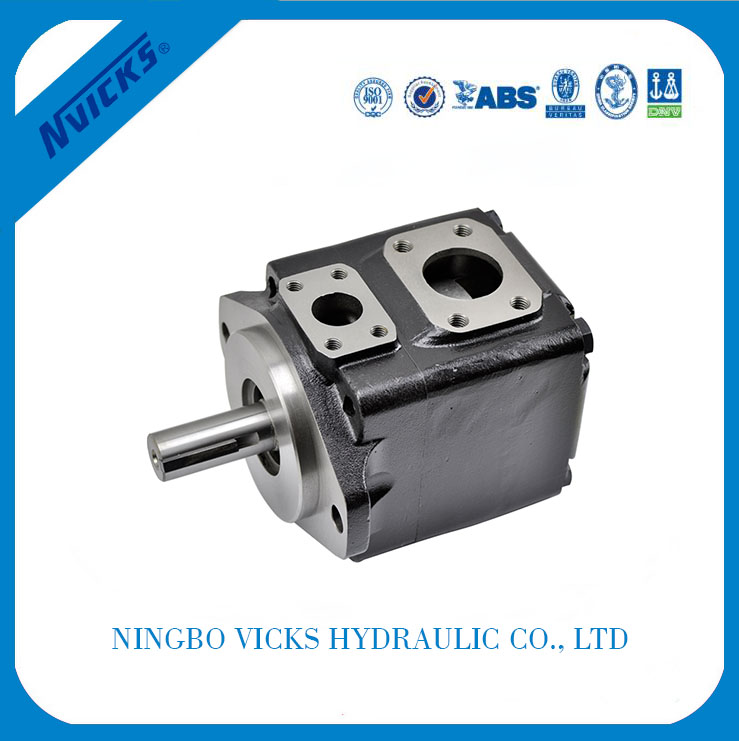
When we design a custom HPU, the pump technology choice drives much of the rest of the system. Vane pumps are the dominant choice for compact custom HPUs in the 15 to 210 bar range, and understanding why helps you evaluate whether your manufacturer’s pump recommendations are appropriate for your application. For deeper technical background on vane pump volumetric efficiency and self-compensating wear characteristics, the ISO hydraulic fluid power standards framework (TC 131 / SC 2) provides the underlying engineering references that classification societies use when reviewing vane pump performance data. For deeper technical background on vane pump volumetric efficiency and self-compensating wear characteristics, the [ISO hydraulic fluid power standards framework (TC 131 / SC 2)](https://www.iso.org/ics/23_100/23_100_10.html) provides the underlying engineering references that classification societies use when reviewing vane pump performance data.
Vane pumps excel in continuous-duty applications because of their design characteristics. The sliding vanes in a vane pump self-compensate for wear as they operate, maintaining volumetric efficiency over a long service life. This is why vane pumps are the standard choice for marine hydraulic systems, industrial automation equipment, and machine tools — applications where the HPU runs continuously for years, not hours.
Compared to gear pumps, vane pumps offer higher volumetric efficiency (typically 92 to 95 percent at operating pressure) because the vane chambers maintain consistent sealing throughout the rotation cycle. Gear pumps rely on the precision of gear tooth spacing and housing bore tolerance; as wear occurs, efficiency drops. Vane pumps self-adjust.
Compared to piston pumps, vane pumps have fewer moving parts and lower manufacturing cost, making them the economical choice for applications that do not require the extremely high pressures (above 210 bar) that only piston pumps can reliably deliver. If your application operates below 210 bar and requires continuous-duty performance, a vane pump HPU is almost always the right engineering choice.
At Vicks Hydraulic, our dual-circuit vane pump technology integrates two independent hydraulic circuits in a single compact housing. This is particularly valuable for marine applications where redundancy is required, or for industrial equipment that needs separate circuits for different functions. When a buyer specifies “redundant hydraulic supply,” we can engineer it into a single compact unit rather than specifying two separate HPUs.
Factory Acceptance Test: The Checklist That Separates Professionals from Brokers
The Factory Acceptance Test (FAT) is the moment of truth for any custom HPU. A manufacturer that cannot show you documented FAT results with real measurement data is asking you to trust that the equipment works — without evidence. The FAT procedures we follow are aligned with ISO 4413:2010 — hydraulic fluid power — general rules and safety requirements for systems and components, which defines the standard test categories that any responsible HPU manufacturer should be able to demonstrate.
We conduct FAT on every custom HPU before shipment. Here is what a thorough FAT includes, and what you should demand to see in the test report.
Hydrostatic Pressure Test. The entire hydraulic circuit is pressurized to 1.5 times the maximum working pressure and held for 30 minutes. The test measures pressure decay, checks every connection for leaks, and verifies that relief valves are set correctly. A FAT report should show the test pressure, holding time, initial and final pressure readings, and the name of the person who conducted the test.
Flow Curve Verification. At the FAT stage, we measure actual flow output at multiple pressure points across the operating range. This verifies that the pump performs as specified and that system pressure does not drop excessively at full load. The FAT report should include a flow curve table showing flow rate at 25, 50, 75, and 100 percent of rated pressure.
Leak Check Under Simulated Operating Conditions. We cycle the HPU through representative operating conditions — including cold start, peak load, and shutdown — and check every seal, fitting, and connection. We specifically look for leaks that only appear under thermal cycling, because a connection that is perfectly tight at room temperature can leak once the fluid reaches operating temperature and the thermal expansion effects kick in.
Noise and Vibration Measurement. Excessive noise or vibration indicates misalignment, cavitation, or worn components. We measure sound pressure levels at specified distances and compare against the specification. For marine applications, this is particularly critical — vibration can cause structural fatigue in shipboard installations.
Control System Functionality Test. If the HPU includes a control system — such as proportional valve control, PLC integration, or remote monitoring — we test every control function against the specification. We simulate fault conditions and verify that the control system responds correctly. A FAT report for a controlled HPU will include a control function checklist with pass/fail results for each function.
Documentation Review. The FAT package should include the test report, calibration certificates for all measurement instruments used during testing, the pump nameplate data, and the hydraulic circuit diagram with as-built annotations. Any deviations from the original specification should be documented and approved by both parties before shipment.
When you review a FAT report, look for specific measurement data — not just “test passed.” The numbers matter. A pressure reading of 198.3 bar when the specification calls for 200 bar tells you something different than a reading of 195 bar. Vague “passed” language without numbers is a red flag that the test may not have been conducted rigorously.
Certifications That Actually Matter for HPU Sourcing
Certifications for hydraulic equipment are market-specific and application-specific. Listing certifications that do not apply to your industry or target market is worse than listing no certifications — it suggests the manufacturer does not understand your requirements.
For marine applications, the major classification society certifications are CCS (China Classification Society), DNV (Det Norske Veritas), ABS (American Bureau of Shipping), BV (Bureau Veritas), and LR (Lloyd’s Register). Each classification society has its own testing protocols and documentation requirements. A manufacturer that holds CCS certification but has never worked with DNV requirements may face a steep learning curve when asked to supply a DNV-classified vessel.
For industrial automation, the relevant certifications depend on the end market. European buyers typically need CE marking with documentation conforming to the Machinery Directive. North American buyers may require UL or ETL listing. Pharmaceutical or food processing applications may require certification to specific hygiene standards.
For military applications, the certification requirements are typically defined by the defense procurement specifications of the ordering nation. These requirements are often more stringent than commercial standards and include environmental testing (temperature, humidity, salt spray), shock and vibration testing, and electromagnetic compatibility verification. For a global overview of how classification society requirements differ across jurisdictions, the International Association of Classification Societies (IACS) maintains publicly accessible unified requirements that member societies apply to marine equipment.
At Vicks Hydraulic, we have participated in the revision of industry standards for hydraulic equipment, which means our engineering team understands the intent behind certification requirements — not just the checkbox compliance. When a buyer tells us they need equipment certified to a specific standard, we know what testing and documentation that certification actually requires, not just what paperwork to fill out.
The Hidden Costs Most Buyers Discover Too Late
I want to be direct about something that many buyers do not learn until after the equipment arrives: the purchase price of an HPU is often the smallest cost in the equipment’s life cycle.
Installation and integration costs frequently exceed the equipment cost when the HPU does not fit the installation space as expected, when the port locations require custom hose routing, or when the electrical connections use standards different from the local installation. These costs are avoidable if the specification includes dimensional drawings and integration requirements upfront.
Downtime costs during maintenance are proportional to the HPU’s reliability and the availability of spare parts. A vane pump that requires scheduled maintenance every 5,000 hours versus one that requires it every 2,500 hours represents a significant difference in total cost of ownership over a 10-year operating period. The specification sheet should define the expected maintenance intervals and the recommended spare parts inventory.
Energy costs over the operating life can far exceed the equipment purchase price. A pump sized 15 percent larger than necessary consumes 15 percent more energy for every hour of operation. Over 10 years of continuous operation, this is not a minor amount. Proper pump sizing during the specification stage — based on actual system requirements, not safety factor inflation — directly affects your operating costs.
Certification and re-testing costs can be substantial if the HPU arrives and fails to meet the certification requirements of the destination market. We have seen buyers incur costs equal to 30 to 50 percent of the original equipment price to re-test and recertify equipment that was built to the wrong standard. Verify the target market certifications before you sign the purchase order, not after the equipment arrives at your port.
How to Submit Your HPU Specification and Get an Accurate Quote
The specification sheet is the starting point for an accurate quote. The more complete your specification, the more accurate the quote — and the less likely you are to face change orders mid-production that inflate costs and delay delivery.
What to include in your initial inquiry: Start with the basic operating parameters: maximum pressure, continuous operating pressure, flow rate, fluid type, and duty cycle. Include the target application (marine, industrial, military) and the target market for certification (which classification society or regulatory body). State your delivery timeline requirements and whether you need documentation in a specific language.
What to ask the manufacturer: Ask about their in-house engineering capabilities — can they review your specification and suggest optimizations, or do they build exactly what you specify without engineering input? Ask about their testing facilities — do they conduct FAT on every unit, and will they share the test data with you? Ask about their certification scope — does their current certification cover your specific product type and target market?
What to expect from a qualified custom manufacturer: Within 5 to 7 business days of receiving a complete specification, a qualified custom HPU manufacturer should be able to provide a detailed quote including the proposed component selection, price, delivery lead time, and any recommended modifications to your specification based on engineering review. If a manufacturer quotes immediately without asking clarifying questions about your specification, they are likely quoting a catalog product — not truly custom engineering.
If your specification is incomplete, a professional manufacturer will ask questions before quoting. This is not delay tactics — it is engineering due diligence that protects both parties.
Submit Your HPU Specification
Ready to get an accurate quote for your custom hydraulic power unit? Our engineering team will review your specification and respond with a detailed proposal within 5 business days.
Frequently Asked Questions
About the Author
Demi Ge is a hydraulic solutions expert at Vicks Hydraulic, a national high-tech enterprise founded in 2007, specializing in vane pumps, servo systems, and one-stop energy-saving hydraulic solutions. With 6 world-leading production lines and an annual capacity of 80,000+ vane pumps, Vicks serves industries including marine, military, and industrial automation.
Demi is an expert in high-pressure hydraulic technology, helping global buyers source CCS, DNV, ABS, BV, and LR-certified components from a presiding industry standard revision unit.
Post time: Sep-03-2026